Popcorn fight got a little hot back in 1914
YESTERDAY’S NEWS by Frank Boyett
August 17, 2014
It’s often said you can’t fight City Hall. But 100 years ago Mary Cimini did just that, and wound up winning the right to sell popcorn and peanuts on the streets of Henderson.
From the story that appeared in The Gleaner Aug. 19,1914, it appears the dispute had been ongoing for a while. The city had twice served her with warrants charging her with violating a city ordinance, and cited her to appear in Police Court Aug. 31.
She later became one of Henderson’s most beloved characters, but as of 1914 she wasn’t going to be pushed around. If there was going to be any pushing done, it was going to be her huckstering her popcorn wagon. And huckstering was what the disagreement was all about. On April 30, 1913, the Henderson City Council had passed “an ordinance to prevent the operation of or sale from hamburger, lunch, fish, popcorn, fruit or other kindred wagons or carts on the streets or sidewalks of the city of Henderson.” That was just the title of the ordinance, though.
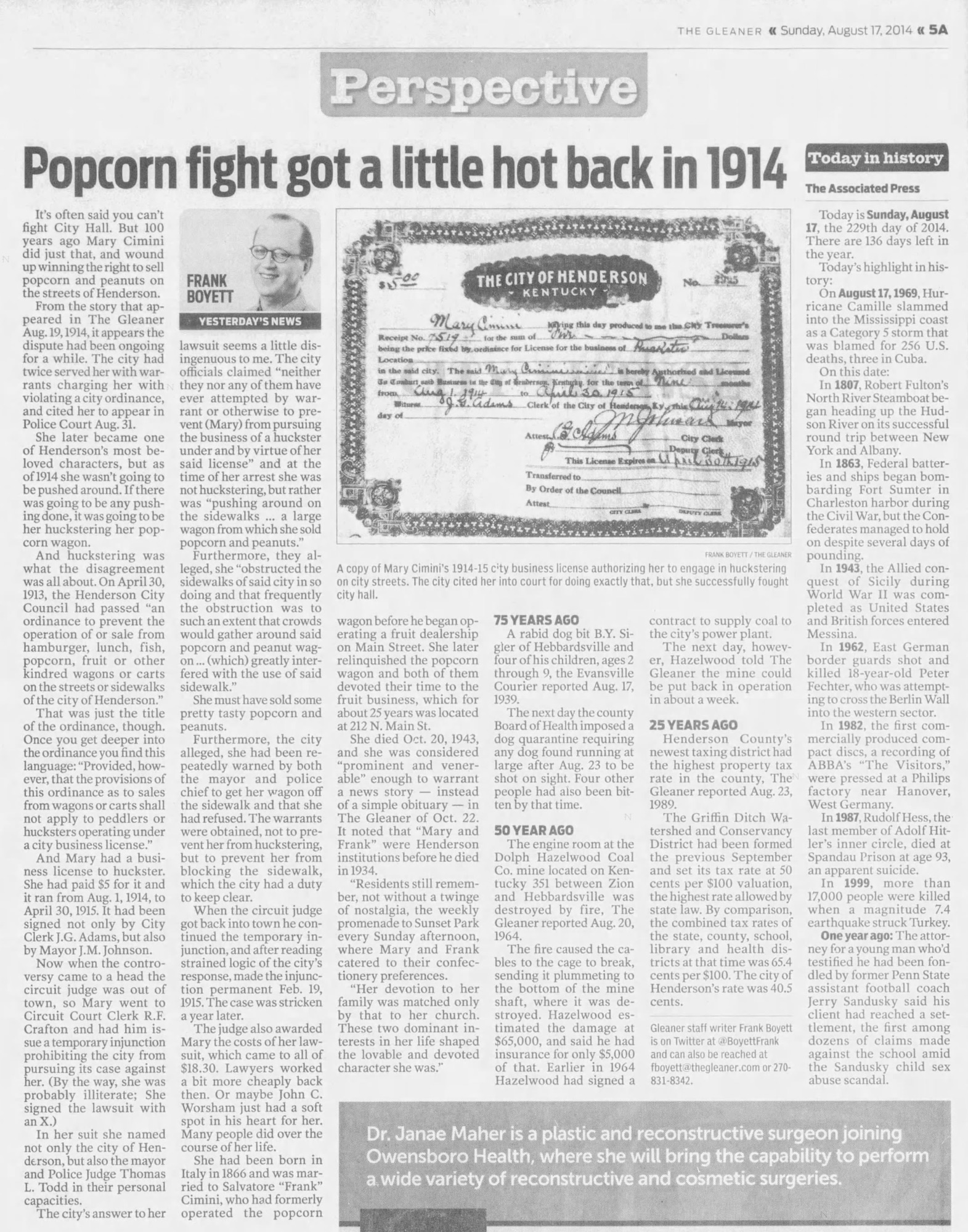
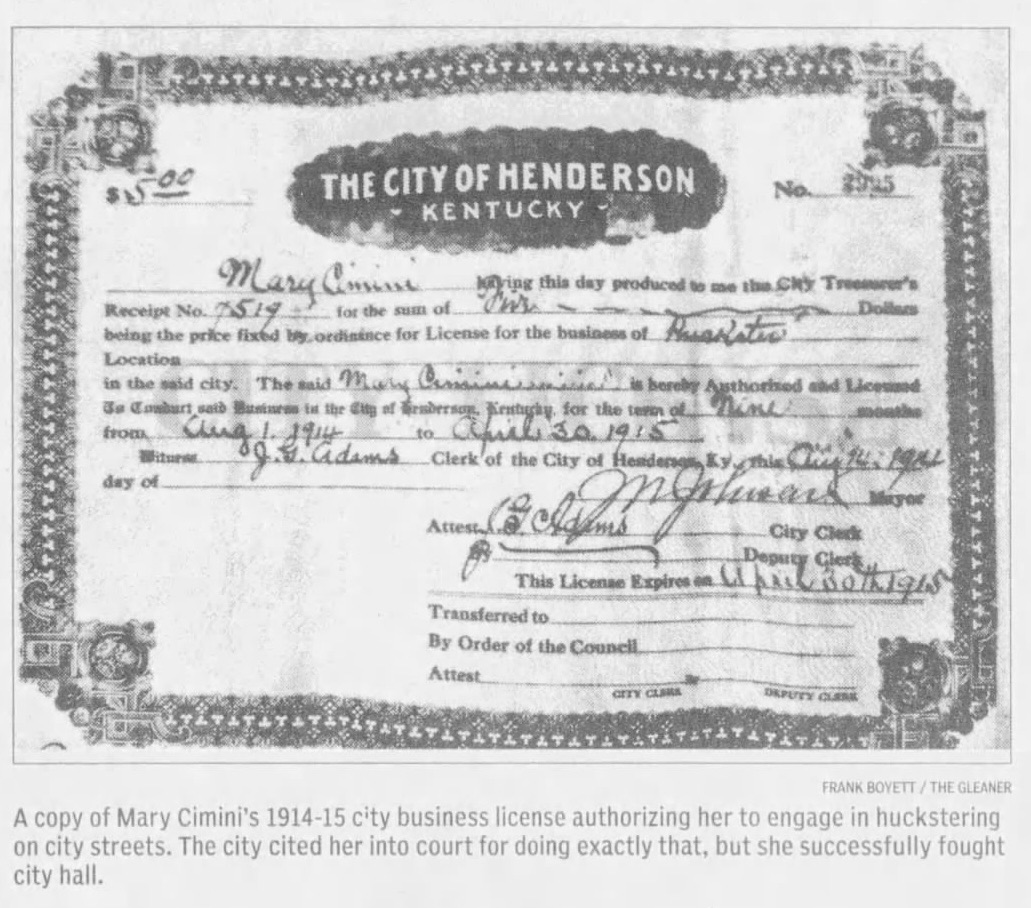
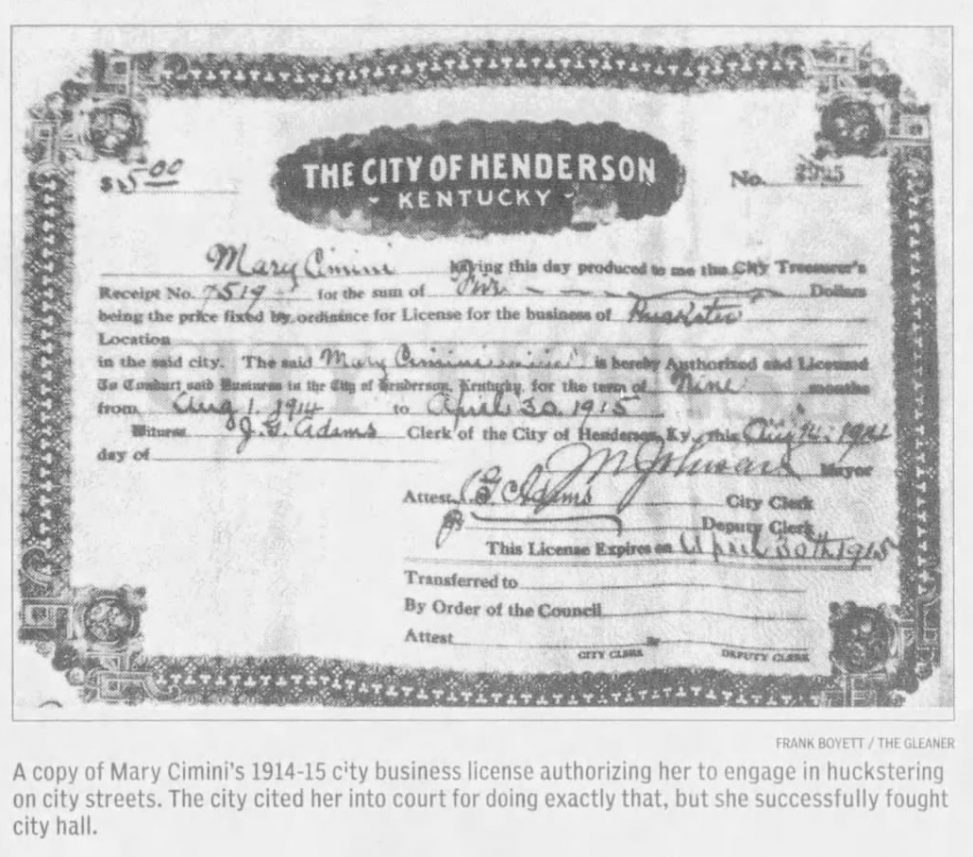
Once you get deeper into the ordinance vou find this language: “Provided, however, that the provisions of this ordinance as to sales from wagons or carts shall not apply to peddlers or hucksters operating under a city business license.” And Mary had a business license to huckster She had paid $5 for it and it ran from Aug. 1, 1914, to April 30, 1915. It had been signed not only by City Clerk J.G. Adams, but also by Mayor J.M. Johnson.
Now when the controversy came to a head the circuit judge was out of town, so Mary went to Circuit Court Clerk R.F. Crafton and had him issue a temporary injunction prohibiting the city from pursuing its case agains her. (By the way, she was probably illiterate; She signed the lawsuit with an X.)
In her suit she named not only the city of Henderson, but also the mayor and Police Judge Thomas L. Todd in their personal capacities.
The city’s answer to her lawsuit seems a little disingenuous to me. The city officials claimed “neither they nor any of them have ever attempted by warrant or otherwise to prevent (Mary) trom pursuing the business of a huckster under and by virtue of her said license” and at the time of her arrest she was not huckstering, but rather was “pushing around on the sidewalks … a large wagon from which she sold popcorn and peanuts.”
Furthermore, they alleged, she “obstructed the sidewalks of said city in so doing and that frequently the obstruction was to such an extent that crowds would gather around said popcorn and peanut wag-on… (which) greatly interfered with the use of said sidewalk.”
She must have sold some pretty tasty popcorn and peanuts. Furthermore, the city alleged, she had been repeatedly warned by both the mayor and police chief to get her wagon off the sidewalk and that she had refused. The warrants were obtained, not to prevent her from huckstering, but to prevent her from blocking the sidewalk, which the city had a duty to keep clear.
When the circuit judge got back into town he continued the temporary in-junction, and after reading strained logic of the city’s response, made the injunction permanent Feb. 19, 1915. The case was stricken a year later.
The judge also awarded Mary the costs of her lawsuit, which came to all of $18.30. Lawyers worked a bit more cheaply back then. Or maybe John C. Worsham just had a soft spot in his heart for her. Many people did over the course of her life.
She had been born in Italy in 1866 and was married to Salvatore “Frank” Cimini, who had formerly operated the popcorn wagon before he began operating a fruit dealership on Main Street. She later relinquished the popcorn wagon and both of them devoted their time to the fruit business, which for about 25 years was located at 212 N. Main St.
She died Oct. 20, 1943, and she was considered
“prominent and vener-able” enough to warrant a news story – instead of a simple obituary – in The Gleaner of Oct. 22. It noted that “Mary and Frank” were Henderson institutions before he died in 1934.
“Residents still remember, not without a twinge of nostalgia, the weekly promenade to Sunset Park every Sunday afternoon, where Mary and Frank catered to their confectionery preferences.
“Her devotion to her family was matched only by that to her church. These two dominant interests in her life shaped the lovable and devoted character she was.”
75 YEARS AGO
A rabid dog bit B.Y. Sigler of Hebbardsville and four of his children, ages z through 9, the Evansville Courier reported Aug. 17, 1939. The next day the county Board of Health imposed a dog quarantine requiring any dog found running at large after Aug. 23 to be shot on sight. Four other people had also been bitten by that time.
50 YEAR AGO
The engine room at the Dolph Hazelwood Coal Co. mine located on Kentucky 351 between Zion and Hebbardsville was destroyed by fire, The Gleaner reported Aug. 20, 1964.
The fire caused the cables to the cage to break, sending it plummeting to the bottom of the mine shaft, where it was destroyed. Hazelwood estimated the damage at $65,000, and said he had insurance for only $5,000 of that. Earlier in 1964 Hazelwood had signed a contract to supply coal to the city’s power plant.
The next day, howev-er, Hazelwood told The Gleaner the mine could be put back in operation in about a week.
25 YEARS AGO
Henderson County’s newest taxing district had the highest property tax rate in the county, The Gleaner reported Aug. 23, 1989. The Griffin Ditch Watershed and Conservancy District had been formed the previous September and set its tax rate at 50 cents per $100 valuation, the highest rate allowed by state law. By comparison, the combined tax rates of the state, county, school, library and health districts at that time was 65.4 cents per $100. The city of Henderson’s rate was 40.5 cents.