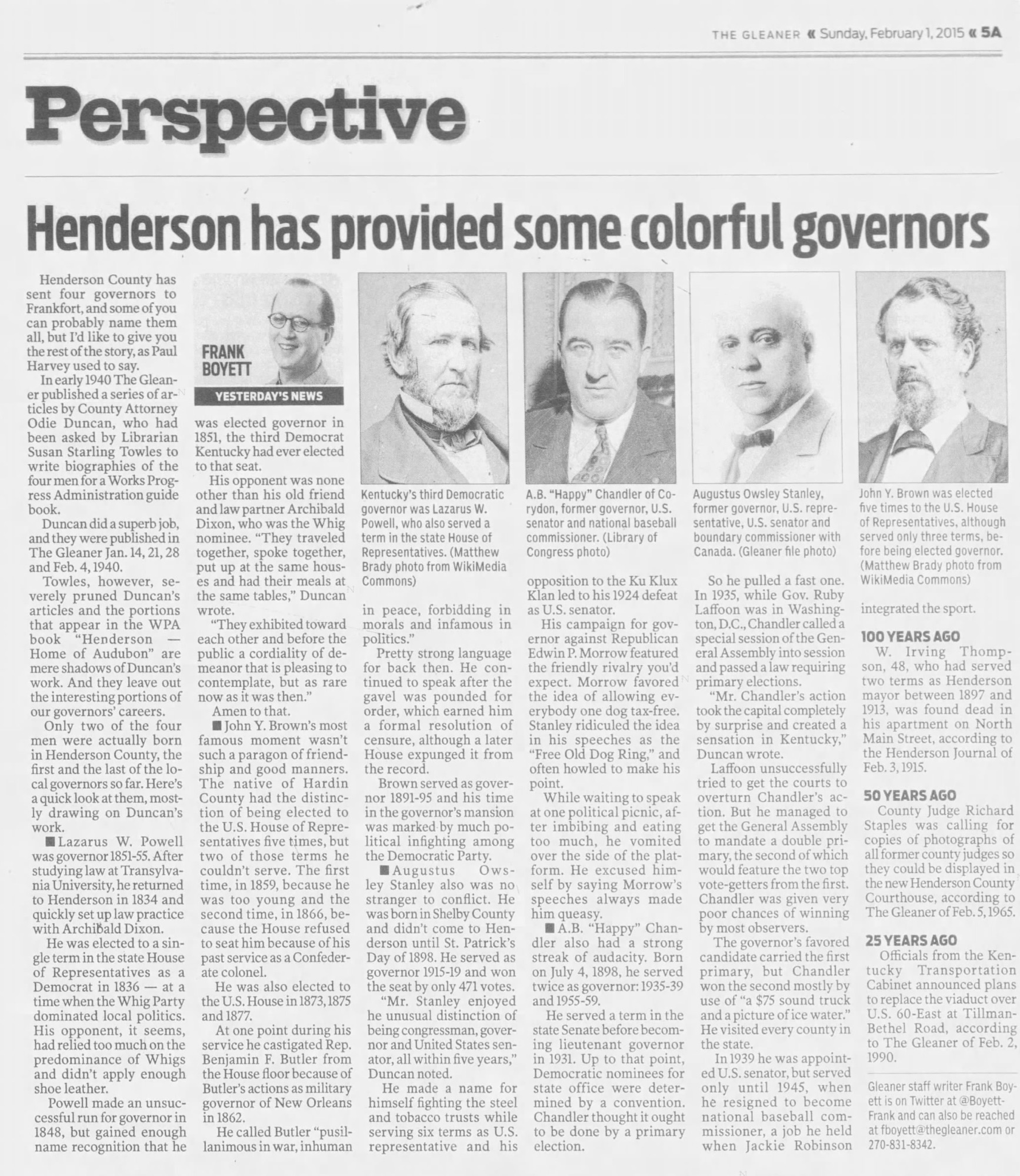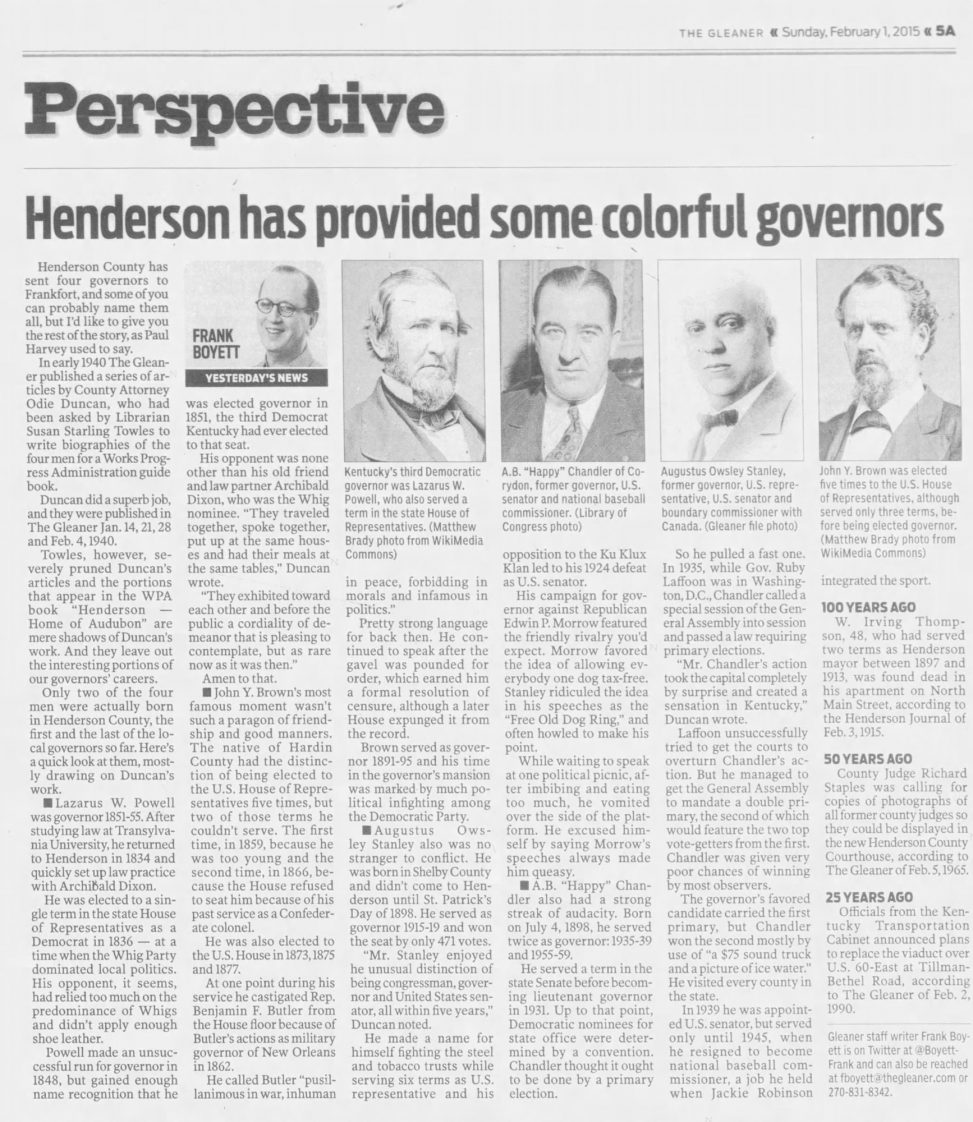
Henderson has provided some colorful governors
By Frank Boyett Feb. 01, 2015
Henderson County has sent four governors to Frankfort, and some of you can probably name them all, but I’d like to give you the rest of the story, as Paul Harvey used to say.
In early 1940 The Gleaner published a series of articles by County Attorney Odie Duncan, who had been asked by Librarian Susan Starling Towles to write biographies of the four men for a Works Progress Administration guide book.
Duncan did a superb job, and they were published in The Gleaner Jan. 14, 21, 28 and Feb. 4, 1940.
Towles, however, severely pruned Duncan’s articles and the portions that appear in the WPA book “Henderson – Home of Audubon” are mere shadows of Duncan’s work. And they leave out the interesting portions of our governors’ careers.
Only two of the four men were actually born in Henderson County, the first and the last of the local governors so far. Here’s a quick look at them, mostly drawing on Duncan’s work.
Lazarus W. Powell was governor 1851-55. After studying law at Transylvania University, he returned to Henderson in 1834 and quickly set up law practice with Archibald Dixon.
He was elected to a single term in the state House of Representatives as a Democrat in 1836 — at a time when the Whig Party dominated local politics. His opponent, it seems, had relied too much on the predominance of Whigs and didn’t apply enough shoe leather.
Powell made an unsuccessful run for governor in 1848, but gained enough name recognition that he was elected governor 1851, the third Democrat Kentucky had ever elected to that seat.
His opponent was none other than his old friend and law partner Archibald Dixon, who was the Whig nominee. “They traveled together, spoke together, put up at the same houses and had their meals at the same tables,” Duncan wrote.
“They exhibited toward each other and before the public a cordiality of demeanor that is pleasing to contemplate, but as rare now as it was then.”
Amen to that.
John Y. Brown’s most famous moment wasn’t such a paragon of friendship and good manners. The native of Hardin County had the distinction of being elected to the U.S. House of Representatives five times, but two of those terms he couldn’t serve. The first time, in 1859, because he was too young and the second time, in 1866, because the House refused to seat him because of his past service as a Confederate colonel.
He was also elected to the U.S. House in 1873, 1875 and 1877.
At one point during his service he castigated Rep. Benjamin F. Butler from the House floor because of Butler’s actions as military governor of New Orleans in 1862.
He called Butler “pusillanimous in war, inhuman in peace, forbidding in morals and infamous in politics.”
Pretty strong language for back then. He continued to speak after the gavel was pounded for order, which earned him a formal resolution of censure, although a later House expunged it from the record.
Brown served as governor 1891-95 and his time in the governor’s mansion was marked by much political infighting among the Democratic Party.
Augustus Owsley Stanley also was no stranger to conflict. He was born in Shelby County and didn’t come to Henderson until St. Patrick’s Day of 1898. He served as governor 1915-19 and won the seat by only 471 votes.
“Mr. Stanley enjoyed he unusual distinction of being congressman, governor and United States senator, all within five years,” Duncan noted.
He made a name for himself fighting the steel and tobacco trusts while serving six terms as U.S. representative and his opposition to the Ku Klux Klan led to his 1924 defeat as U.S. senator.
His campaign for governor against Republican Edwin P. Morrow featured the friendly rivalry you’d expect. Morrow favored the idea of allowing everybody one dog tax-free. Stanley ridiculed the idea in his speeches as the “Free Old Dog Ring,” and often howled to make to his point.
While waiting to speak at one political picnic, after imbibing and eating too much, he vomited over the side of the platform. He excused himself by saying Morrow’s speeches always made him queasy.
A.B. “Happy” Chandler also had a strong streak of audacity. Born on July 4, 1898, he served twice as governor: 1935-39 and 1955-59.
He served a term in the state Senate before becoming lieutenant governor in 1931. Up to that point, Democratic nominees for state office were determined by a convention. Chandler thought it ought to be done by a primary election.
So he pulled a fast one. In 1935, while Gov. Ruby Laffoon was in Washington, D.C., Chandler called a special session of the General Assembly into session and passed a law requiring primary elections.
“Mr. Chandler’s action took the capital completely by surprise and created a sensation in Kentucky,” Duncan wrote.
Laffoon unsuccessfully tried to get the courts to overturn Chandler’s action. But he managed to get the General Assembly to mandate a double primary, the second of which would feature the two top vote-getters from the first. Chandler was given very poor chances of winning by most observers.
The governor’s favored candidate carried the first primary, but Chandler won the second mostly by use of “a $75 sound truck and a picture of ice water.” He visited every county in the state.
In 1939 he was appointed U.S. senator, but served only until 1945, when he resigned to become national baseball commissioner, a job he held when Jackie Robinson integrated the sport.
100 years ago
W. Irving Thompson, 48, who had served two terms as Henderson mayor between 1897 and 1913, was found dead in his apartment on North Main Street, according to the Henderson Journal of Feb. 3, 1915.
50 years ago
County Judge Richard Staples was calling for copies of photographs of all former county judges so they could be displayed in the new Henderson County Courthouse, according to The Gleaner of Feb. 5, 1965.
25 years ago
The state Transportation Cabinet announced plans to replace the viaduct over U.S. 60-East at Tillman-Bethel Road, according to The Gleaner of Feb. 2, 1990.