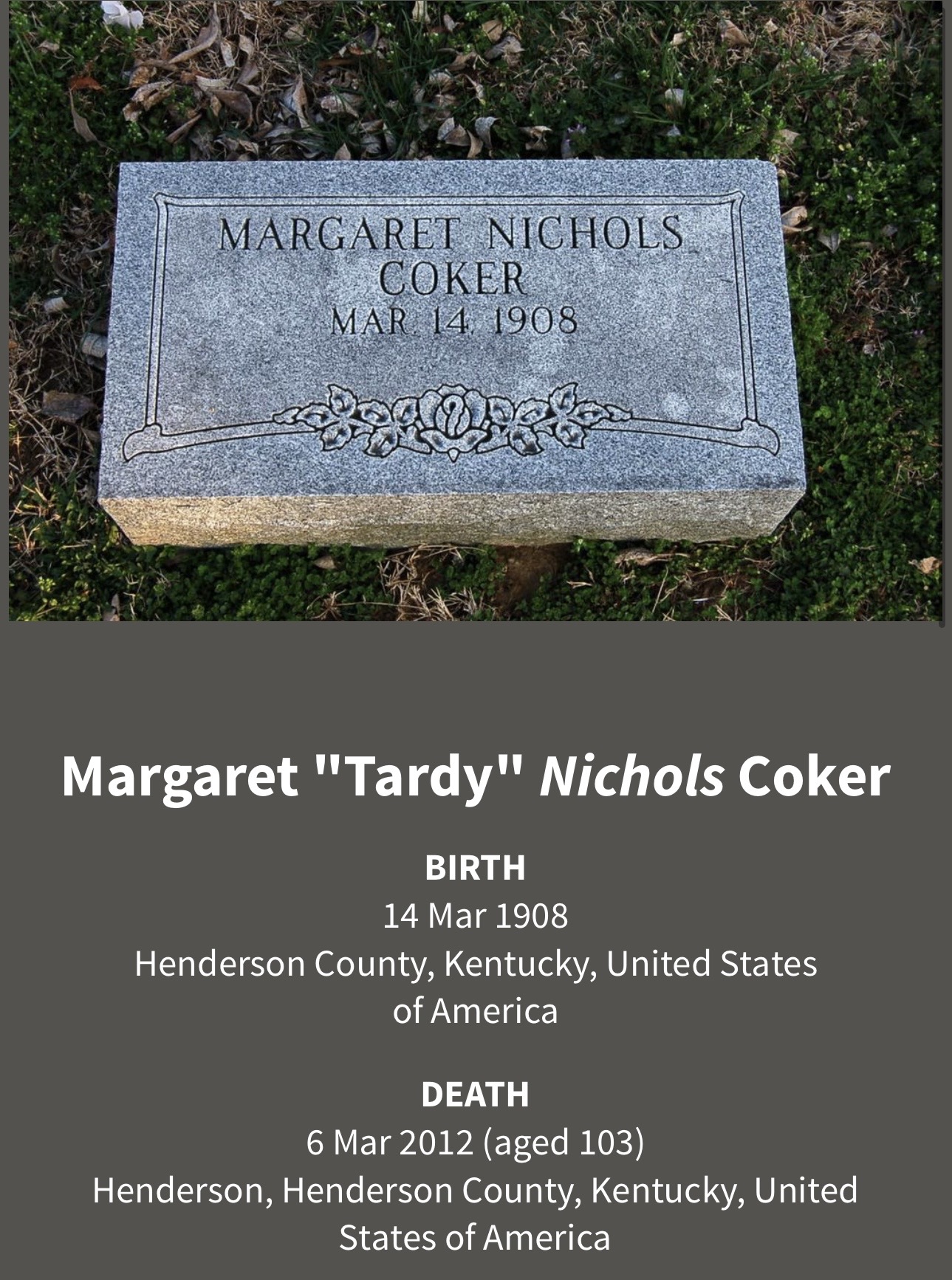
Margaret “Tardy” Nichols Coker
After 33 years inside Henderson City Hall, Margaret Nichols asked voters to put her at its head. In 1973, she nearly became Henderson’s first woman mayor.
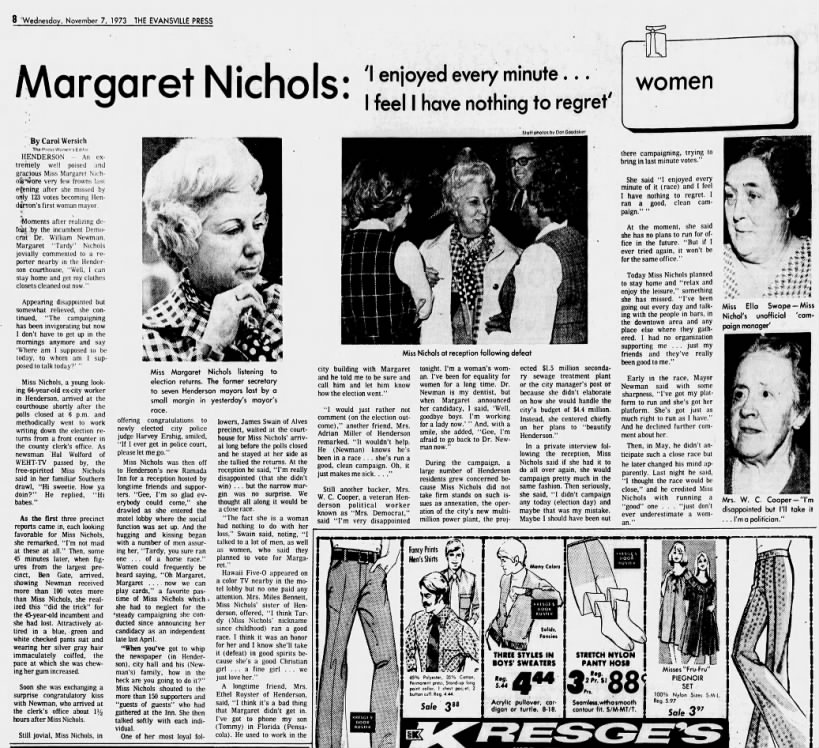
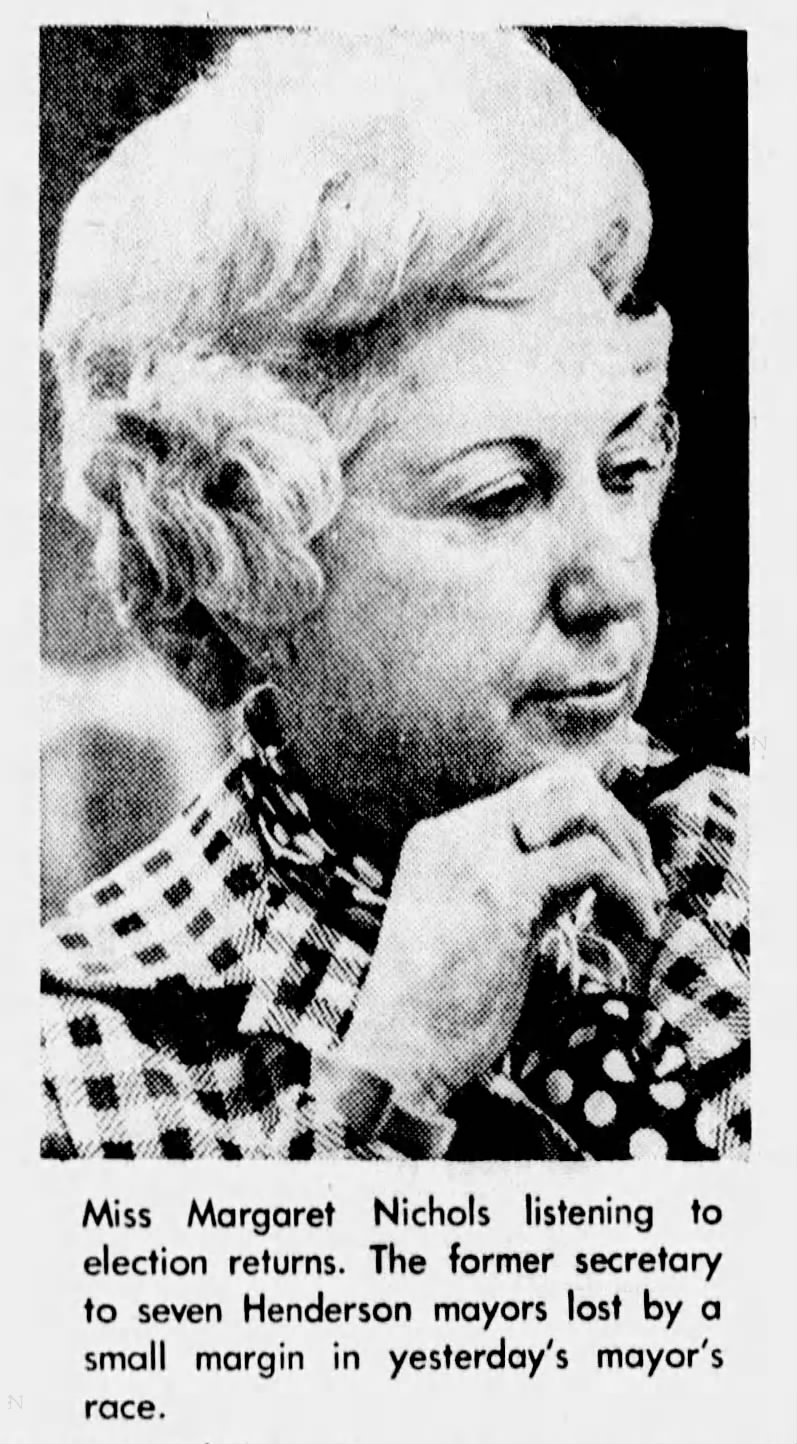
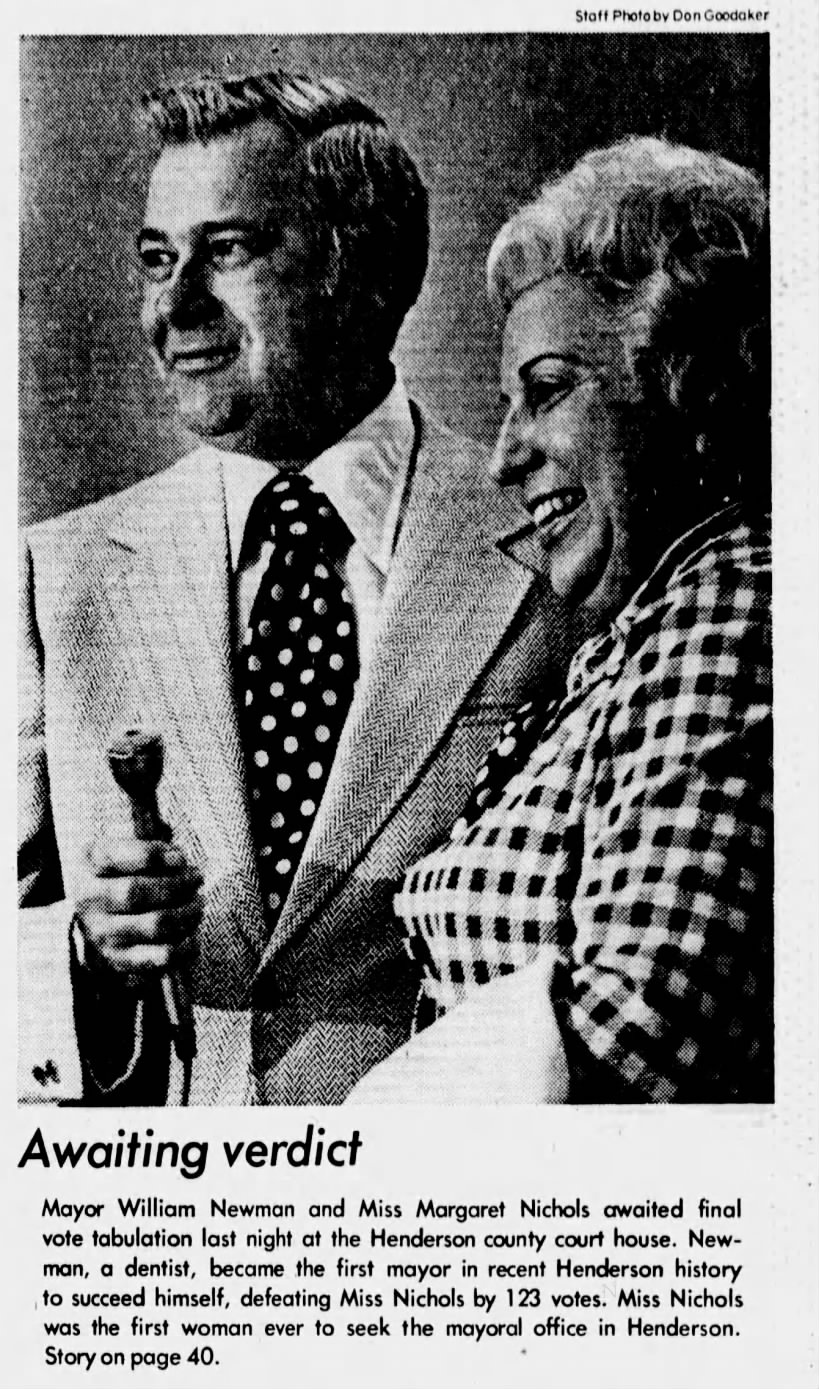
On the evening of November 6, 1973, Margaret “Tardy” Nichols sat in the Henderson County clerk’s office and watched the election returns come in. Wearing a blue, green and white checked pantsuit, her silver-gray hair carefully arranged, Nichols followed each precinct report while chewing a piece of gum.
The first three precincts favored her. “I’m not mad at these at all,” she remarked. Then the figures arrived from BenGate, the city’s largest precinct. Incumbent Mayor Dr. William L. “Bill” Newman had received more than 100 votes there than Nichols. She realized that had “done the trick,” and the pace of her chewing increased. When all the votes were counted, Nichols had fallen only 123 votes short of becoming Henderson’s first woman mayor.
Newman arrived at the courthouse about an hour and a half later. The two exchanged a congratulatory kiss. Nichols then joked to a reporter, “Well, I can stay home and get my clothes closets cleaned out now.”
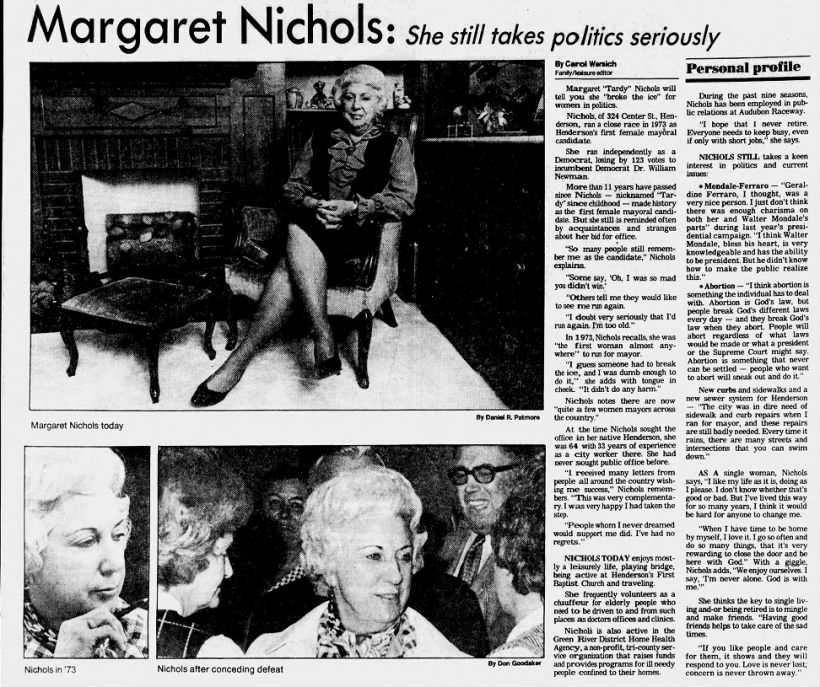
Reporter Carol Wersich captured the scene in a next-day Evansville Press profile. Although disappointed, Nichols also seemed relieved. Campaigning had been invigorating, she said, but now she would not have to wake each morning wondering where she was supposed to be and whom she was supposed to address.
“I enjoyed every minute of it,” she said. “I feel I have nothing to regret. I ran a good, clean campaign.”
A life inside City Hall
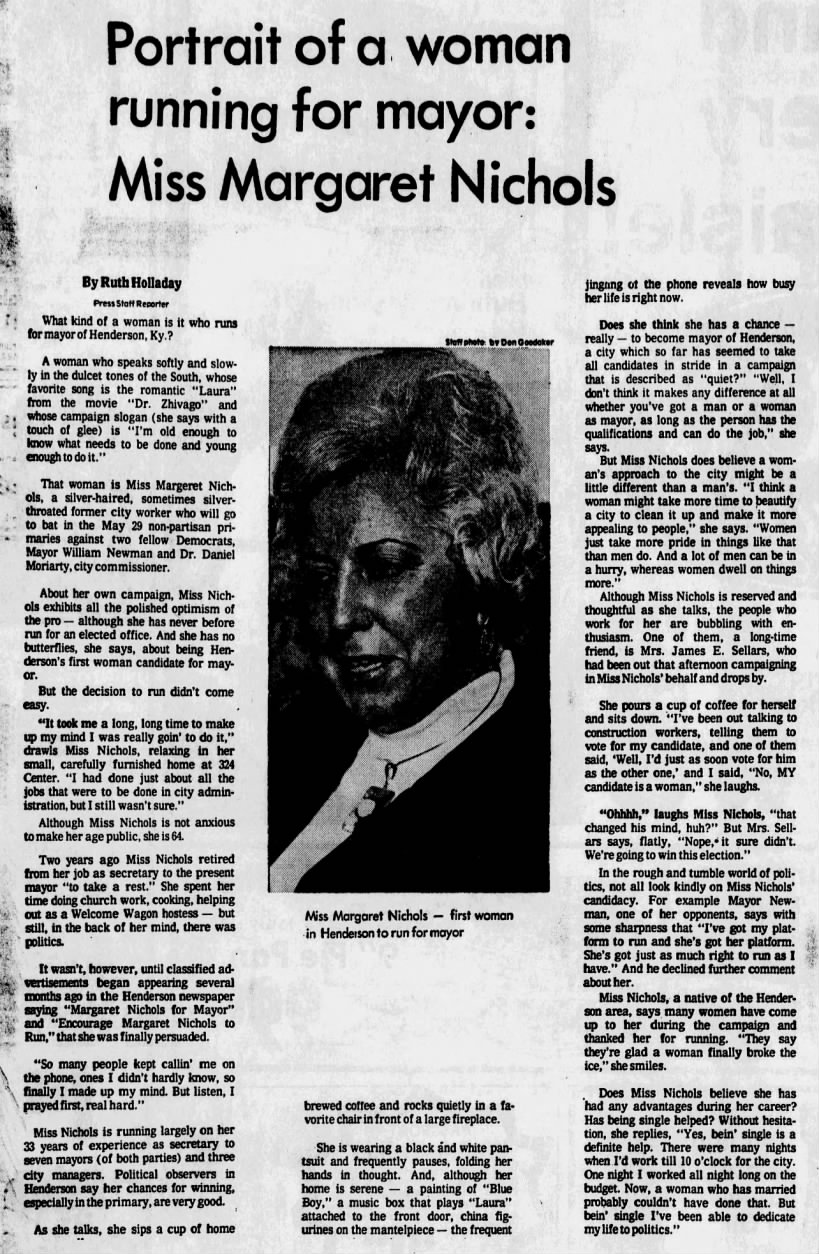
Margaret Louise Nichols was born in 1908 and raised on a farm in the Zion area of Henderson County. She was the youngest of Robert Nichols’ eight children. Her childhood memories included skating on frozen ponds and riding to church in a horse-drawn buggy on Christmas Eve. After attending Henderson County schools, she studied secretarial work at Lockyear Business College in Evansville.
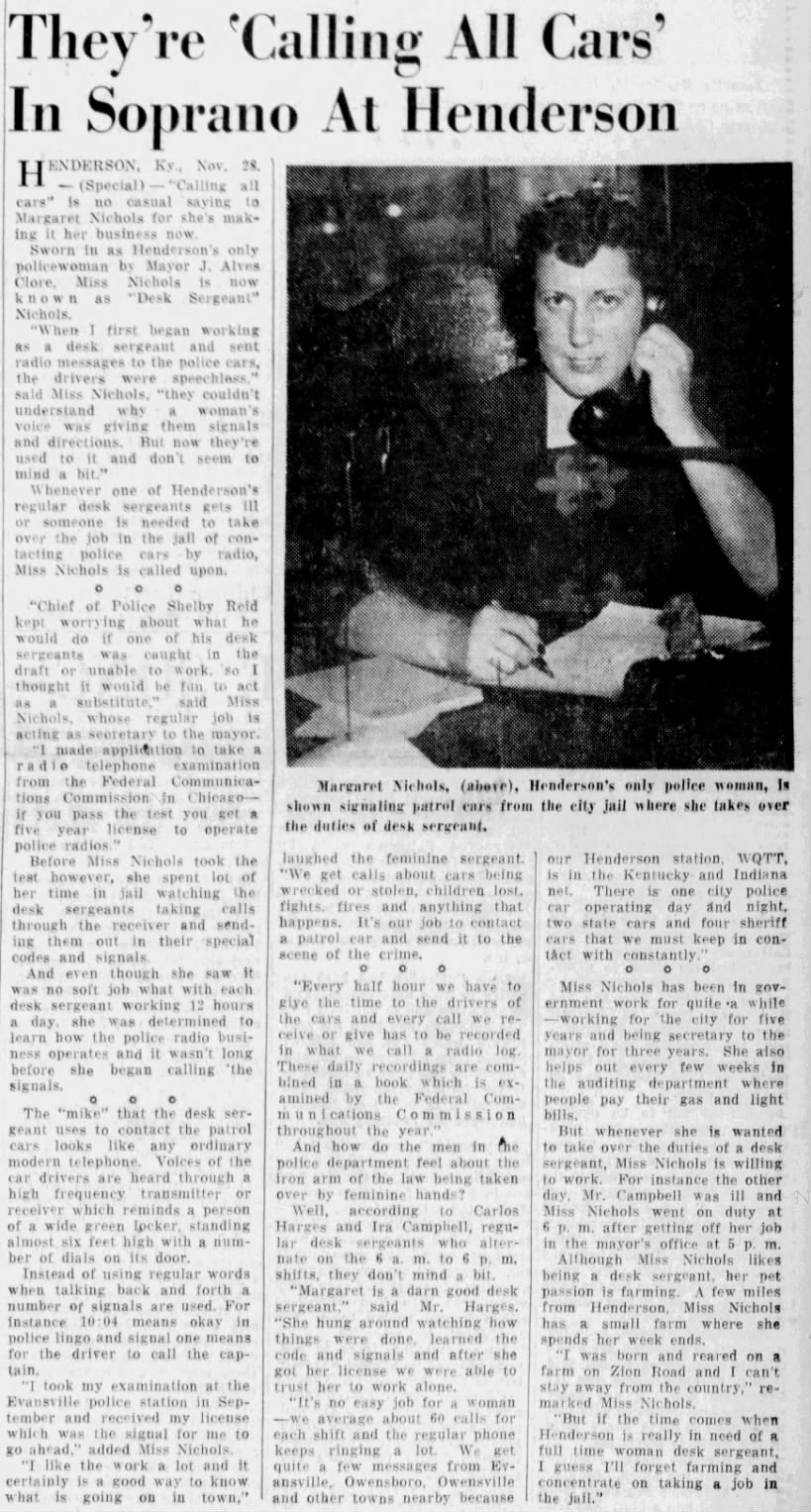
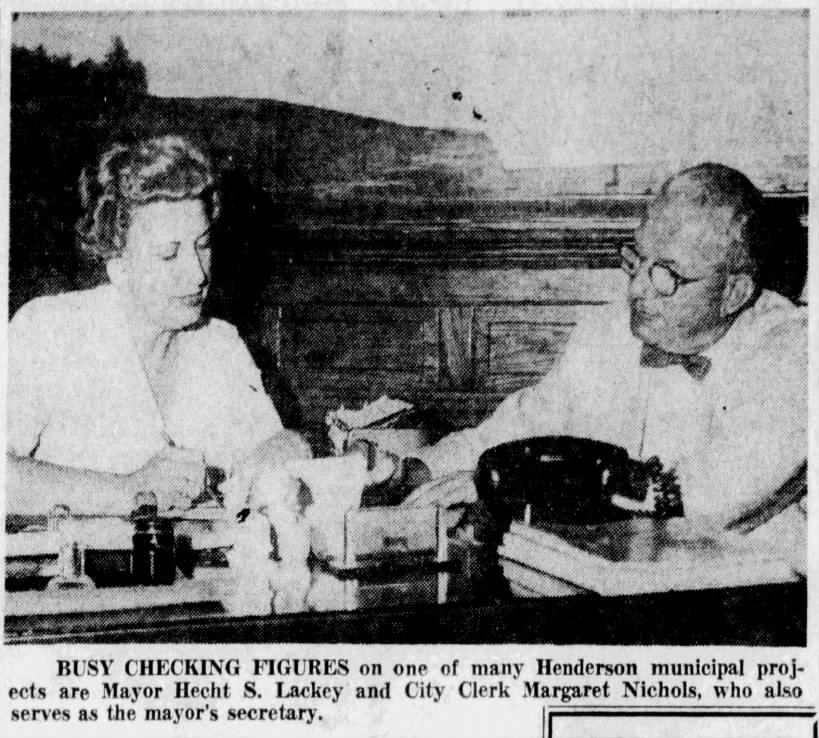
In May 1938, Nichols was hired as secretary to the mayor. She eventually served as an administrative assistant under seven Henderson mayors. A 2012 Kentucky legislative memorial states that, during World War II, she became acting desk sergeant for the Henderson Police Department in November 1942 and also worked as a police dispatcher.
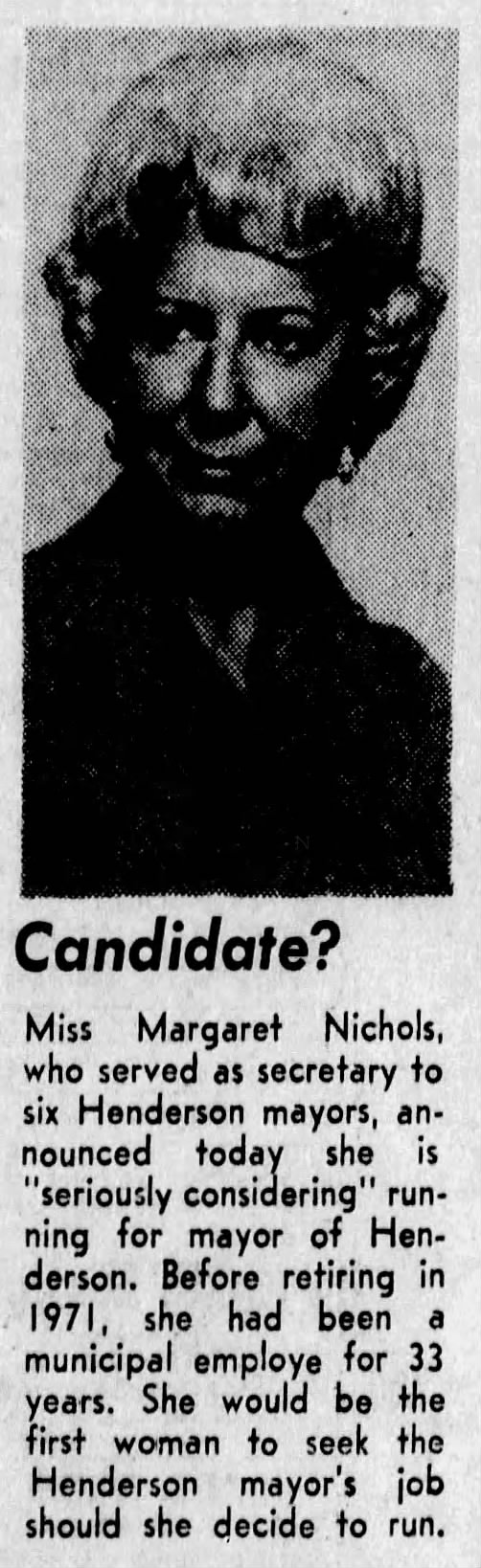
Nichols continued advancing through city government until she became personnel director. By the time she retired in 1971, she had given Henderson 33 years of municipal service. She knew City Hall from the inside. Two years after retiring, she decided she was qualified to run it.
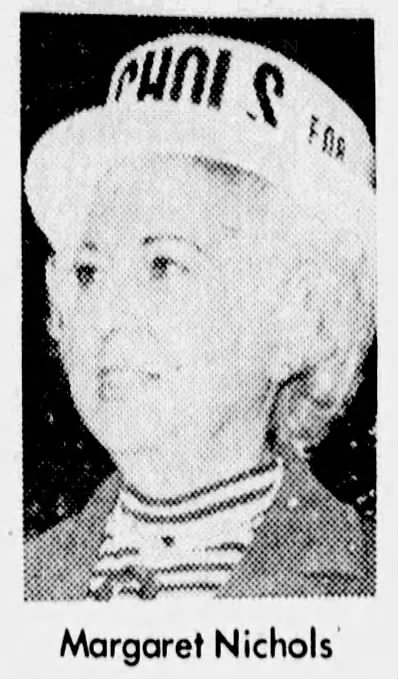
Nichols announced her independent candidacy in April 1973. She was 65 years old and the first woman ever to run for mayor of Henderson.
Her opponent was formidable. Newman had taken office in 1970 and would eventually become Henderson’s longest-serving mayor, holding the office for six terms and 24 years. Yet Nichols nearly defeated him near the beginning of that tenure. The legislative memorial records that she finished 132 votes ahead of Newman in the 1973 primary. In November, the order was reversed, with Newman winning by only 123 votes.
Nichols accomplished this without a traditional political organization. Miss Ella Swope served as her unofficial campaign manager, but Nichols said she had no real organization behind her, only her friends. She spent her days talking with people downtown, in bars and anywhere else Hendersonians gathered.
Her campaign was not without criticism. The Press reported that some voters wanted firmer positions from Nichols on annexation, operation of the city’s new power plant, a proposed sewage-treatment plant, the city manager’s position and management of the municipal budget. Her most visible theme was a plan to “beautify Henderson.”
Newman nevertheless acknowledged her right to challenge him. By election night, he expected a close result and credited Nichols with running a good race.
“Just don’t ever underestimate a woman,” Newman concluded.
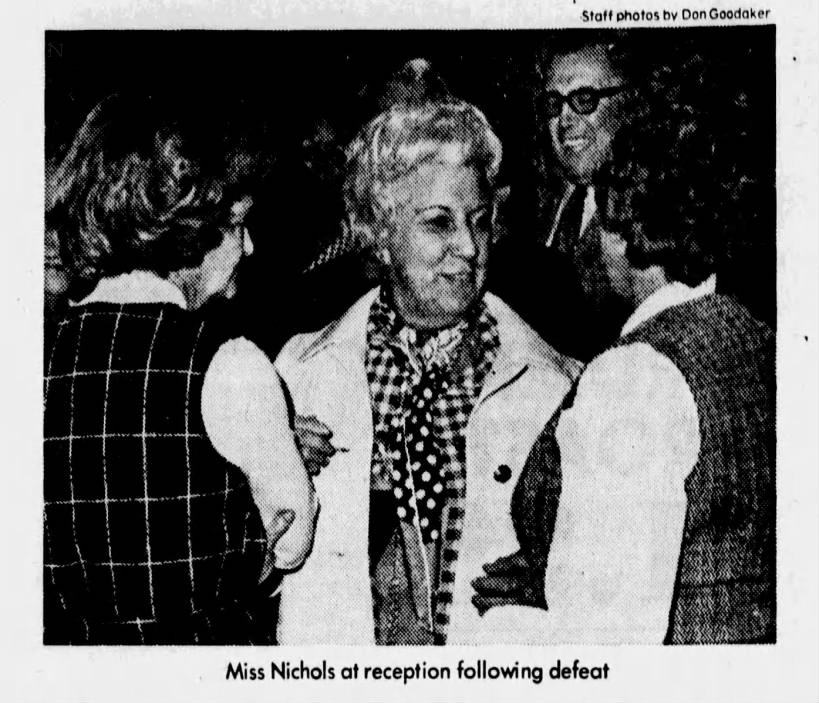
Even in defeat, Nichols remained unmistakably herself. She congratulated newly elected city police judge Harvey Ershig, adding, “If I ever get in police court, please let me go.”
From the courthouse, she traveled to Henderson’s new Ramada Inn, where more than 130 friends and supporters had gathered. Her sister, Mrs. Miles Benson, explained that “Tardy” had been Margaret’s nickname since childhood. She said Nichols had run a good race and would accept defeat in good spirits.
Nichols wondered whether staying off the campaign trail on Election Day had been a mistake. Perhaps she should have been out trying to bring in a few final votes. Still, she said that if she could do it again, she would conduct essentially the same campaign.
Afterward, Nichols worked in public relations at Audubon Raceway and remained active in the Green River District Home Health Agency. Later known as Margaret Nichols Coker, she was also closely connected to the woman who finally accomplished what Nichols nearly achieved. Nichols introduced Joan Hoffman to her future husband, John Stanley Hoffman. Twenty-five years after Nichols’s campaign, Hoffman won the 1998 election and became Henderson’s first woman mayor.
Margaret Nichols Coker died on March 6, 2012, at the age of 103. The Kentucky House and Senate adopted resolutions honoring her municipal service and pioneering campaign. The memorial credited her with having “broke the ice” for women in Henderson city government.
Characteristically, Nichols once described her candidacy more modestly: “I was dumb enough to do it.”
She never took the oath of office, but Margaret “Tardy” Nichols changed who Henderson could imagine leading City Hall. She missed making that history by only 123 votes.
Lackey
Leave a Reply