The Rise of Apple Production in Henderson County, Kentucky
How scientific orcharding, cold storage, cooperative marketing, and the celebrated Winesap made Henderson one of Kentucky’s foremost apple-growing counties
Today, Henderson County is remembered for tobacco, corn, soybeans, and the rich farmland bordering the Ohio and Green rivers. Apples rarely enter the conversation. Yet for several decades during the late nineteenth and early twentieth centuries, thousands of apple trees covered portions of the county, buyers came from distant cities in search of Henderson fruit, and local growers carried home armfuls of ribbons from the Kentucky State Fair.
The industry became so closely associated with the county that a Works Progress Administration guide published in 1941 described Henderson as the home of “the flowering orchards of the greatest apple producing county of the State.”
That distinction did not appear overnight. Henderson’s apple industry grew from scattered family orchards into an organized commercial enterprise through experimentation, careful cultivation, cold storage, cooperative marketing, and the work of a remarkable group of local orchardists.
From Farm Orchards to Commercial Fruit Growing
Apple trees had long been part of Henderson County farms. A few trees could provide fresh fruit, cider, preserves, vinegar, dried apples, and winter food for a household. Commercial orcharding, however, required something more: large plantings of dependable varieties, regular spraying and pruning, careful grading, suitable containers, storage space, and reliable transportation to outside markets.
A later history by Henderson writer Maralea Arnett traced one of the county’s earliest commercial ventures to Wickliffe Farm in the Smith Mills area. The farm was established by Elias D. Powell, the youngest brother of Kentucky governor Lazarus W. Powell. According to that account, Powell planted approximately 100 acres in crab apples, wild apples, and Wild Goose plums. He also produced apple brandy that was shipped to Cincinnati, St. Louis, Chicago, and New York.
Another important development occurred in the Robards area during the 1880s. W. A. Sandefur Sr. of the Green River Home Nursery reportedly discovered a promising seedling descended from the old Horse apple. He propagated it under the name Polly Eades. Although it ripened as a summer apple, it possessed unusually good keeping and shipping qualities – characteristics essential to commercial success.
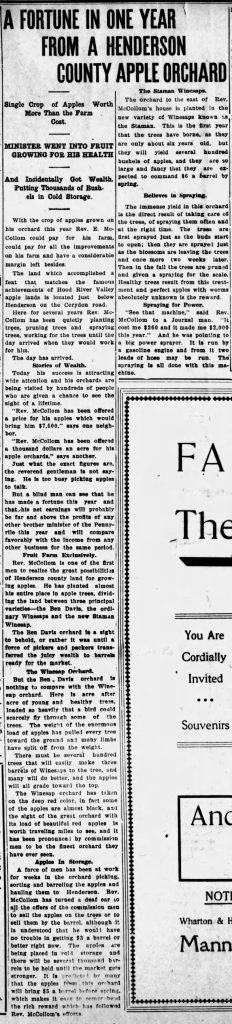
The most influential figure in the county’s early expansion may have been the Rev. Edwin McCollom. Beginning horticulture later in life, McCollom experimented with varieties and demonstrated that an orchard managed as a serious business could outperform fields devoted to traditional crops. Contemporary and later accounts credited his example with encouraging other farmers to plant commercial orchards. Newspapers rendered his surname in several different ways, but his influence is unmistakable: by 1910, one county survey listed his orchard at approximately 1,500 trees.
Cairo Becomes the Center of the Boom
By the opening years of the twentieth century, commercial orchards could be found across Henderson County, but the greatest concentration stood around Cairo. A lengthy article published in the Henderson Morning Gleaner on February 6, 1910, estimated that the county contained between 30,000 and 40,000 apple trees in commercial orchards. Approximately 17,000 were said to stand within three or four miles of Cairo.
The newspaper identified many of the county’s larger growers. They included George T. Baldwin, Dr. Ben Floyd, Dr. C. A. Galloway, A. Konsler, Arch Melton, Fred Rudy, and Charles Sugg around Cairo; H. King near Corydon; Dan Galloway and P. Liles at Dixie; W. T. Benton and E. Williams near Hebbardsville; Fred Williams and J. N. Toy at Zion; Tom Eblen, a Dr. Ligon, A. Wilson, and Henry Funston near Robards; and John Baskett, Mrs. P. Clayton, Jacob Bom, and others near Henderson. The tree counts printed beside those names totaled approximately 34,200, closely matching the paper’s countywide estimate.
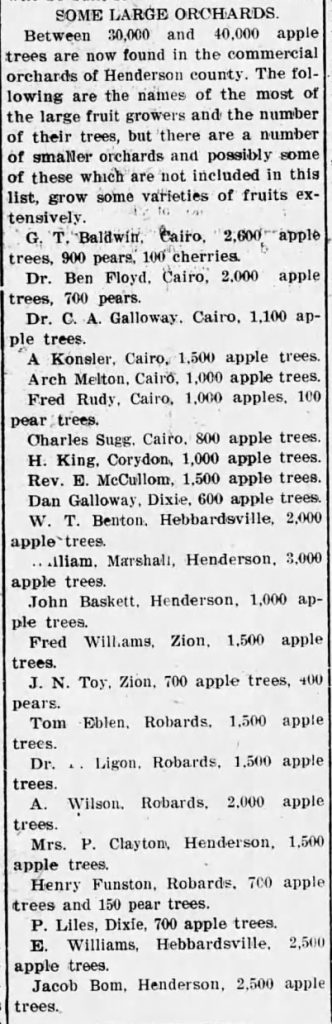
Figure 1. A portion of the countywide orchard inventory published by the Henderson Morning Gleaner on February 6, 1910.
George T. Baldwin emerged as one of the best-known of these pioneer fruit growers. His Cairo orchard specialized in Winesaps and repeatedly represented Henderson at state exhibitions. Apples from Baldwin’s orchard were exhibited at the 1904 Louisiana Purchase Exposition – the St. Louis World’s Fair – where later accounts state that his Winesaps received a bronze medal in competition with fruit from around the world.
Henderson’s reputation continued to spread. In July 1909, M. F. Johnson, president of the Kentucky State Horticultural Society, wrote that prospects in the Henderson section were particularly strong for Winesap and Grimes’ Golden apples. His conclusion was characteristically bold: “The Henderson district can beat the world on Winesaps.” The same report said a Louisville commission merchant had returned $4 per barrel for a Henderson shipment and immediately asked for more.
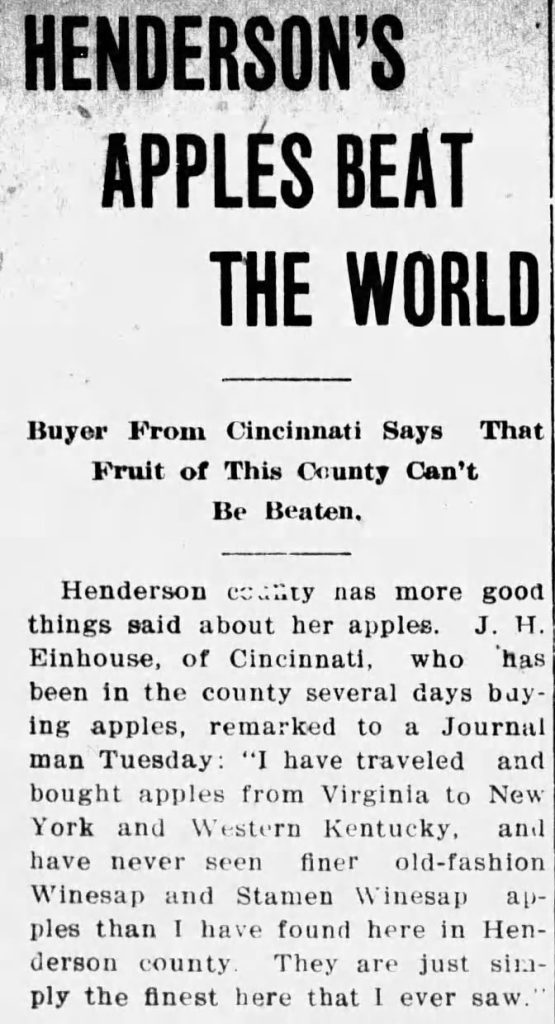
In October 1910, Cincinnati buyer J. H. Einhouse offered similarly extravagant praise. He said that after buying apples from Virginia to New York and across western Kentucky, he had never encountered finer old-fashioned Winesaps and Stayman Winesaps than those grown in Henderson County.
Science, Spraying, and Organization
The success of Henderson’s orchards was not simply a gift of the soil. Local growers increasingly treated fruit production as a science. They selected suitable varieties, pruned their trees, fought insects and disease, and learned that neglected orchards could not produce consistent commercial crops.
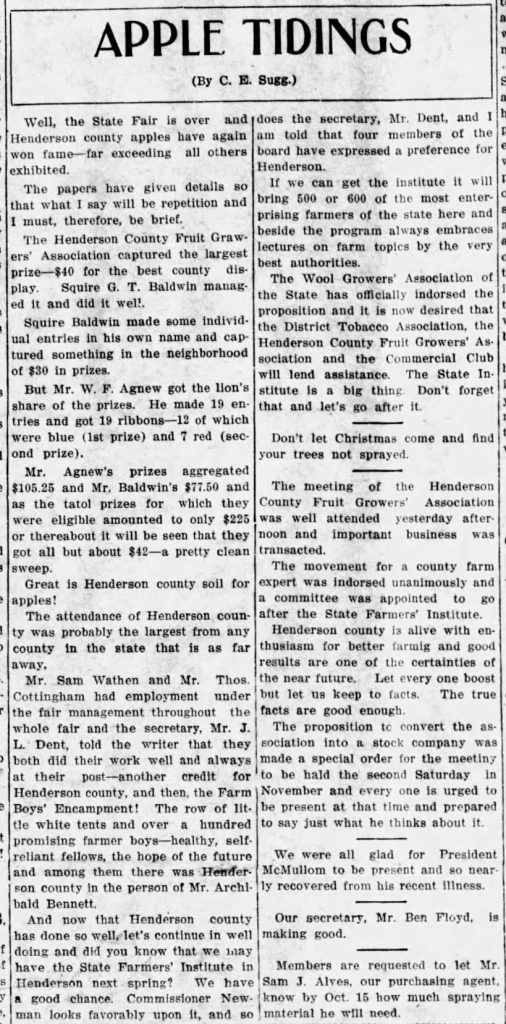
Spraying was especially important. The Henderson County Fruit Growers’ Association purchased spraying materials for its members and urged orchardists to complete their work on time. In a September 1912 column titled “Apple Tidings,” C. E. Sugg warned growers not to let Christmas arrive with their trees still unsprayed.
The association also gave individual orchardists a way to cooperate. It coordinated exhibits, discussed standardized packing and marketing, considered reorganizing as a stock company, and supported the employment of a county agricultural expert. Its purchasing agent was Sam J. Alves, while Dr. Ben Floyd served as secretary. This organization helped turn numerous privately owned orchards into something resembling a countywide industry.
The results were visible at the 1912 Kentucky State Fair. The Henderson County Fruit Growers’ Association won the $40 prize for the best county display under Baldwin’s management. W. F. Agnew made 19 entries and returned with 19 ribbons – 12 blue and seven red. Agnew and Baldwin together captured most of the prize money for which they were eligible.
A Market Larger Than Henderson Could Supply
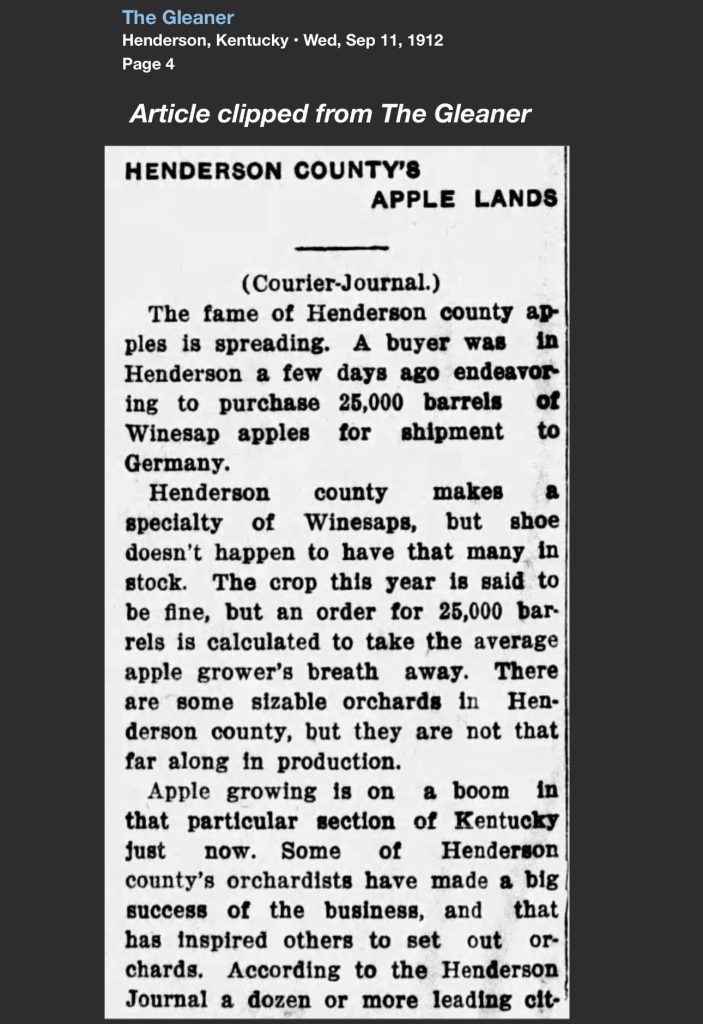
By 1912, Henderson’s apple reputation had spread far beyond Kentucky. On September 11, the Gleaner reprinted a Courier-Journal report that a buyer had visited Henderson hoping to purchase 25,000 barrels of Winesaps for shipment to Germany.
The proposed purchase exceeded the county’s available supply. Many newly planted orchards had not reached full bearing, and Henderson could not fill the order. No evidence in the article indicates that the German shipment occurred. Nevertheless, the attempted purchase demonstrates both the growing fame of Henderson Winesaps and the enormous expectations surrounding the industry.
Closer markets included Evansville, Louisville, Cincinnati, Memphis, Nashville, Chicago, and New York. Local dealers bought entire crops or smaller lots and shipped the fruit by rail. One early account reported that the firm of S. Cimini sent a railroad car containing 195 barrels to Memphis, where the apples were placed in cold storage. A Louisville produce company sent a representative through the county purchasing orchard crops and reserved storage space below Henderson at Frank Eckert’s facility.
Apples generally moved in wooden barrels, although crates, trays, plates, and smaller commercial packages became important for exhibitions and premium sales. Fruit had to be picked without bruising, sorted for size and quality, and packed so that it would arrive in marketable condition. Poor grading could damage the reputation of the entire region; uniform packing could open distant markets.
Cold Storage Changes the Business
The greatest practical obstacle was timing. Without refrigeration, a large crop had to be sold quickly, leaving growers at the mercy of buyers when prices were lowest. Cold storage allowed orchardists to hold their fruit for the winter market rather than dumping the entire harvest immediately.
In 1910, growers complained that existing facilities were inadequate and discussed building a cooperative cold-storage plant. Some of the previous year’s crop had been sent outside the county simply to be stored.
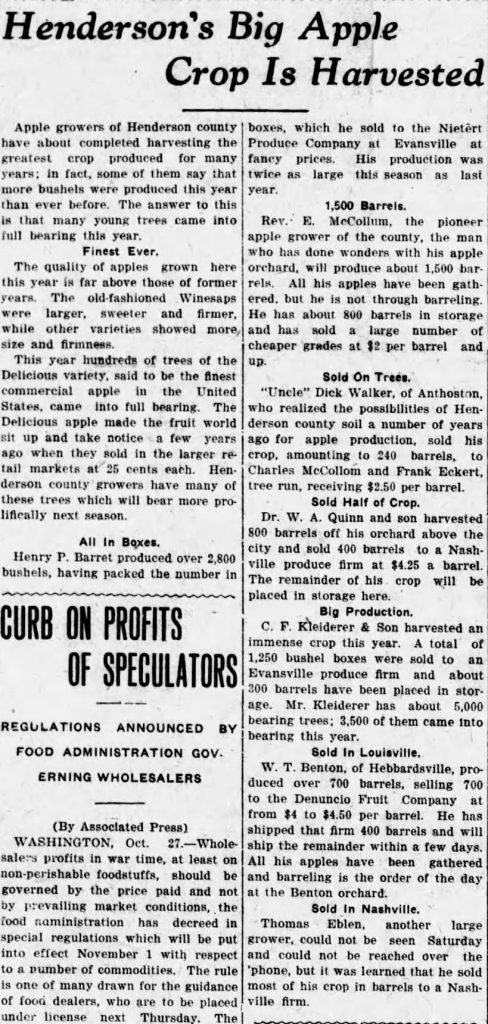
Within a few years, J. L. Nicholson had become the leading local figure in refrigerated storage. A November 29, 1915, article reported that the fruit of 170 Henderson County apple raisers occupied approximately 17,000 barrels of space in the Nicholson plant. The Home Ice Company’s storage rooms were also filled. Total county production that year was conservatively estimated at 25,000 barrels, worth roughly $75,000 to $80,000.
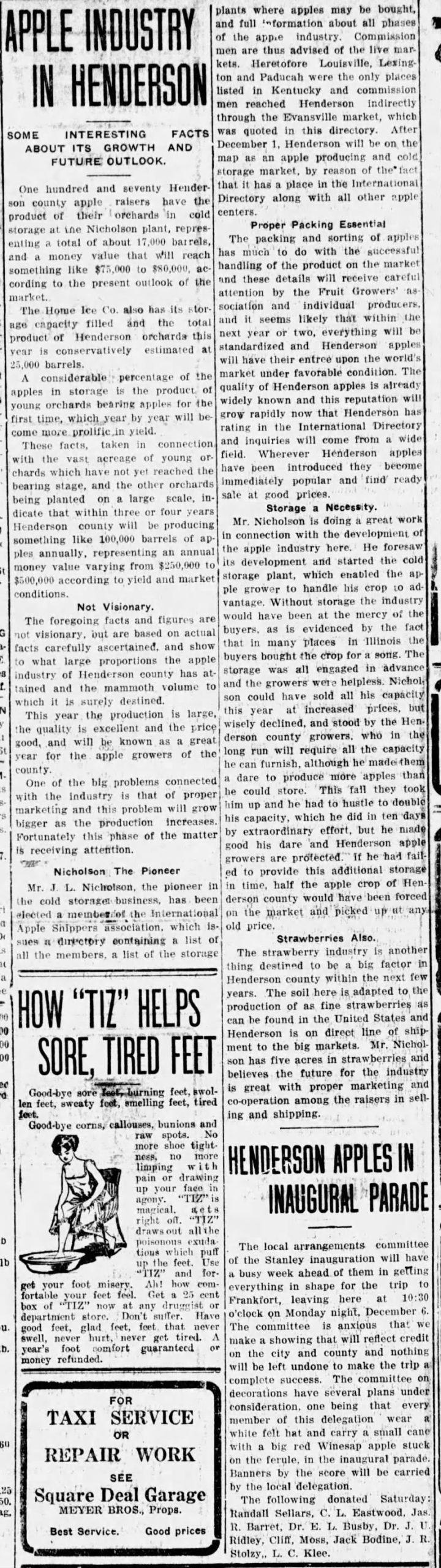
Figure 2. The Gleaner’s November 29, 1915, survey documented 170 growers, 25,000 barrels of production, and the importance of proper packing and cold storage.
Demand became so great that Nicholson reportedly doubled his capacity in only ten days. Had he failed, the newspaper estimated that half of the county’s crop might have been forced immediately onto the market and sold at whatever price buyers offered.
Nicholson was elected to the International Apple Shippers’ Association, and Henderson was added to its directory as an apple-producing and cold-storage center. Previously, the only Kentucky locations listed were Louisville, Lexington, and Paducah, while Henderson business was handled indirectly through Evansville. Directory recognition placed Henderson before commission merchants searching for fruit and storage facilities throughout the country.
The 1915 article predicted that Henderson might produce 100,000 barrels annually within three or four years. That figure was a projection, not a documented harvest. Based upon the surviving articles examined for this history, the 25,000-barrel estimate for 1915 remains the clearest verified countywide production figure.
Henderson Apples at the State Fair
State-fair competition provided Henderson growers with advertising that money could hardly buy. Ribbons established that their claims of superior fruit were more than local boasting.
In 1917, Henderson entries won across numerous classifications. Prize-winning varieties included Grimes’ Golden, Polly Eades, Liveland Raspberry, Gano or Black Ben Davis, Arkansas or Mammoth Black Twig, Kinnaird’s Choice, Rome Beauty, Delicious, Stayman, King Davis, Winesap, and Stayman Winesap. Leading exhibitors included C. F. Kleiderer & Son, W. Tell Benton, George T. Baldwin, George L. Baldwin, and others.
County Agent Angus Gordon was quoted as saying that Henderson possessed more marketable apples than the rest of Kentucky combined. A visiting county agent reportedly asked which displays belonged to Henderson. He was told to look for “the ones with the blue and red ribbons on.” After inspecting the exhibit, he conceded that the answer was accurate.
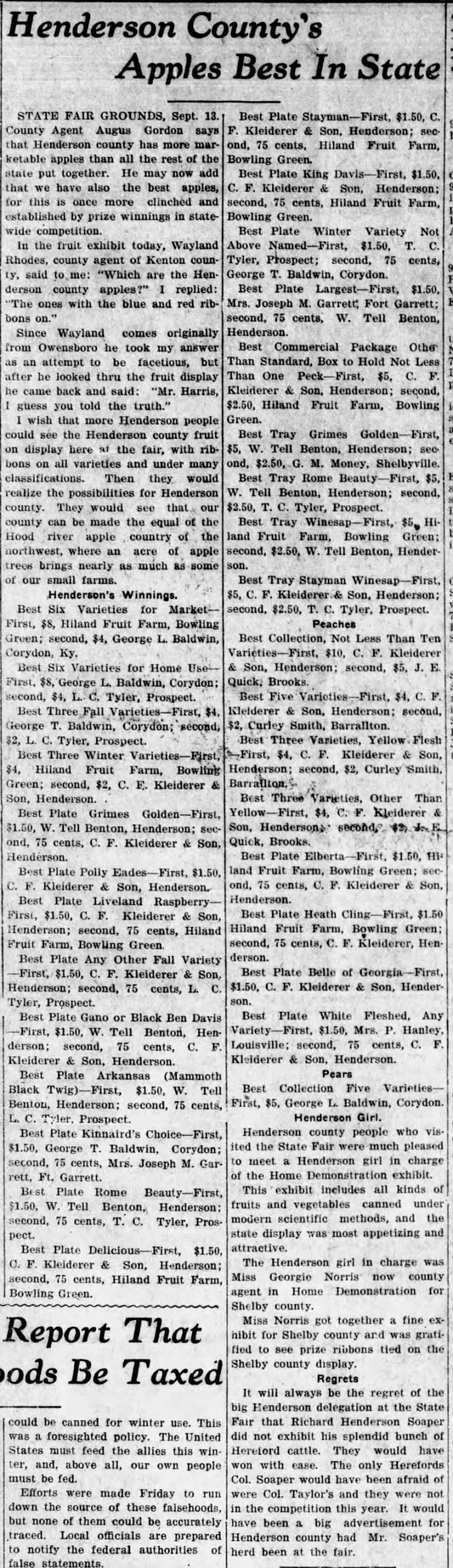
Figure 3. The September 15, 1917, State Fair report recorded Henderson victories across numerous apple varieties and classifications.
The victories continued. In September 1927, Henderson sent 50 crates and 50 plates of apples to Louisville. The principal varieties included Winesap, Delicious, Grimes’ Golden, Stayman Winesap, and the locally developed Polly Eades. The newspaper declared that Henderson apples had been winning blue ribbons at the State Fair for 23 years.
Two years later, Henderson again won first place in the county apple competition. The judge, Purdue University horticulturist F. P. Cullinan, was so impressed by the fruit’s uniformity that he offered to pay one dollar for every defect anyone could find in the display. Jefferson County placed second and McCracken County third.
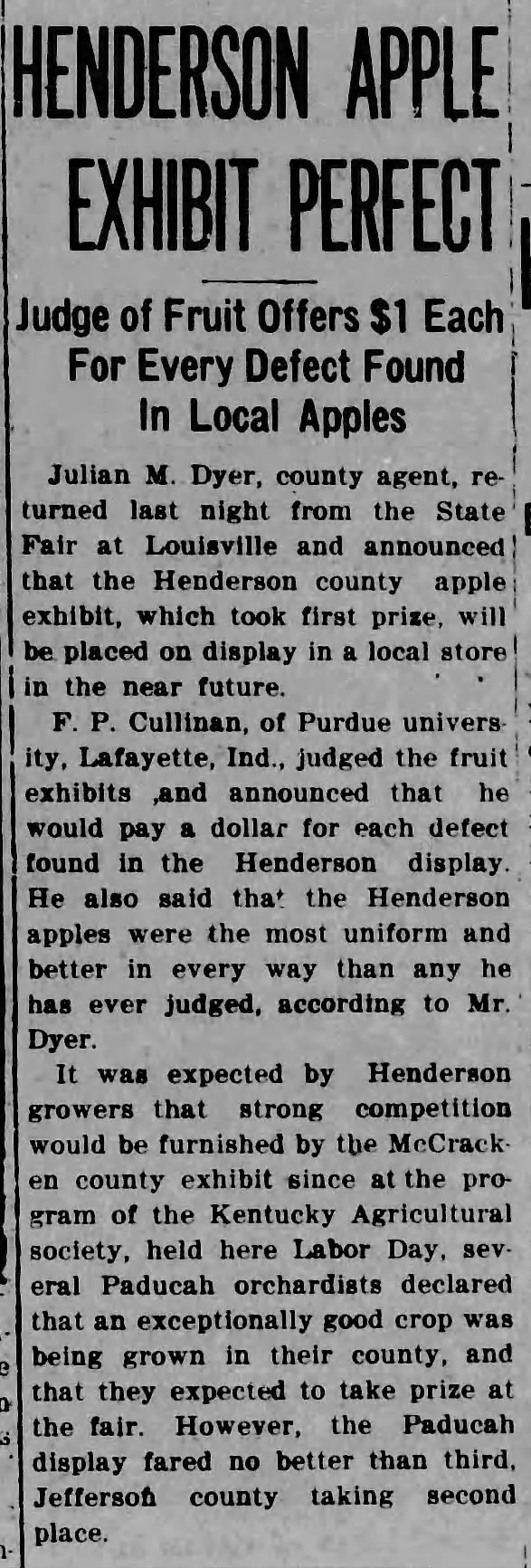
Figure 4. In 1929, a State Fair judge reportedly offered one dollar for every defect anyone could find in Henderson’s first-place display.
Heinz Finds a Use for the “Drops”
Not every apple was suitable for a premium barrel or prize-winning display. Windfalls and lower-grade fruit – usually called “drops” – still had value for cider, vinegar, preserves, and industrial processing.
In 1919, the H. J. Heinz Company had recently established a Henderson branch in the East End to manufacture ketchup and chili. Company representatives were reportedly surprised to discover the scale of the surrounding apple industry. After investigating the crop, Heinz contracted with several local orchards to purchase apples for processing.
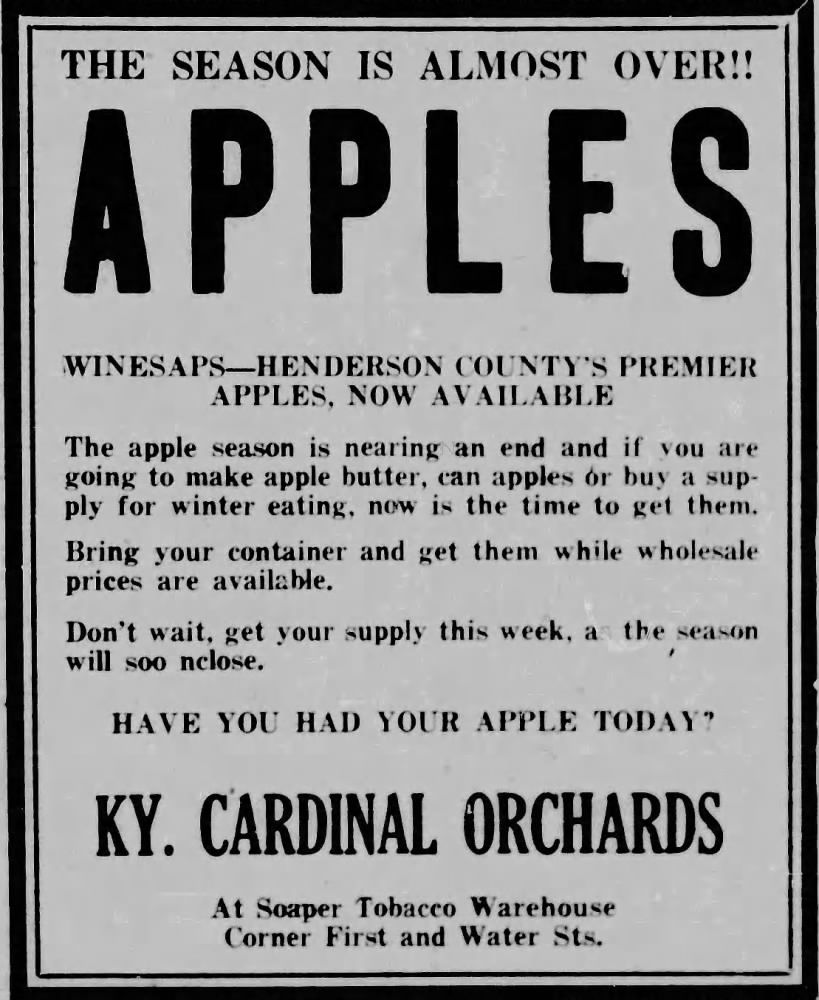
One October shipment came from W. H. Stites’s orchard east of Henderson. Apples were hauled directly from the orchards to the East End plant. Because Heinz could use drops that might otherwise have gone to waste, the company provided growers with another market and improved the value of the total harvest. The newspaper speculated that Heinz might eventually install a large cider mill and additional apple-processing machinery, although the article does not establish that those improvements were built.
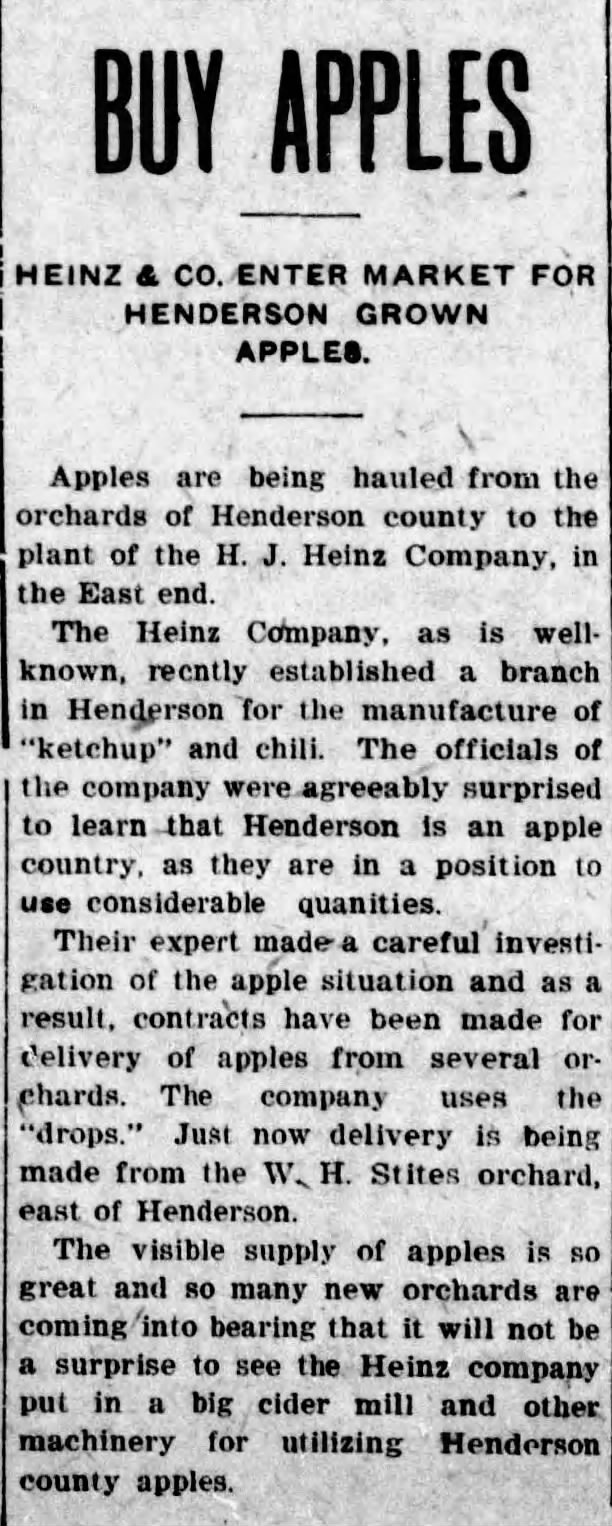
Figure 5. The Gleaner reported on October 22, 1919, that Heinz was buying lower-grade “drops” from several Henderson County orchards.
Apples Become Part of Henderson’s Identity
By the 1930s, apples were more than a profitable crop. They had become a source of civic pride.
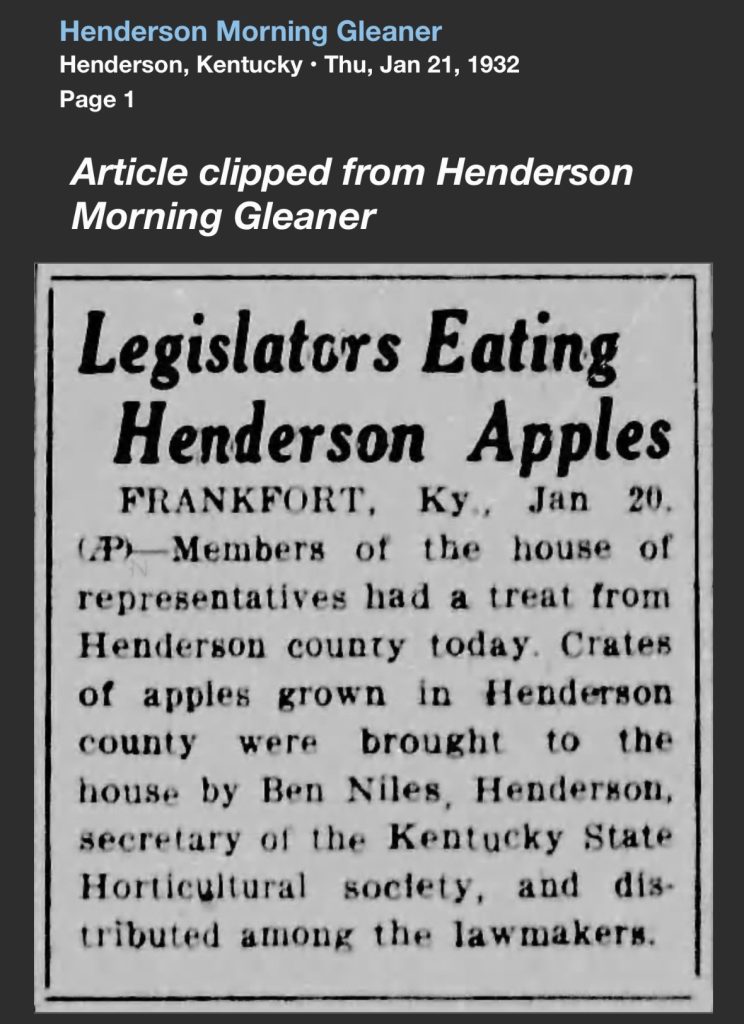
In January 1932, Ben Niles of Henderson, secretary of the Kentucky State Horticultural Society, delivered crates of Henderson-grown apples to the Kentucky House of Representatives. Legislators distributed and ate the fruit – an uncomplicated but effective advertisement at the state capitol.
The grandest celebration came four years later. On April 6, 1936, Mayor Lee L. Hurley issued a formal proclamation declaring April 13 through April 18 Henderson Apple Blossom Festival Week. The proclamation stated that Henderson’s reputation had been achieved through years of scientific cultivation and that the industry provided a livelihood for hundreds of people. Hurley asked local businesses to close at an appointed time so residents could see the orchards at the height of their spring beauty.
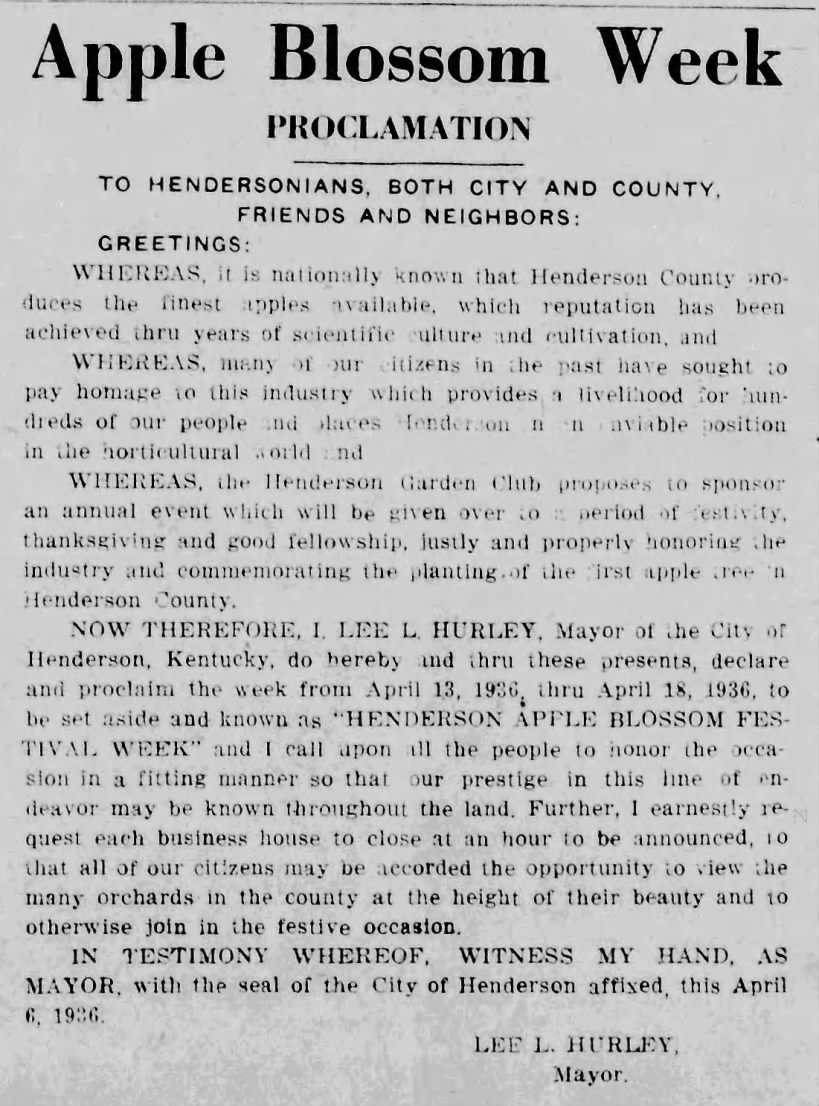
Figure 6. Mayor Lee L. Hurley’s proclamation appeared on the front page of the Henderson Morning Gleaner on April 8, 1936.
The Henderson Garden Club sponsored the celebration, while Ben Niles received credit for championing the idea after observing successful festivals near Benton Harbor, Michigan, and other fruit-growing centers. Cold weather initially delayed the program, but warmer temperatures arrived in time for the festivities.
On Friday, April 17, a parade assembled at the post office and proceeded through downtown behind the high-school band. Merchants were asked to decorate automobiles in white, green, and pink. After the parade, the cars embarked upon a 33-mile tour of county orchards. The day concluded with Apple Blossom Festival Night at the Merchants and Manufacturers Exposition and an Apple Blossom Ball.
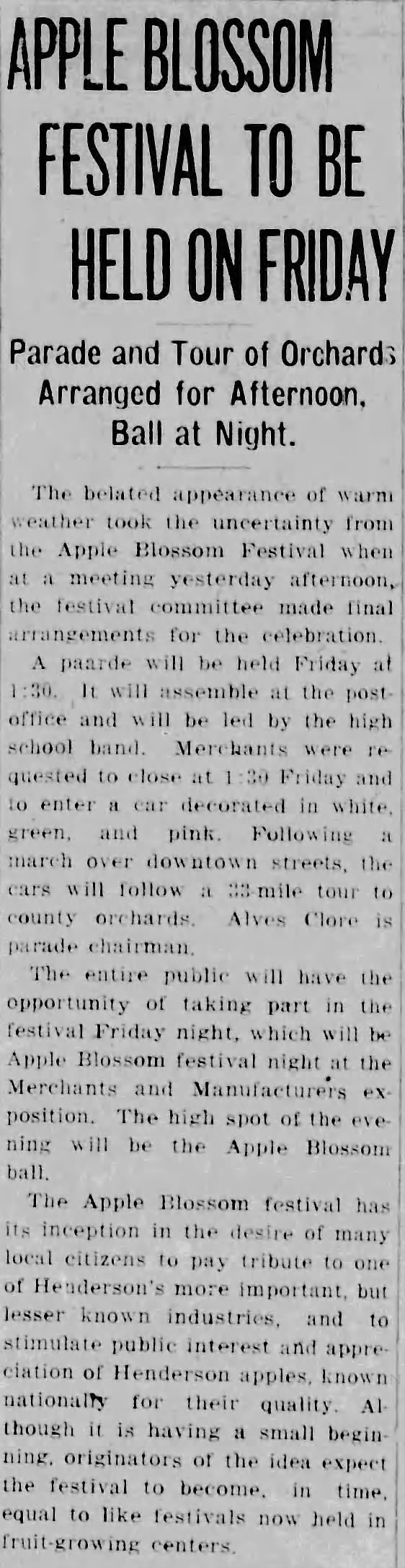
Figure 7. The festival program included a downtown parade, a 33-mile automobile tour of the orchards, and an Apple Blossom Ball.
The Louisville Courier-Journal praised the celebration and suggested that it might grow into a nationally known event. Henderson, the paper observed, had finally decided not to hide its light under a bushel.
The Fading of the Orchards
No single event ended Henderson County’s apple industry. The surviving accounts instead suggest that the competitive advantages enjoyed by local growers gradually changed.
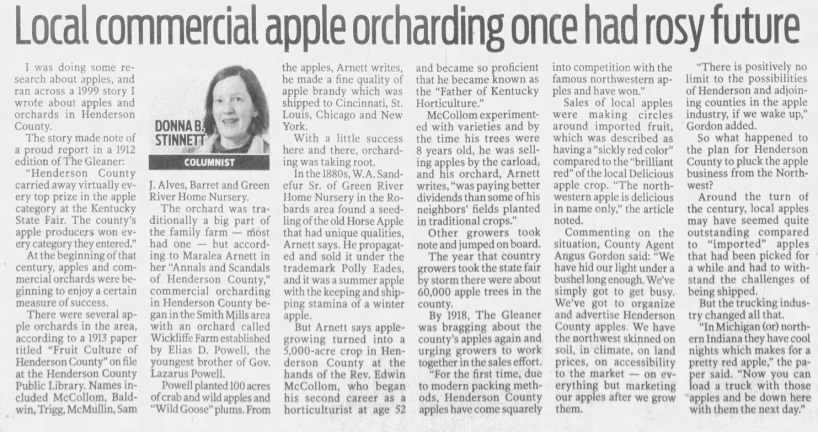
At the beginning of the twentieth century, fruit shipped great distances arrived slowly and often suffered in transit. Henderson’s location near major rail markets, combined with its storage plants, gave its growers an advantage. A 2015 retrospective by Gleaner columnist Donna B. Stinnett explained that improved refrigerated trucking eventually altered that equation. Apples grown in Michigan and northern Indiana – regions where cooler nights helped produce deeply colored fruit – could be loaded onto trucks and delivered to Henderson and nearby markets the following day.
The same transportation system that once helped Henderson reach outside customers now brought large quantities of competing fruit directly into its home market. The historical sources assembled here do not provide a precise year when Henderson ceased to be a leading commercial apple county. They show instead that the industry remained vigorous through the 1920s, was still nationally promoted during the 1936 festival, and retained enough importance in 1941 for the WPA guide to call Henderson Kentucky’s greatest apple-producing county.
After that, the orchards gradually disappeared from the landscape and from popular memory.
A Forgotten Agricultural Achievement
Henderson’s apple era was neither a minor experiment nor a piece of exaggerated folklore. Contemporary newspapers document tens of thousands of trees, hundreds of growers, tens of thousands of barrels, cold-storage plants filled to capacity, buyers arriving from distant cities, repeated State Fair victories, interest from Germany, contracts with Heinz, and a civic festival created to honor the industry.
Its success rested upon more than fertile soil. Growers such as Edwin McCollom, George T. Baldwin, W. F. Agnew, C. F. Kleiderer & Son, W. Tell Benton, W. H. Stites, and many others applied scientific cultivation, embraced spraying and varietal improvement, organized cooperatively, standardized their packing, and found ways to store and market a perishable crop.
For a generation, Henderson County did not merely grow apples. It built an apple industry – and for many years, Kentucky knew exactly where to find its finest fruit.
Principal Sources
• The Gleaner, July 28, 1909, p. 7, “Best Shipped to Louisville.”
• The Gleaner, October 6, 1910, p. 3, “Henderson’s Apples Beat the World.”
• Henderson Morning Gleaner, February 6, 1910, p. 5, “Fruit Culture to Become Big Industry in the County.”
• The Gleaner, September 11, 1912, p. 4, “Henderson County’s Apple Lands,” reprinted from the Courier-Journal.
• C. E. Sugg, “Apple Tidings,” The Gleaner, September 15, 1912, p. 4.
• The Gleaner, November 29, 1915, p. 7, “Apple Industry in Henderson.”
• “Henderson County’s Apples Best in State,” Henderson Morning Gleaner, September 15, 1917, p. 4.
• The Gleaner, October 22, 1919, p. 1, “Buy Apples.”
• Henderson Morning Gleaner, September 11, 1927, p. 7, “County to Take Active Part in Kentucky Fair.”
• Henderson Morning Gleaner, September 14, 1929, p. 8, “Henderson Apple Exhibit Perfect.”
• Henderson Morning Gleaner, January 21, 1932, p. 1, “Legislators Eating Henderson Apples.”
• Henderson Morning Gleaner, April 8, 1936, p. 1, “Apple Blossom Week – Proclamation.”
• Henderson Morning Gleaner, April 12, 1936, p. 17, “Apple Blossom Celebration’s Plans Contingent on Temperature.”
• Henderson Morning Gleaner, April 16, 1936, p. 6, “Apple Blossom Festival to Be Held on Friday.”
• Henderson: A Guide to Audubon’s Home Town in Kentucky, Kentucky Writers’ Project, Works Progress Administration, 1941.
• Donna B. Stinnett, “Local Commercial Apple Orcharding Once Had Rosy Future,” The Gleaner, October 11, 2015, p. 26.
• Maralea Arnett, Annals and Scandals of Henderson County, as summarized by Stinnett.











Leave a Reply