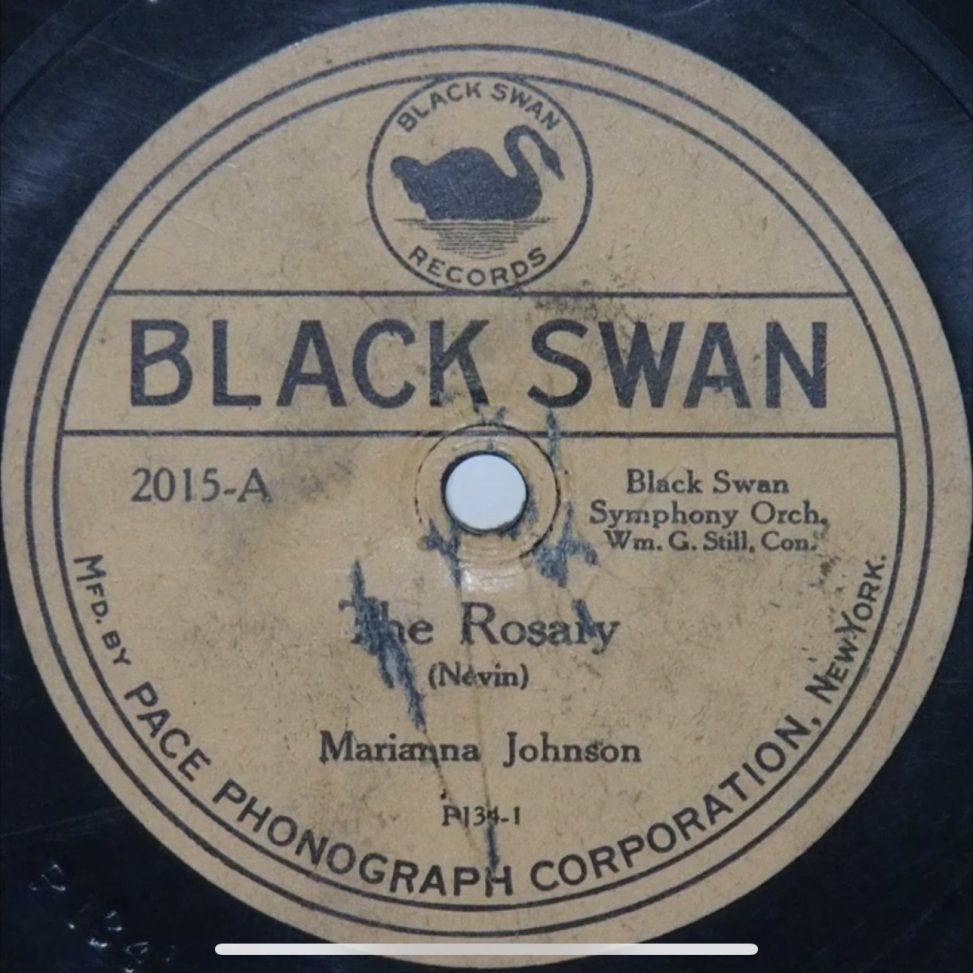
A HENDERSON VOICE ON BLACK SWAN
Marianna Johnson’s 1921 Record
Born in Henderson, Johnson carried her musical gifts to Huntington, Harlem and one of America’s pioneering Black-owned record companies. More than a century later, her voice can be heard again.
| LISTEN TO MARIANNA JOHNSON “The Rosary” – Black Swan 2015-A “Sorter Miss You” – Black Swan 2015-B Both sides were issued in 1921 and are now available as online transfers of the original recording. |
The recording begins with the soft crackle of an old shellac disc. An orchestra enters, and then a woman’s voice rises above it: controlled, resonant and unmistakably trained. The singer is Marianna Johnson, a Henderson native whose path carried her into the musical and political world of early 1920s Harlem.
For generations, Johnson’s name survived mainly in family memory, census records and specialist discographies. Her only presently documented commercial record was rare enough that a nearly pristine copy was offered at auction in 2009 with an estimate of $800 to $1,200. Today, digitized transfers allow Henderson listeners to hear what once seemed almost lost.
That surviving record connects Henderson to Black Swan Records, the groundbreaking company founded by Harry H. Pace in New York in 1921. It also places Johnson alongside musicians and cultural leaders who were reshaping American music during the opening years of the Harlem Renaissance.
From Henderson to Huntington
Marianna Johnson was born in Henderson, Kentucky, on December 9, 1897. The Notable Kentucky African Americans Database identifies her parents as Mary E. Carr and Edward W. Johnson. She later became the mother of Pierre W. “Red” Jackson, the celebrated Henderson athlete, educator, coach and civil rights leader.
Johnson grew up in Huntington, West Virginia, where her father worked for the Chesapeake and Ohio Railway. Huntington was a major railroad and coal-shipping center, and the city’s growing Black community supported churches, schools, civic organizations and musical life. By 1920, the census placed Johnson with her family in Huntington. The same year’s census also recorded her in New York City, where she was listed as a student.
In New York, Johnson lodged at 227 West 136th Street with her friend Revella Hughes, a gifted soprano, pianist and violinist from Huntington. Their residence placed them in the orbit of the Rev. Adam Clayton Powell Sr. and in the heart of a neighborhood becoming one of the nation’s most important centers of Black art, politics and intellectual life.
A Young Musician in Harlem
Johnson did not arrive in New York merely as an observer. On December 2, 1920, she and Hughes were scheduled to perform in a benefit recital organized by the New York local of the National Association of Negro Musicians. The program was held at St. Philip’s Church on West 134th Street. Johnson was billed as a pianist, while Hughes appeared as a soprano.
The following March, the two women joined a select group of New York performers at Washington’s Howard Theatre. The event raised funds for a proposed national school of music for African Americans through the Washington Conservatory of Music, led by Harriet Gibbs Marshall. These appearances show Johnson working within a network that treated musical excellence as both an art and a means of racial advancement.
The two friends also performed at events supporting Marcus Garvey’s movement. Scholars identify Johnson as a Garveyite, or supporter of Garvey’s program of Black pride, economic independence and international unity. That political commitment would eventually put Johnson and Hughes at odds with Harry Pace, whose ideas about racial advancement sharply diverged from Garvey’s.
The Black Swan Record
Black Swan Records offered Johnson an opportunity that the mainstream recording industry rarely extended to classically trained Black vocalists. Pace created the company to demonstrate Black artistic achievement and Black business capability. The label employed future jazz giant Fletcher Henderson as recording director and composer William Grant Still as arranger and music director.
Black Swan’s catalog deliberately ranged beyond a single definition of Black music. It released blues, jazz, spirituals, popular songs and concert pieces. The Smithsonian National Museum of African American History and Culture describes the label’s work as an experiment joining economic self-determination, racial uplift and entertainment. Johnson’s formal contralto performance fit squarely within that mission.
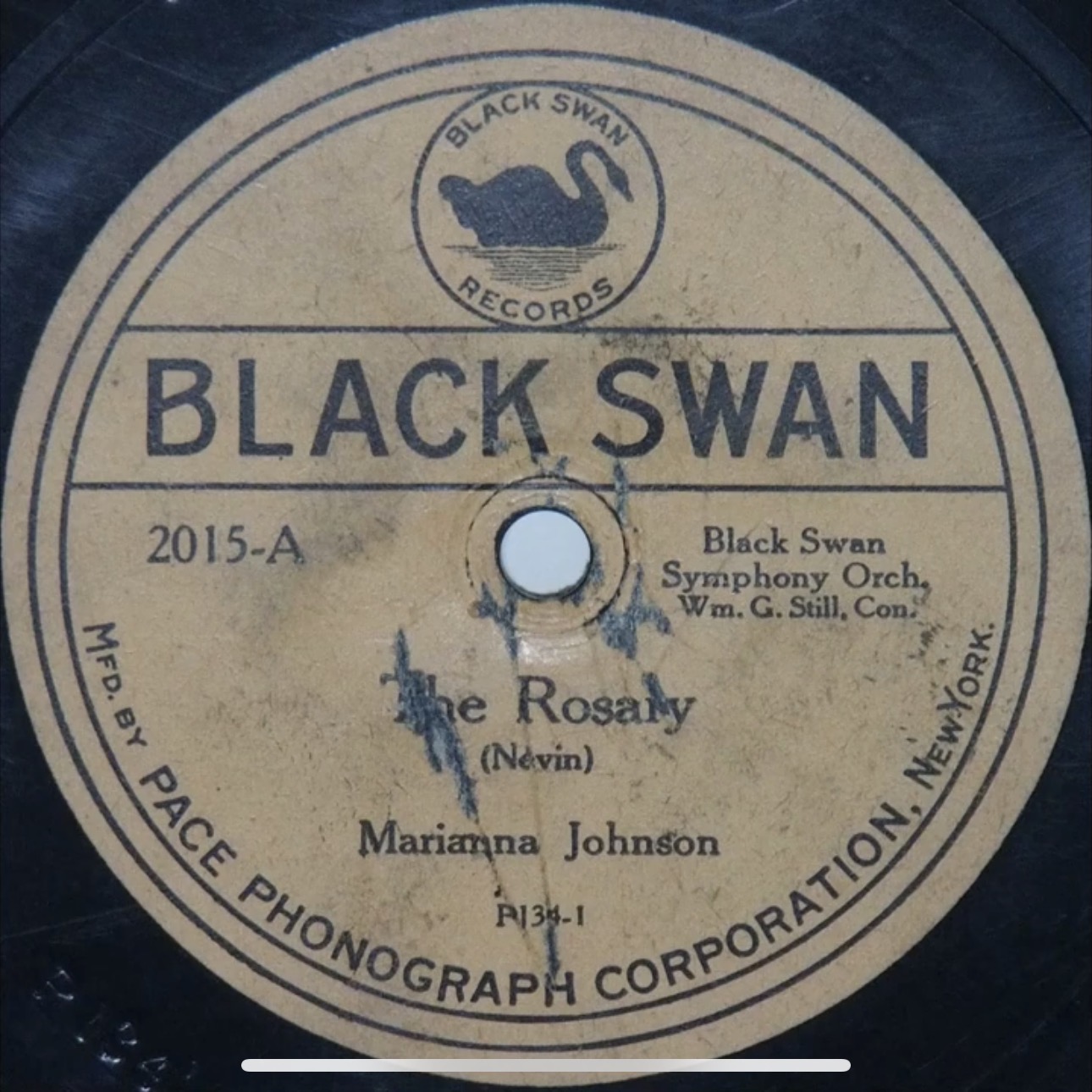
In 1921, Johnson recorded Black Swan 2015. The first side featured “The Rosary,” the popular sentimental ballad with words by Robert Cameron Rogers and music by Ethelbert Nevin. The reverse carried “Sorter Miss You.” Johnson was accompanied by the Black Swan Symphony Orchestra, with William Grant Still credited as director. The recording also linked her work to Fletcher Henderson during his formative years at the label.
Johnson’s voice is notably different from the blues performances most often associated with early race records. She sings in a formal concert style, with careful diction, broad phrasing and a rich lower register. That difference is historically important. Black Swan was arguing, through records like Johnson’s, that Black musicians belonged across the full range of American musical culture.
| “More than a century later, a Henderson-born voice still rises from the grooves.” |
Two Songs, Two Sides of a Voice
“The Rosary” was already familiar to American audiences when Johnson recorded it. Her version transformed the parlor ballad into a showcase for a Black concert singer whose opportunities in the commercial record industry were severely limited. The Organization of American Historians later selected the recording as a teaching source for examining music, sound and race.
“Sorter Miss You” is less widely documented, but its survival is equally valuable. Heard together, the two sides preserve the sound of one recording session and the artistry of a woman whose professional career appears to have been brief. The record was reissued under the Paramount-Black Swan name in 1924 after Black Swan’s catalog changed hands, further extending the life of Johnson’s performance.
Original copies remain scarce. The University of Connecticut’s Archives and Special Collections has identified Johnson’s disc among its Harlem Renaissance holdings, describing it as a rare Black Swan recording accompanied by the Black Swan Symphony Orchestra.
Return, Family and a Long Life
By 1923, Johnson had returned to Huntington. Available records indicate that she married there and that by 1930 she had remarried. The 1930 census placed her in a multigenerational Huntington household with her husband, her young son Pierre Jackson, her parents and other relatives. Her professional recording career appears to have ended after the Black Swan period.
Her son would carry another part of the family’s legacy back to Henderson. Pierre “Red” Jackson became an outstanding athlete at Douglass High School and Kentucky State College, later returned home as a teacher and coach, and helped establish Henderson’s NAACP branch. Johnson’s own story adds a newly audible chapter to that better-known legacy.
Marianna Johnson eventually returned to the city where she had been born. She died in Henderson on September 1, 1998, at the age of 100. Her life spanned the transition from acoustic 78-rpm records to the digital age, although she did not live to see how easily listeners would one day be able to call up her 1921 performance.
A Voice Recovered
Johnson’s known discography may consist of only two songs, but historical importance is not measured solely by the size of a catalog. Her record captures a Henderson-born Black woman participating in the cultural ambitions of Harlem, the institution-building work of Black musicians and the political debates of the Garvey era.
It also makes the past immediate. A census entry can tell us where Johnson lived. A concert notice can tell us where she performed. A record allows us to hear her breathe, phrase a lyric and hold a note. More than a century after Black Swan pressed her voice into shellac, Marianna Johnson can sing to Henderson again.
Source Notes:
Notable Kentucky African Americans Database: Principal biographical source for Johnson’s dates, parents, Henderson birth, census history, New York performances, Black Swan recording, Garvey affiliation, return to Huntington and death in Henderson. Open source
West Virginia Encyclopedia: Biographical entry for Revella Hughes documenting her New York household with Johnson, their performances and Johnson’s return to Huntington. Open source
Smithsonian National Museum of African American History and Culture: Context for Harry Pace, Black Swan Records, Fletcher Henderson, William Grant Still and the label’s broad artistic mission. Open source
University of Connecticut Archives and Special Collections: Description of its rare copy of Johnson’s Black Swan recording and the label’s place in Harlem Renaissance history. Open source
Organization of American Historians: Educational primary-source collection containing Johnson’s recording of “The Rosary.” Open source
Discography of American Historical Recordings: Allan Sutton’s Black Swan discography, including the original record and 1924 Paramount-Black Swan reissue. Open source
David Suisman: Black Swan teaching chapter with contextual notes and an audio presentation of Johnson’s “The Rosary.” Open source
Leftover Shellac: Online transfers of both sides of Black Swan 2015. Open source
Deborah Hoda
Thanks for the.informative report on my grandmother Marianna Johnson..* she was not married twice..Our family hold her activism, musical journey, and leadership in great regard.