Silk Culture in Henderson County, Kentucky
By Spalding Trafton
Some thirty-eight years after the dawn of the Nineteenth Century when the Course of the Empire was taking its way westward, there trekked along with others, during that period, Birdsey Gibbs and his wife (my grandparents) and their little brood of three. Their object was Kentucky—imbued to go thither by the glittering representations that fortune awaited them in this land of promise. They had first come from Milton, Connecticut, and latterly from Kingston, New York. With his household goods and family loaded in ox carts, Birdsey Gibbs began his toilsome travel to the end of the rainbow which, to him, appeared to be centered in Tallmadge, near the town of Henderson. On their way the ox teams and vehicles became stuck in the mud. Mrs. Gibbs told the story of how she was obliged to leave the cart and wade in the mud, and how she lost her slippers and had to walk around in her stocking feet.
After many weeks of weary and harrowing travel by the Erie Canal, thence by stage to Pittsburgh, and with the last lap of the journey by steamboat, they landed at Henderson, Kentucky. Upon arrival at Tallmadge they found that several log houses had been erected, that the situation was much like “Eden”—otherwise Cairo, Illinois, as described by Dickens in Martin Chuzzlewit.
About twelve miles east of Henderson—on what is now the Henderson and Owensboro road via Zion—Colonel William G. Taylor, David Hart Cowan, and others had represented that they were preparing to establish a manufacturing community. They were to build a silk growing and manufacturing enterprise.
Birdsey Gibbs, who was primarily a man of letters and knew more about Greek translations than he did of the practical business of life, was induced to invest all of his worldly substance in this venture. His wife and faithful helpmate, Emily Catlin Gibbs, was a cousin of George Catlin the celebrated Indian painter and historian.
This proposed manufacturing community, known as Tallmadge, consisted of some 450 acres of land acquired by David Hart Cowan, William G. Taylor, and others. The town was plotted into lots which were sold at fancy prices for those days. It was named for Benjamin Tallmadge, a Revolutionary officer and politician. Tallmadge was born at Brookhaven, New York, in 1754, and died March 7, 1835, at Litchfield, Connecticut, the same county from which Birdsey Gibbs and family came.
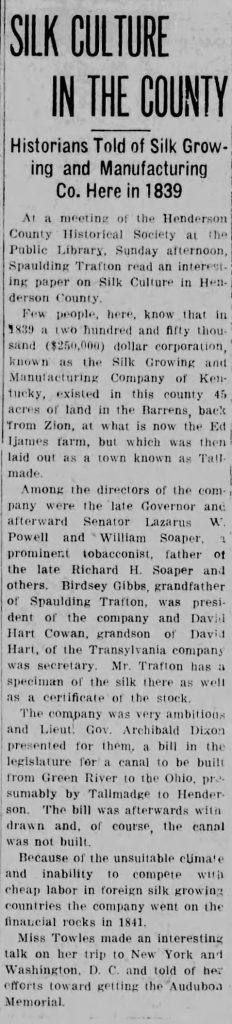
A silk growing and manufacturing company was formed, and on January 16, 1838, was incorporated by an act of the Kentucky Legislature. One of the stock certificates of this company lies before me. It is printed on thin paper. It is ornamented with three pictures: On the left is the likeness of a silkworm eating a mulberry leaf; another is of a mulberry tree; and the third is a drawing of three cocoons. Spread out over and above these illustrations are these words: “Capital $250,000. Chartered, 1838. No. 239, $25.00.” The title of the company, “Kentucky Silk Manufacturing Company” is followed by: “Be it known that Mr. ____ is entitled to nine shares in the Capital Stock of the Kentucky Silk Manufacturing Company transferable by the said attorney at the office of the Company in the Town of Henderson, State of Kentucky, upon the surrender of this Certificate. Dated at Henderson, this the third day of May, 1839.” It is signed in ink “Birdsey Gibbs, Prest.,” and “D. Hart Cowan, Secy.”
The incorporators included several prominent men of that community, among them being Lazarus W. Powell, afterward Governor of Kentucky and later United States Senator, William Soaper, a local tobacco man and capitalist, Edmund H. Hopkins, a member of the Kentucky Legislature, Dr. Thomas J. Johnson, William G. Taylor, Hervy Green, Livingston G. Taylor, Stephen B. Peet, and John H. Chapman, all of whom were directors. The articles of incorporation state that the purpose of the company is “Cultivating the different kinds of mulberry trees, raising silkworms, and manufacturing silk. And the Legislature being disposed to encourage so useful and important an undertaking, therefore this charter to said Company.”
It might be well to relate how this silk company came to be opened at such a distance from the town of Henderson where facilities for its operation were much more desirable. The land which is described as Lot No. 22 was inherited by David Hart Cowan from his uncle David Hart, of Knox County, Indiana, who in his will dated December 12, 1822, requested that William Hart, Trustee, of Henderson, Kentucky, deed to David Hart Cowan 450 acres of land as part of Lot No. 22. This deed was made some sixteen years later—or to be very exact—on April 23, 1838.
And five days thereafter there appears of record in the Henderson County Court Clerk’s office a power of attorney from David Hart Cowan to William G. Taylor stating that the name of the town is “Tallmadge,” and that Edmund H. Hopkins, surveyor, has been directed to lay it off in lots, and that “the said Taylor” is authorized to sell such lots.
David Hart Cowan was the grandson of David Hart, of the Transylvania Company, and the son of Susan Hart and Joseph Cowan. William G. Taylor was the son of Eliza Cowan and Livingston Taylor, who was a brother-in-law of David Hart Cowan.
Edmund H. Hopkins, one of the stockholders and directors of the company, and who was also a surveyor, laid off the town of Tallmadge in lots, and streets. A few names of the streets are of record, namely, Broad Street and Milton Street, the latter probably being named for Milton, Litchfield County, Connecticut, the home town of Birdsey Gibbs. There was a plot designated Public Square, where community gatherings could be held, and where the children of this wonderful silk manufacturing community could engage in healthful play.
It appears that the sale of Tallmadge lots was highly successful in Kingston, New York, as witness the following list: C. T. Dubois, bought two lots for $110; Pierce Catlin, a relative of Mrs. Gibbs, six lots for $200, and then ten lots for $250; C. F. Waring, one lot, $25; Birdsey Gibbs, four lots for $200; J. S. Smith, nine lots, $270; James S. Halleck, 112 acres, $1,000; same, eight lots, $560; Samuel W. Pierce, thirteen lots, $385. Sarah Court, of Jersey City, New Jersey, bought five lots for $120.
Some eighty-seven or more lots in Tallmadge were sold; most of them to people in and around Kingston, New York. Many were sold by Birdsey Gibbs, as attorney-in-fact for William G. Taylor.
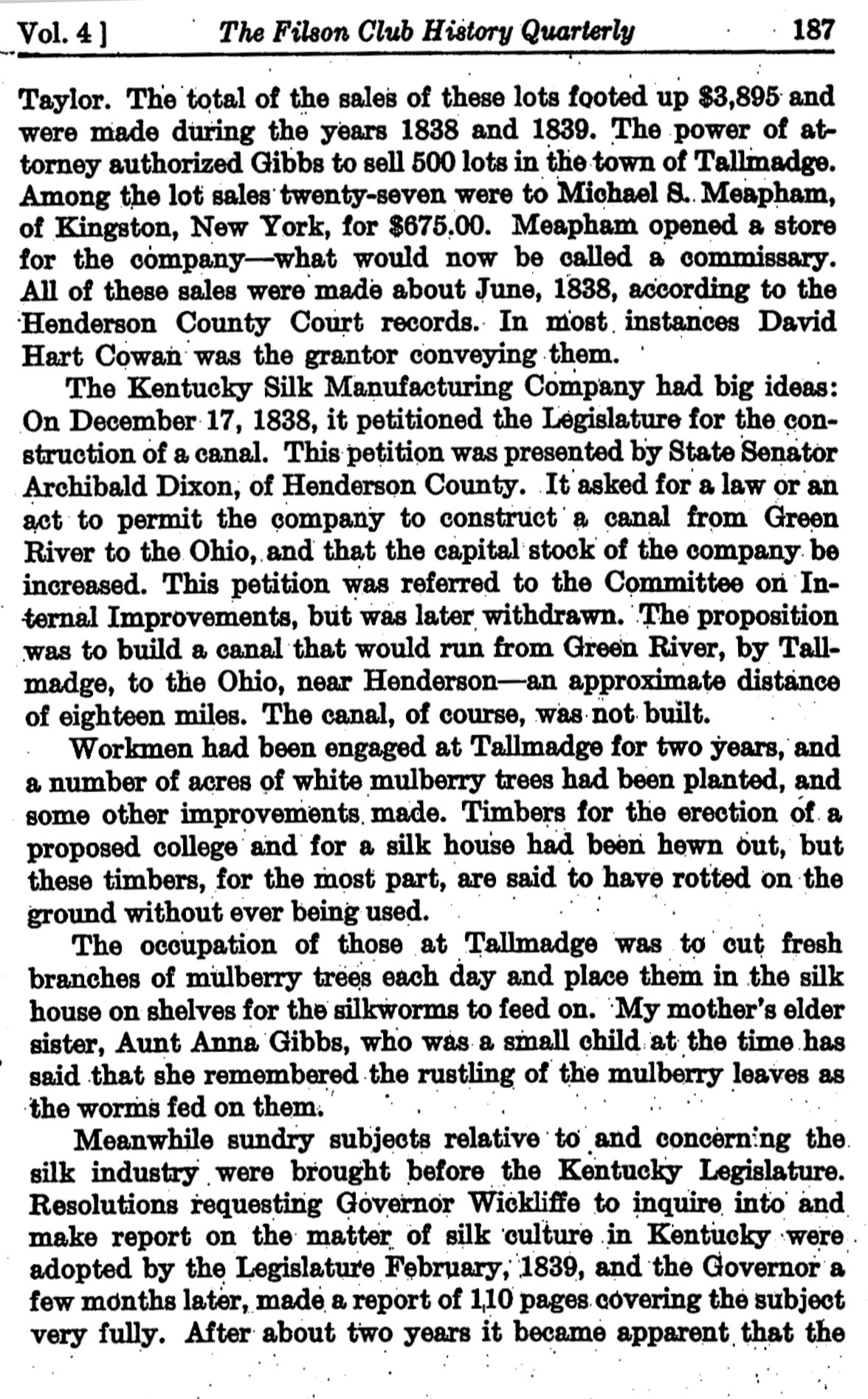
The total of the sales of these lots footed up $3,895 and were made during the years 1838 and 1839. The power of attorney authorized Gibbs to sell 500 lots in the town of Tallmadge. Among the lot sales twenty-seven were to Michael S. Meapham, of Kingston, New York, for $675.00. Meapham opened a store for the company—what would now be called a commissary. All of these sales were made about June, 1838, according to the Henderson County Court records. In most instances David Hart Cowan was the grantor conveying them.
The Kentucky Silk Manufacturing Company had big ideas: On December 17, 1838, it petitioned the Legislature for the construction of a canal. This petition was presented by State Senator Archibald Dixon, of Henderson County. It asked for a law or an act to permit the company to construct a canal from Green River to the Ohio, and that the capital stock of the company be increased. This petition was referred to the Committee on Internal Improvements, but was later withdrawn. The proposition was to build a canal that would run from Green River, by Tallmadge, to the Ohio, near Henderson—an approximate distance of eighteen miles. The canal, of course, was not built.
Workmen had been engaged at Tallmadge for two years, and a number of acres of white mulberry trees had been planted, and some other improvements made. Timbers for the erection of a proposed college and for a silk house had been hewn out, but these timbers, for the most part, are said to have rotted on the ground without ever being used.
The occupation of those at Tallmadge was to cut fresh branches of mulberry trees each day and place them in the silk house on shelves for the silkworms to feed on. My mother’s elder sister, Aunt Anna Gibbs, who was a small child at the time has said that she remembered the rustling of the mulberry leaves as the worms fed on them.
Meanwhile sundry subjects relative to and concerning the silk industry were brought before the Kentucky Legislature. Resolutions requesting Governor Wickliffe to inquire into and make report on the matter of silk culture in Kentucky were adopted by the Legislature February, 1839, and the Governor a few months later, made a report of 110 pages covering the subject very fully. After about two years it became apparent that the venture was on its last legs. However, some silk was grown and manufactured. I have a specimen of it in my possession.
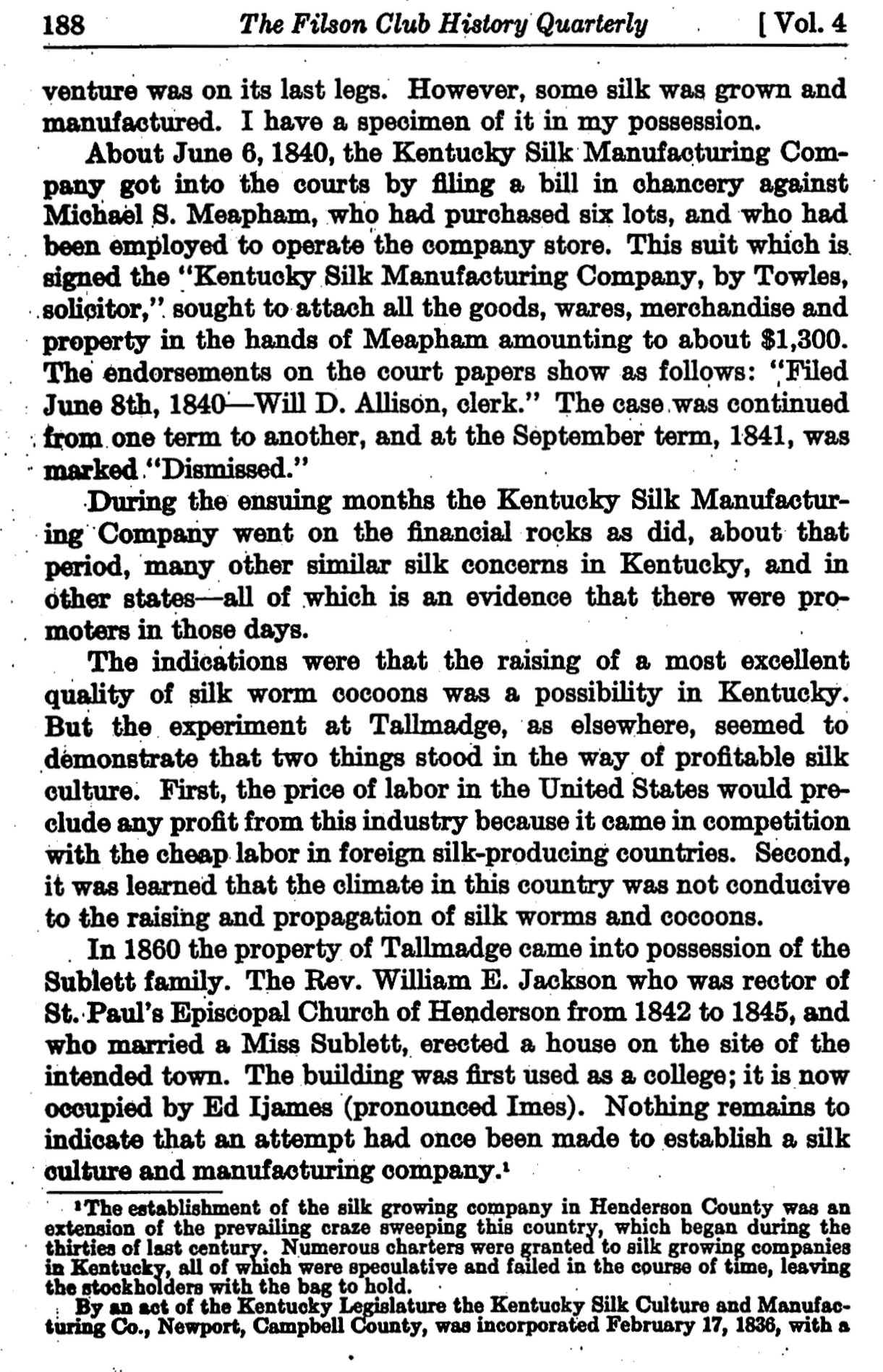
About June 6, 1840, the Kentucky Silk Manufacturing Company got into the courts by filing a bill in chancery against Michael S. Meapham, who had purchased six lots, and who had been employed to operate the company store. This suit which is signed the “Kentucky Silk Manufacturing Company, by Towles, solicitor,” sought to attach all the goods, wares, merchandise and property in the hands of Meapham amounting to about $1,300. The endorsements on the court papers show as follows: “Filed June 8th, 1840—Will D. Allison, clerk.” The case was continued from one term to another, and at the September term, 1841, was marked “Dismissed.”
During the ensuing months the Kentucky Silk Manufacturing Company went on the financial rocks as did, about that period, many other similar silk concerns in Kentucky, and in other states—all of which is an evidence that there were promoters in those days.
The indications were that the raising of a most excellent quality of silk worm cocoons was a possibility in Kentucky. But the experiment at Tallmadge, as elsewhere, seemed to demonstrate that two things stood in the way of profitable silk culture. First, the price of labor in the United States would preclude any profit from this industry because it came in competition with the cheap labor in foreign silk-producing countries. Second, it was learned that the climate in this country was not conducive to the raising and propagation of silk worms and cocoons.
In 1860 the property of Tallmadge came into possession of the Sublett family. The Rev. William E. Jackson who was rector of St. Paul’s Episcopal Church of Henderson from 1842 to 1845, and who married a Miss Sublett, erected a house on the site of the intended town. The building was first used as a college; it is now occupied by Ed Ijames (pronounced Imes). Nothing remains to indicate that an attempt had once been made to establish a silk culture and manufacturing company.¹
Footnote (pages 188-189)
¹ The establishment of the silk growing company in Henderson County was an extension of the prevailing craze sweeping this country, which began during the thirties of last century. Numerous charters were granted to silk growing companies in Kentucky, all of which were speculative and failed in the course of time, leaving the stockholders with the bag to hold.
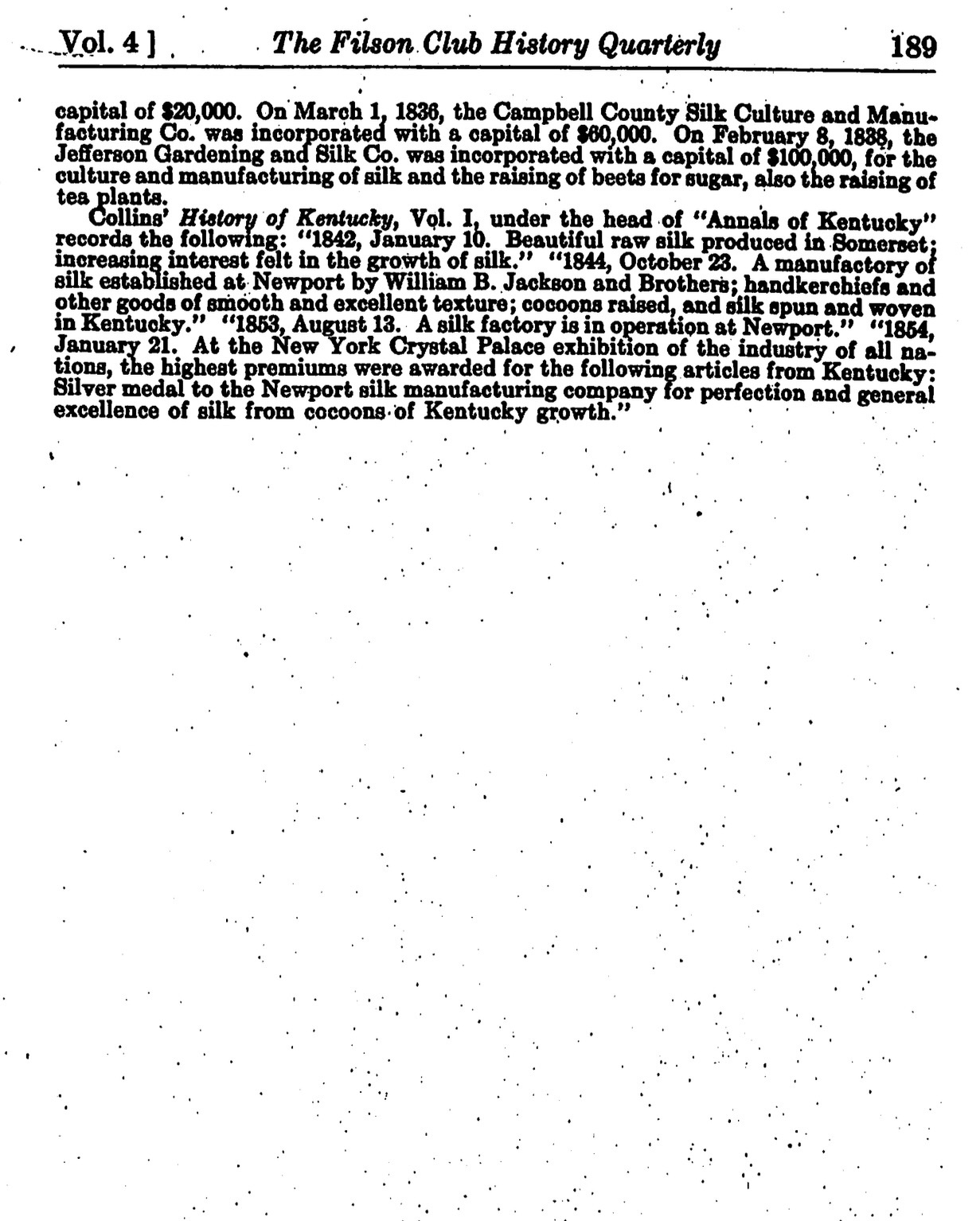
By an act of the Kentucky Legislature the Kentucky Silk Culture and Manufacturing Co., Newport, Campbell County, was incorporated February 17, 1836, with a capital of $20,000. On March 1, 1836, the Campbell County Silk Culture and Manufacturing Co. was incorporated with a capital of $60,000. On February 8, 1838, the Jefferson Gardening and Silk Co. was incorporated with a capital of $100,000, for the culture and manufacturing of silk and the raising of beets for sugar, also the raising of tea plants.
Collins’ History of Kentucky, Vol. I, under the head of “Annals of Kentucky” records the following: “1842, January 10. Beautiful raw silk produced in Somerset; increasing interest felt in the growth of silk.” “1844, October 23. A manufactory of silk established at Newport by William B. Jackson and Brothers; handkerchiefs and other goods of smooth and excellent texture; cocoons raised, and silk spun and woven in Kentucky.” “1853, August 13. A silk factory is in operation at Newport.” “1854, January 21. At the New York Crystal Palace exhibition of the industry of all nations, the highest premiums were awarded for the following articles from Kentucky: Silver medal to the Newport silk manufacturing company for perfection and general excellence of silk from cocoons of Kentucky growth.”
Source: The Filson Club History Quarterly, Vol. 4, pp. 184-189.
Leave a Reply