Noakes Alley and the Man Behind Its Name
Between First and Second Streets in Henderson is an alley with a name many people have never heard: Noakes Alley. Current street signs and maps do not identify it by that name, but older maps and newspaper accounts do.
The alley was named for Jonas Noakes, who once owned property there. Noakes was a cooper, a craftsman who made wooden barrels. Records of his business and family help explain the man whose surname became part of the neighborhood’s geography.
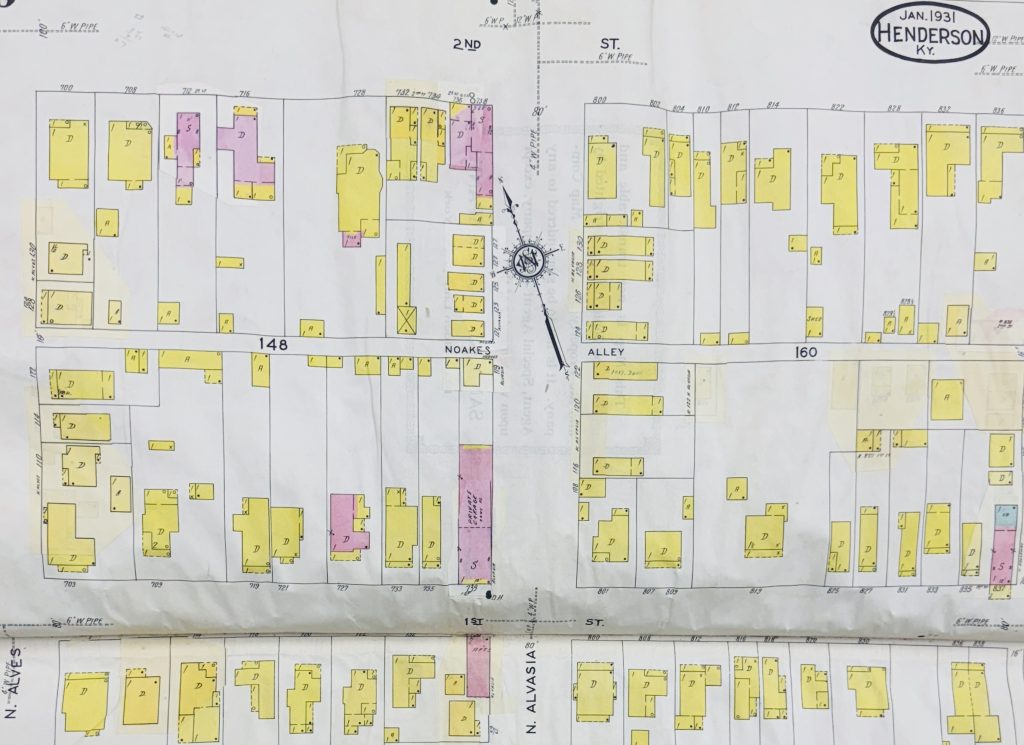
A Sanborn fire insurance map dated January 1931 labels the passage “NOAKES ALLEY.” It shows the alley crossing Alvasia Street, behind houses fronting First and Second streets. Along the passage are smaller buildings and rear portions of residential lots. The map marks the alley as sixteen feet wide.
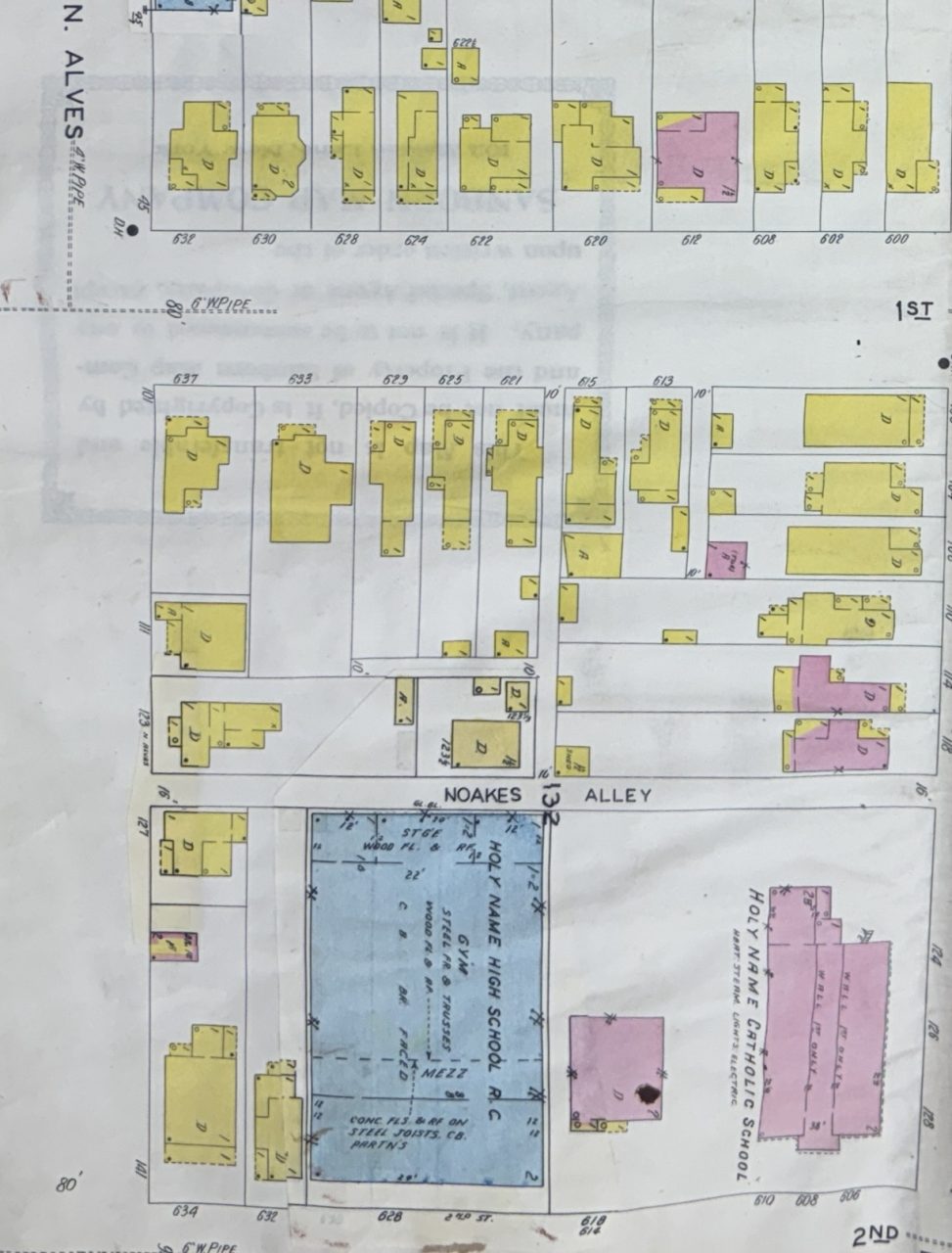
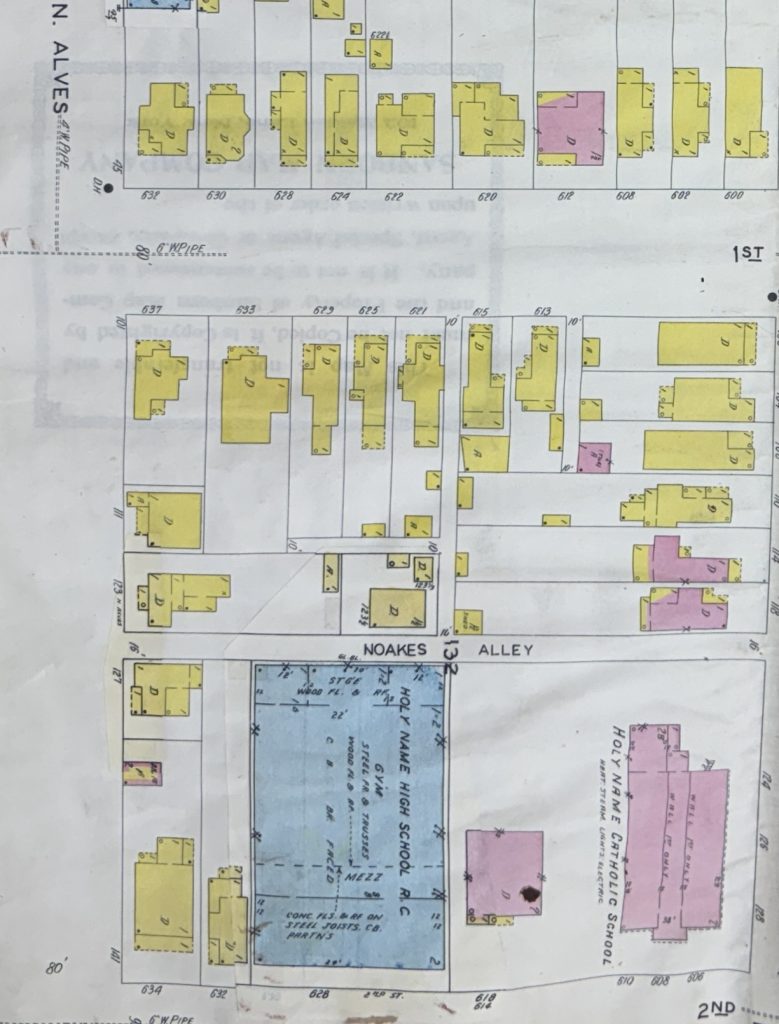
Another surviving map extract carries the same name beside the grounds of Holy Name High School and Holy Name Catholic School. The name appears on more than one map sheet, identifying a passage through several blocks of the neighborhood.
The 1880 census index places Jonas Noakes on Second Street with his wife, Mary E. Noakes. He was listed as fifty-four years old and born in Indiana, placing his birth around 1826.
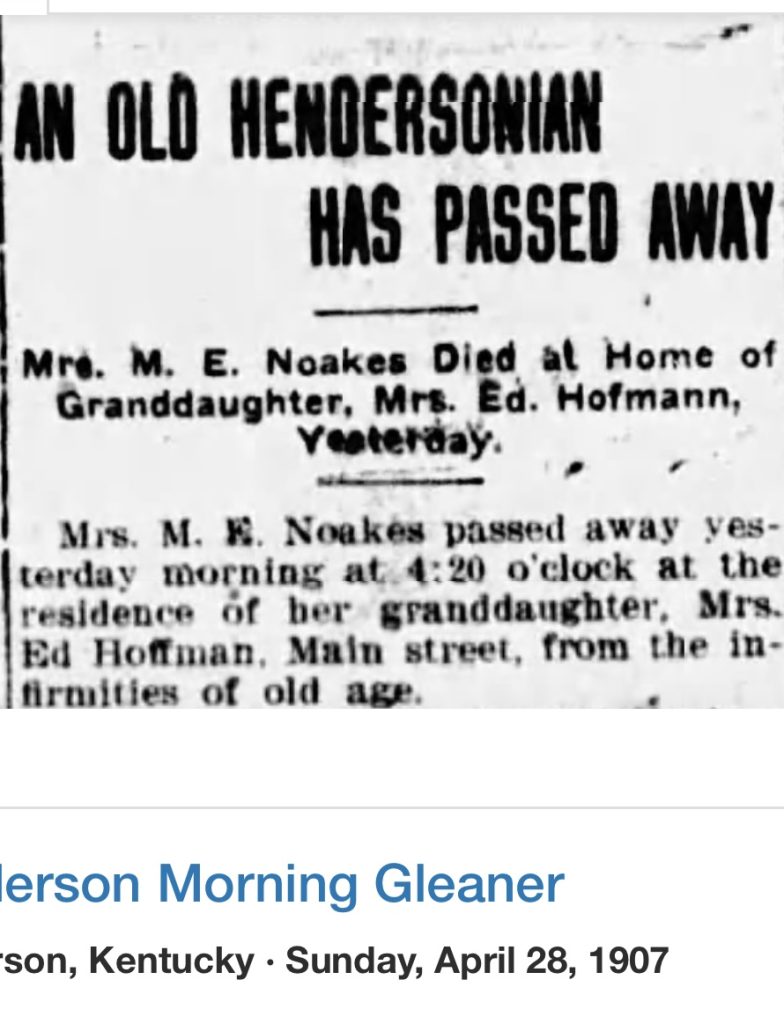
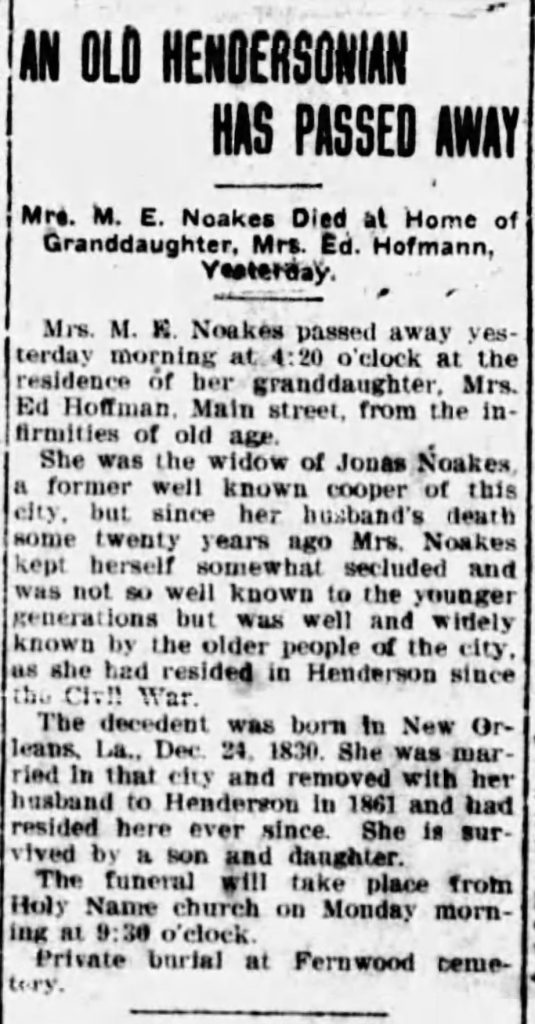
Mary’s obituary provides an earlier chapter in their lives. She was born in New Orleans on December 24, 1830, and married Jonas there. In 1861, the couple moved to Henderson, where she remained for the rest of her life. Their arrival came during the opening year of the Civil War.
The deeds place Jonas in the neighborhood as a property owner by September 1865. A conveyance recorded in Deed Book U, page 358, transferred a lot on Second Street from Francis Millet and his wife, Mary, to Jonas Noakes. The property had come through a division of the estate of Wyatt H. Ingram.
On February 24, 1866, Jonas and Mary E. Noakes conveyed that lot to William Ingram. Recorded in Deed Book U, page 477, the deed refers back to the earlier purchase and describes a lot fronting Second Street and extending more than two hundred feet back. These transactions document a particular Noakes holding; later records place the family’s name on other nearby parcels.
The Kentucky State Gazetteer and Business Directory for 1881–1882 identifies him in a brief entry: “Noakes Jonas, cooper, 2d.” The same directory describes Henderson as a center of river trade, with tobacco its principal export. Barrel making was a practical trade in such a town, and a local newspaper welcomed Noakes’s plans to expand his capacity.
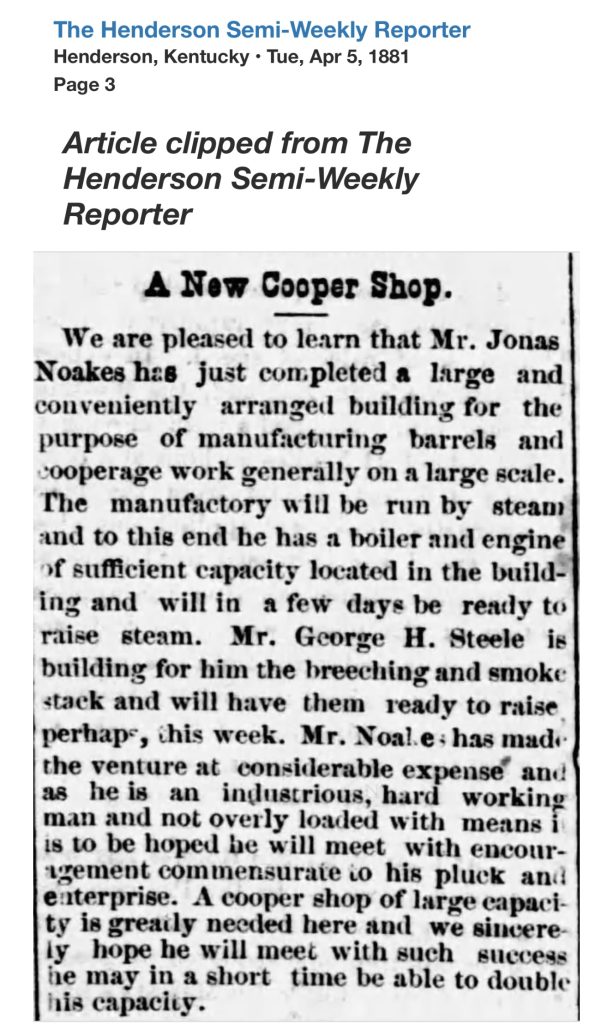
On April 5, 1881, the Henderson Semi-Weekly Reporter published an item headed “A New Cooper Shop.” Noakes had completed a large building arranged for manufacturing barrels and carrying out cooperage work on a substantial scale.
The shop was being prepared for steam power. A boiler and engine were already inside, and George H. Steele was building the breeching and smokestack. The newspaper expected the equipment to be ready to raise steam within a few days.
The account also offered an unusually personal description of the proprietor. Noakes had undertaken the project at considerable expense. The paper called him an “industrious, hard working man” who was “not overly loaded with means,” and urged encouragement for his enterprise. It hoped he would succeed well enough to double the shop’s capacity.
Jonas died roughly two decades before Mary. Her 1907 obituary described his death as having occurred “some twenty years ago,” suggesting a date around 1887. It remembered him as a formerly well-known Henderson cooper.
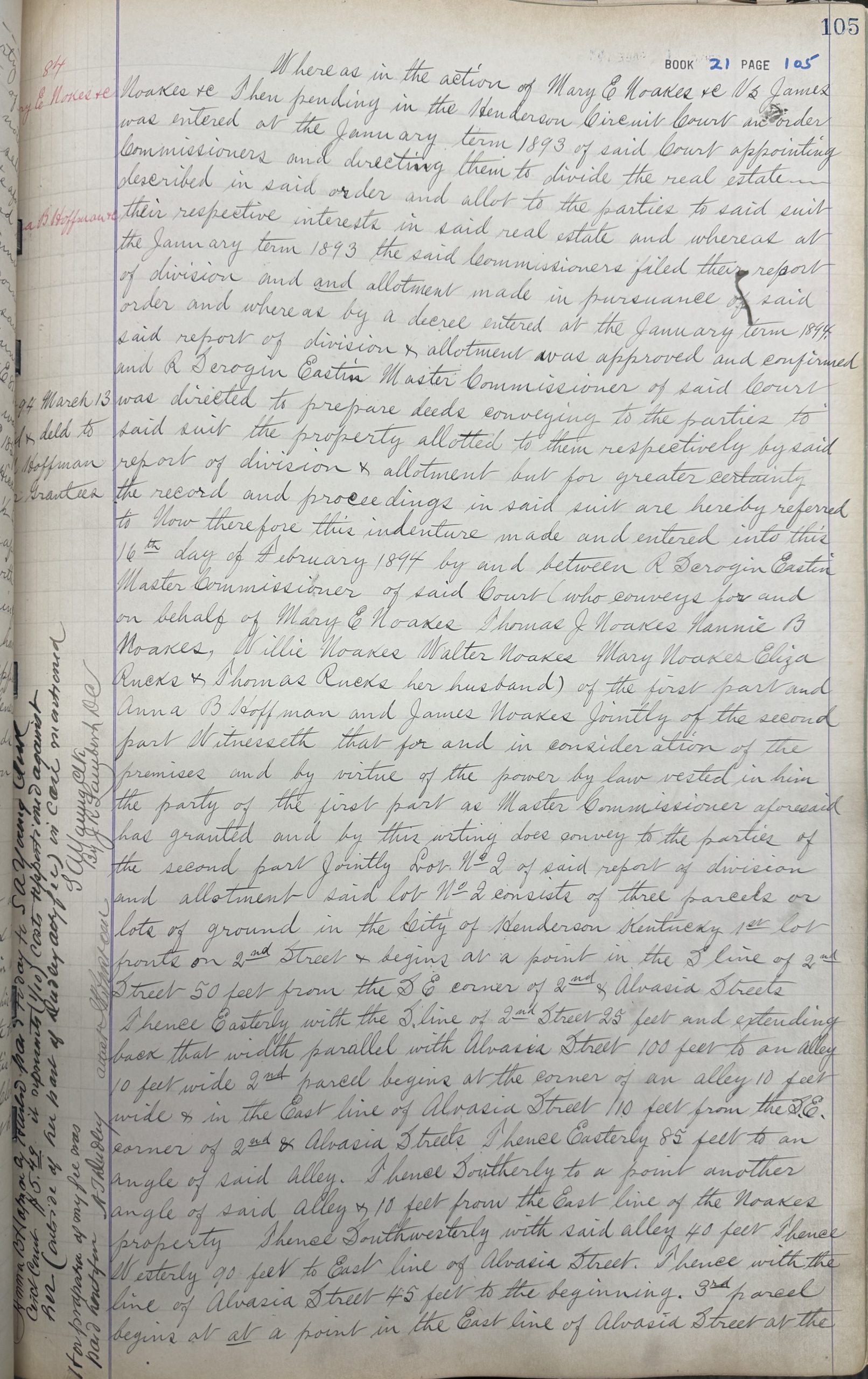
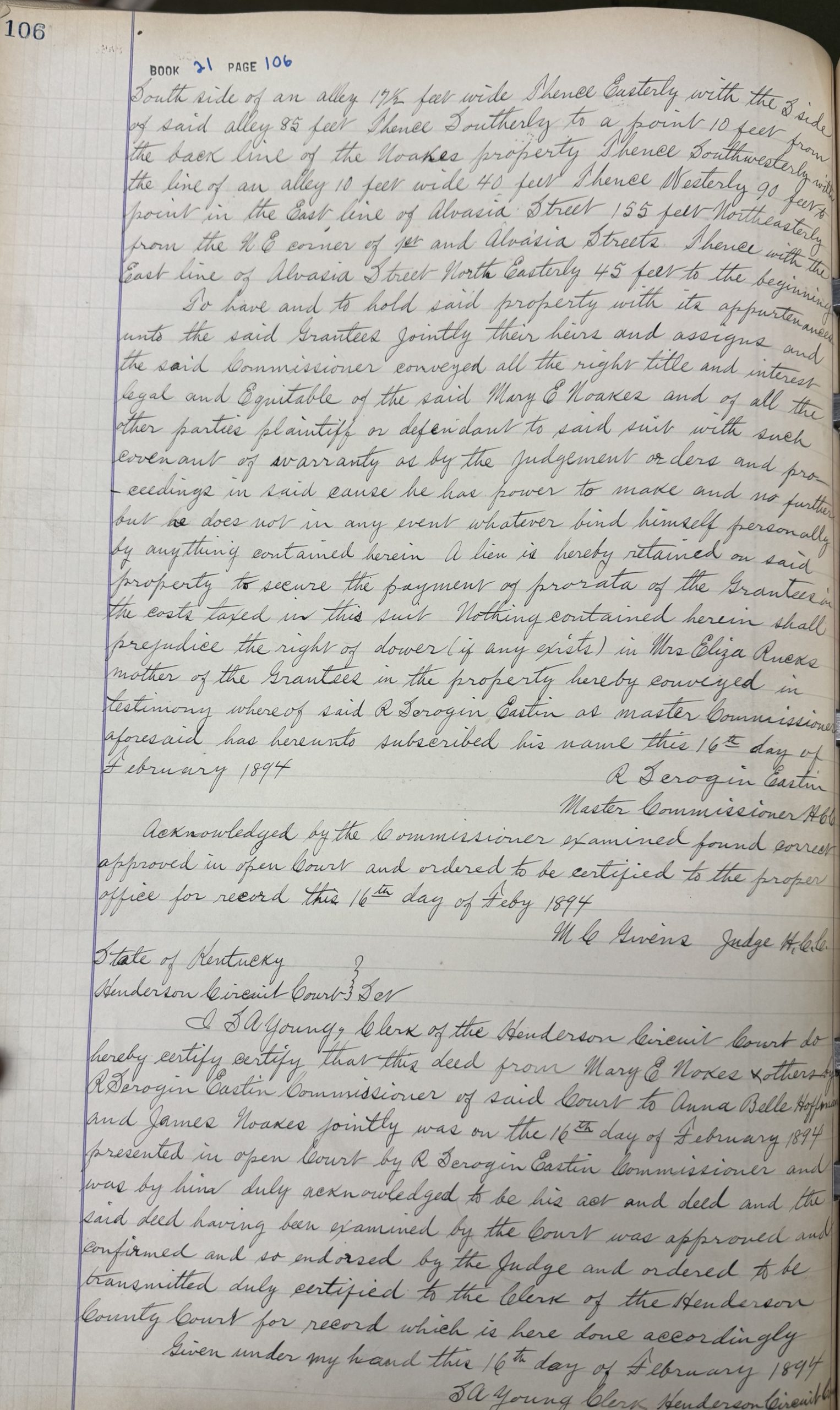
The family’s real estate appears again in a court-ordered division during the 1890s. A deed dated February 16, 1894, refers to the case of Mary E. Noakes and others against James Noakes and others. Following a division begun under court orders in 1893 and approved in 1894, the court’s master commissioner conveyed three parcels jointly to Anna Belle Hoffman and James Noakes.
The descriptions provide a close look at the arrangement of property near Second and Alvasia streets. One parcel had twenty-five feet of frontage on Second Street and extended one hundred feet to an alley ten feet wide. Other boundaries followed turns in an alley near Alvasia and referred to an eleven-and-a-half-foot alley. The deed does not name these passages, but it shows how accessways behind the street-front lots formed part of the family’s property boundaries.
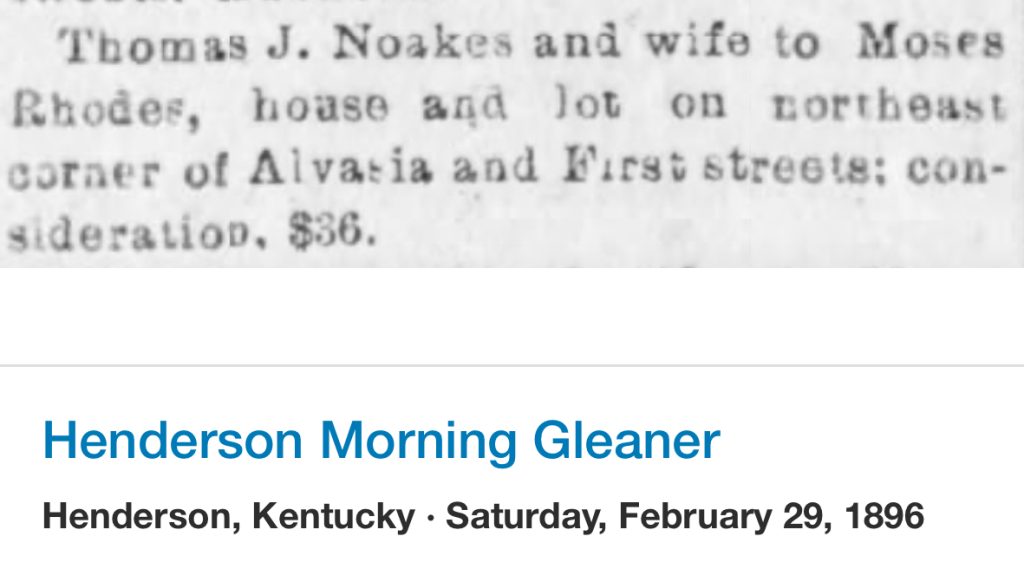
The Noakes surname also continued to appear in property sales. On February 29, 1896, the Henderson Morning Gleaner reported a transfer from Thomas J. Noakes and his wife to Moses Rhodes of a house and lot at the northeast corner of Alvasia and First streets. The county’s conveyance index identifies Thomas’s wife in that transaction as Lily and points to Deed Book 24, page 42.
Mary died on April 27, 1907, at the Main Street home of her granddaughter, Mrs. Ed Hofmann. The obituary said she had lived somewhat privately after Jonas’s death and was better known to older residents than to the younger generation. She was survived by a son and a daughter. Her funeral was to be held at Holy Name Church, with private burial at Fernwood Cemetery.
The conveyance index also records a 1907 transfer of property at Second and Alvasia from the estate of Mary E. Noakes, through an administrator, to J. L. Dorsey. It directs researchers to Deed Book 39, page 591, providing a connection between the family’s property records and a newspaper notice the following year.
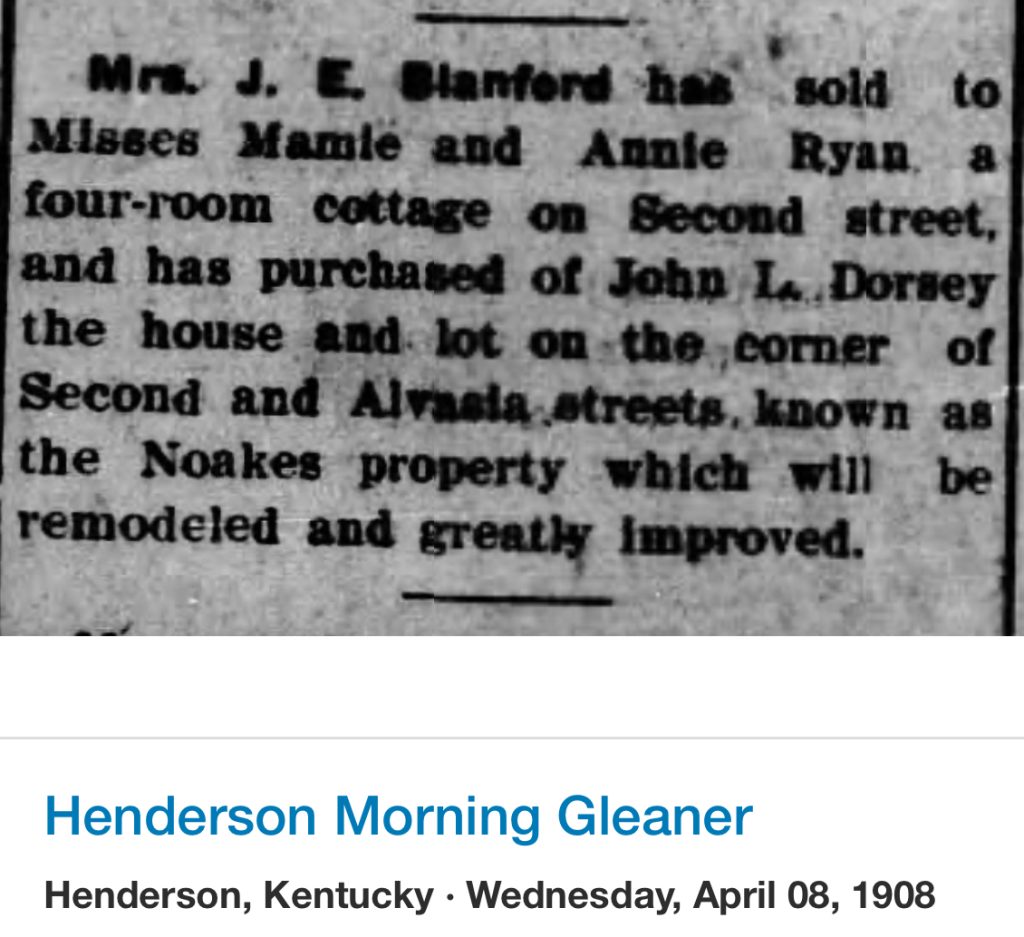
On April 8, 1908, the Gleaner reported that Mrs. J. E. Blanford had purchased a house and lot at the corner of Second and Alvasia streets from John L. Dorsey. The newspaper identified it as the “Noakes property” and said it would be remodeled and greatly improved.
That description shows how a former owner’s name could remain attached to a place after it changed hands. The house had a new purchaser, but readers were still expected to recognize it by the Noakes name.
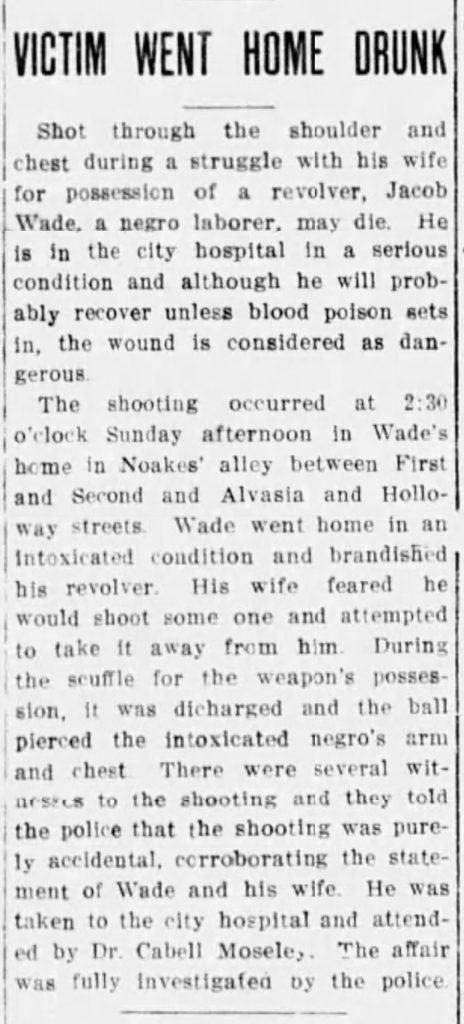
The alley itself also served as an address. An undated newspaper clipping headed “Victim Went Home Drunk” placed the home of Jacob Wade in “Noakes’ alley,” between First and Second streets and Alvasia and Holloway streets.
According to that account, Wade was injured when a revolver discharged during a struggle with his wife, who had tried to take the weapon from him. Witnesses described the shooting as accidental. He was taken to the city hospital and treated by Dr. Cabell Moseley. For the alley’s history, the report is especially useful because it gives both a resident’s name and a clear description of the location.
By the time the January 1931 map was drawn, Jonas Noakes had been dead for decades. His name nevertheless remained on the map, crossing the neighborhood where it had become familiar.
Today, the absence of a sign makes the name easy to miss. The older records preserve it, along with a little of the life of the Henderson barrel maker behind it. The next time you pass the alley between First and Second Streets, you have a name to put to the place: Noakes Alley.
Sources:
Sanborn fire insurance map of Henderson dated January 1931
1880 United States census indexed record for Jonas Noakes
Kentucky State Gazetteer and Business Directory 1881–1882, Volume III, Part 1, Henderson listings.
“A New Cooper Shop,” Henderson Semi-Weekly Reporter, April 5, 1881, page 3.
Property transfer notice, Henderson Morning Gleaner, February 29, 1896.
“An Old Hendersonian Has Passed Away,” Henderson Morning Gleaner, April 28, 1907.
Property notice concerning Mrs. J. E. Blanford and the Noakes property, Henderson Morning Gleaner, April 8, 1908.
“Victim Went Home Drunk,” newspaper clipping.
Henderson County Deed Book U, page 358, September 1865, Francis Millet/Millett and wife Mary to Jonas Noakes.
Henderson County Deed Book U, page 477, February 24, 1866, Jonas and Mary E. Noakes to William Ingram.
Henderson County Deed Book 21, pages 105–106, February 16, 1894, court-ordered conveyance to Anna Belle Hoffman and James Noakes.
Leave a Reply