In the fall of 1924, lessons at Three Mile School paused while teacher Audie Folwell and her pupils scrubbed the floors and walls. Outside, the district’s trustee brought his team and mowing machine to clear weeds, while other men replaced worn boards. The one-room school south of Henderson was getting a fresh start.[1]
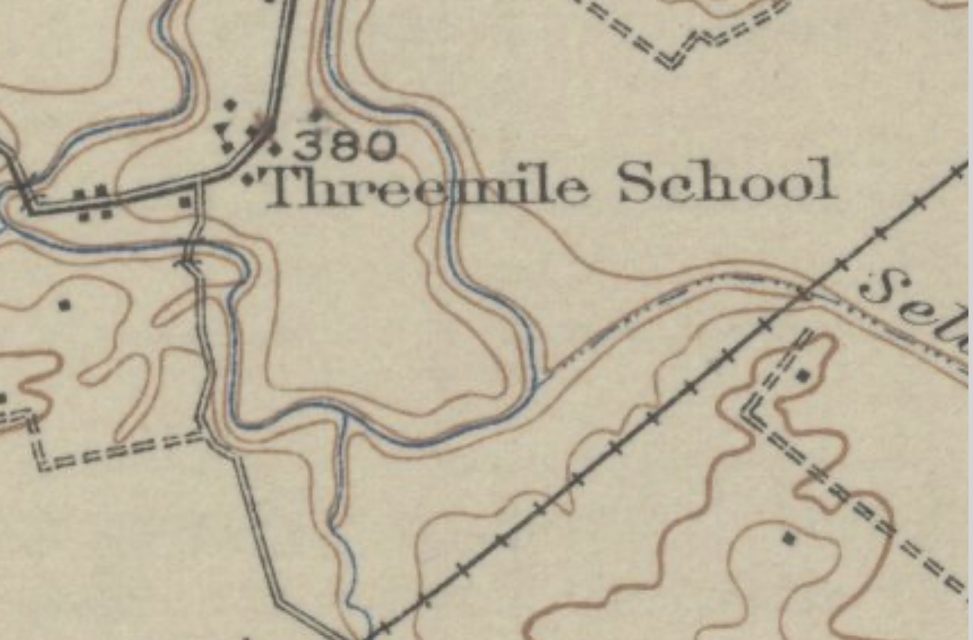
Known as Three Mile School or Three Mile House School, it stood on the Corydon road near Three Mile House. A U.S. Geological Survey map from a 1914 survey labels “Threemile School” near Canoe Creek. Comparing the creek and road bends with a modern Kentucky Transportation Cabinet map points to today’s South Collier Road. This establishes the vicinity, although an exact modern address remains unconfirmed. [2, 3, 4]
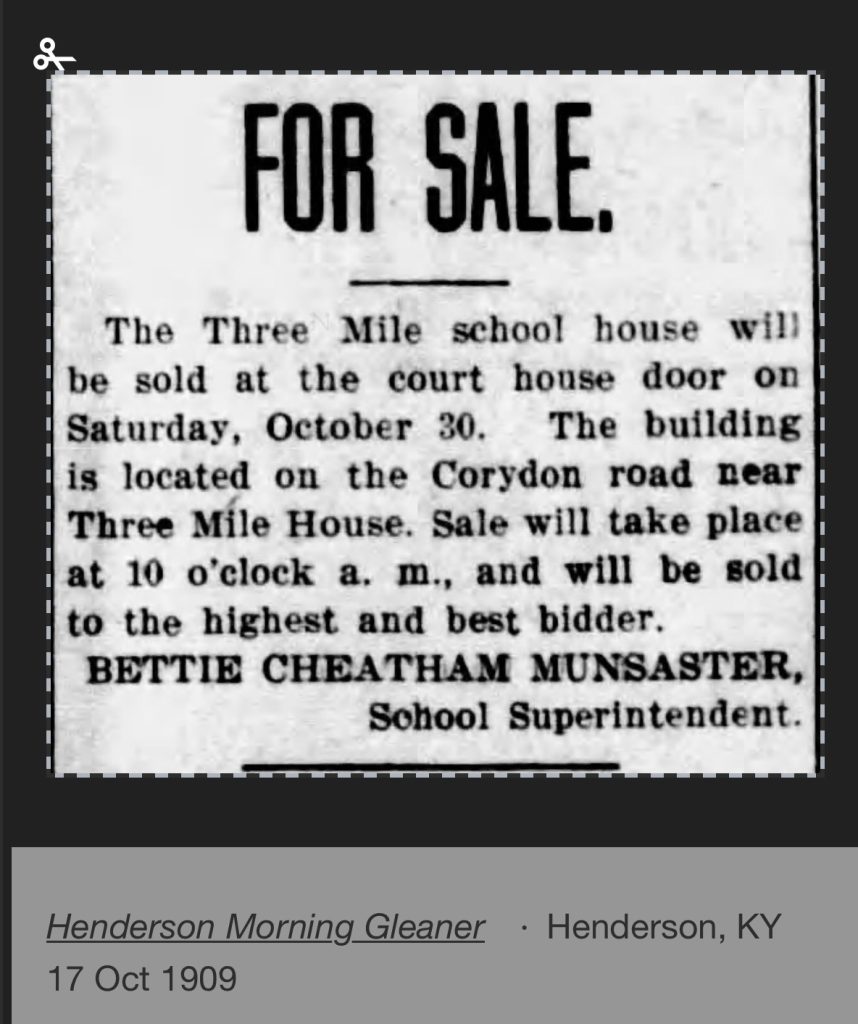
An October 17, 1909, Henderson Morning Gleaner advertisement announced that county superintendent Bettie Cheatham Muncaster would offer the schoolhouse for sale at the courthouse door on October 30 at 10 a.m. The notice does not establish that the sale occurred, and later reports show Three Mile continued operating. [4, 5, 6]
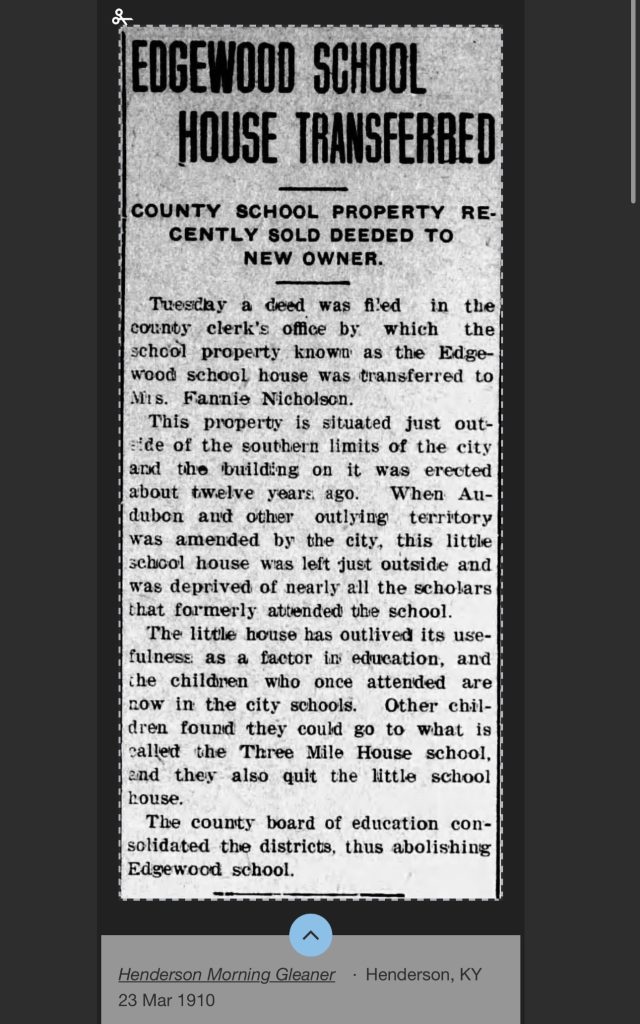
Henderson’s growth brought changes to nearby schools. On March 23, 1910, the Gleaner reported the transfer of Edgewood’s former school property to Mrs. Fannie Nicholson. Annexation of Audubon and other territory had drawn away nearly all its pupils. Some entered city schools; others went to Three Mile. The county consolidated the districts and abolished Edgewood. [5]
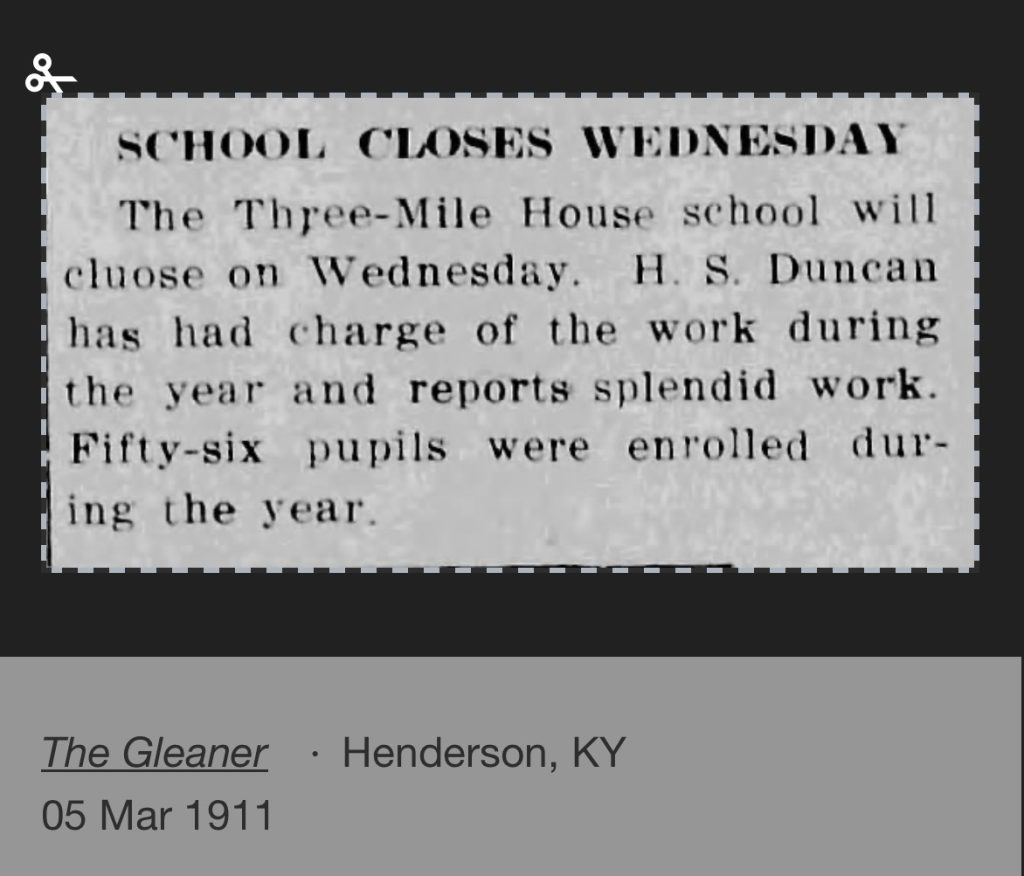
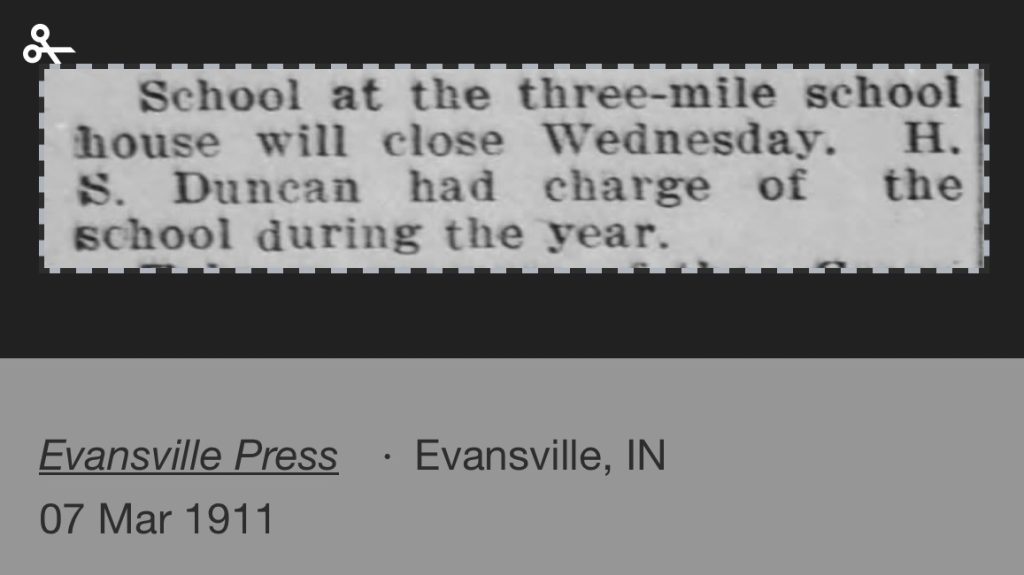
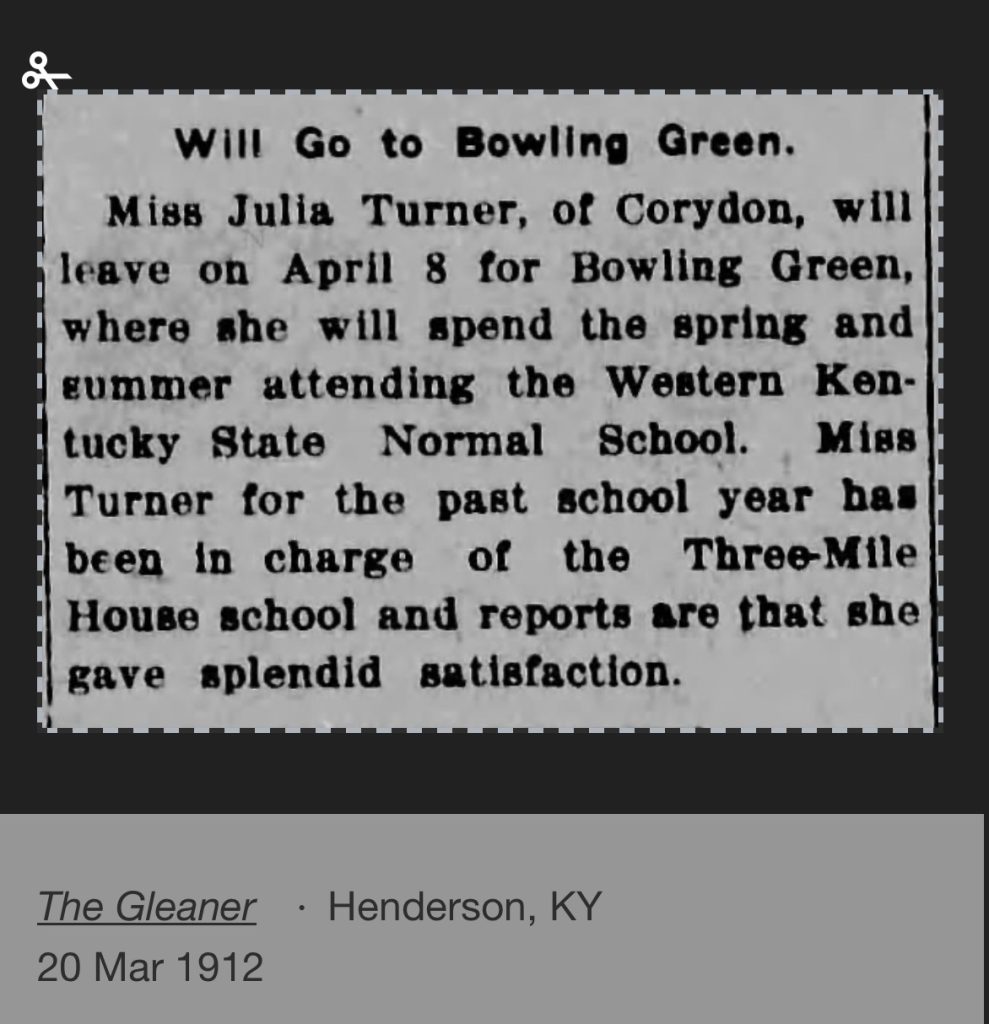
H. S. Duncan taught at Three Mile during 1910–1911, when fifty-six pupils enrolled. March 1911 reports announced the term’s end the following Wednesday. A March 20, 1912, notice identified Julia Turner of Corydon as the preceding year’s teacher. She planned to leave April 8 for spring and summer study at Western Kentucky State Normal School in Bowling Green. [6, 7]
Folwell’s improvements drew fuller coverage on November 1, 1924, under the headline “Progressive Air at 3 Mile House.” The previously unpainted schoolhouse received fresh paint, its outbuildings were repaired, and tall weeds disappeared from the yard. An American flag flew above the school, where children studied and discussed lessons with their teacher. The renewed property attracted attention along the Ohio River Route. Many pupils attended only the lower grades before entering Henderson’s city schools. [1]
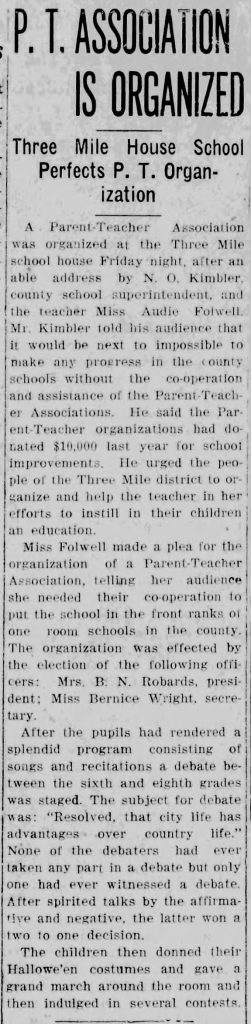
The next day’s Gleaner reported a Parent-Teacher Association organized at a Friday-night gathering. Superintendent N. O. Kimbler urged parents to support their schools, and Folwell asked their help in making Three Mile a leading one-room school. Mrs. B. N. Robards became president; Bernice Wright was elected secretary. [8]
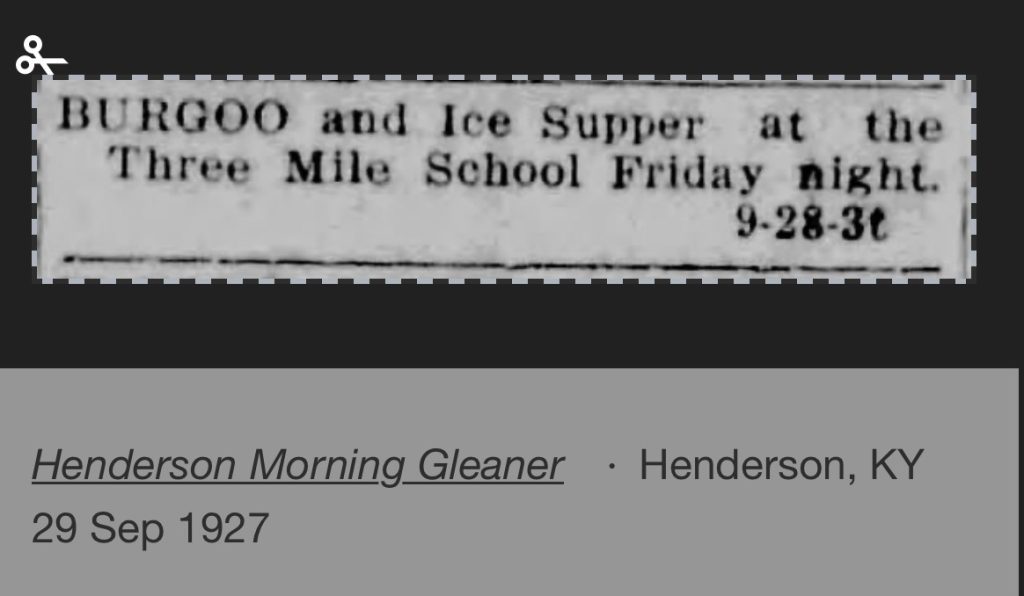
Pupils performed songs and recitations, then sixth and eighth graders debated whether city life offered advantages over country life. None had debated before, and only one had witnessed a debate. The opposing side won two to one. Halloween costumes, a march around the room, and contests followed. The program also confirms instruction through at least eighth grade. A September 29, 1927, advertisement announced another gathering: a Friday-night burgoo and ice supper. [8, 9]
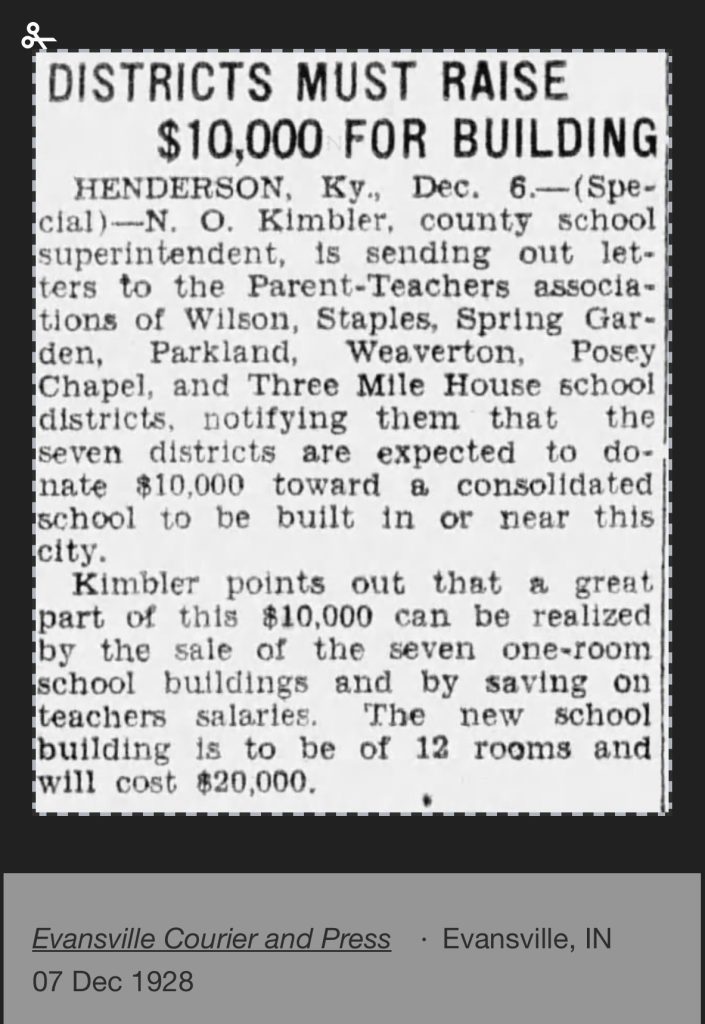
Consolidation plans emerged by December 1928. Kimbler wrote to parent-teacher associations in seven districts—Wilson, Staples, Spring Garden, Parkland, Weaverton, Posey Chapel, and Three Mile House—seeking a combined $10,000 toward a proposed twelve-room school costing $20,000. He suggested selling the seven one-room buildings and using savings on teachers’ salaries to help meet the contribution. These figures described the proposal, rather than a verified final cost. [10]
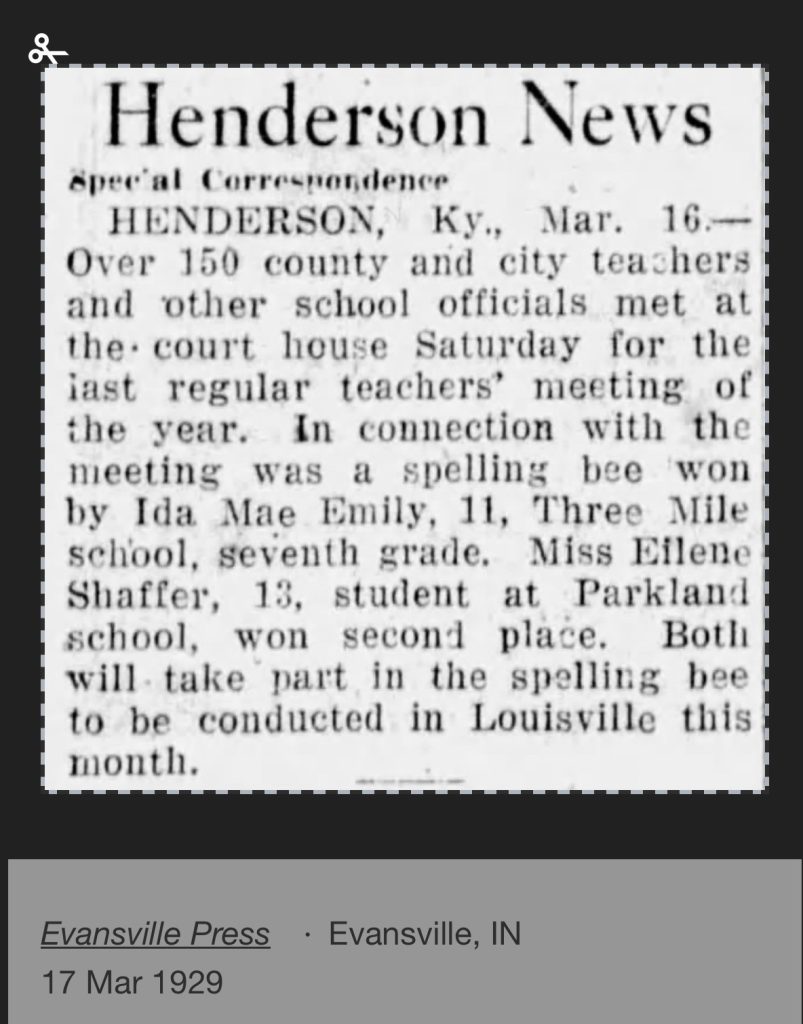
Meanwhile, Three Mile celebrated a pupil’s achievement. At a March 16, 1929, courthouse gathering of more than 150 teachers and school officials, eleven-year-old seventh grader Ida Mae Emily won a spelling bee. Eilene Shaffer, thirteen, of Parkland placed second. The Evansville Press reported that both girls would compete in Louisville later that month. [11]
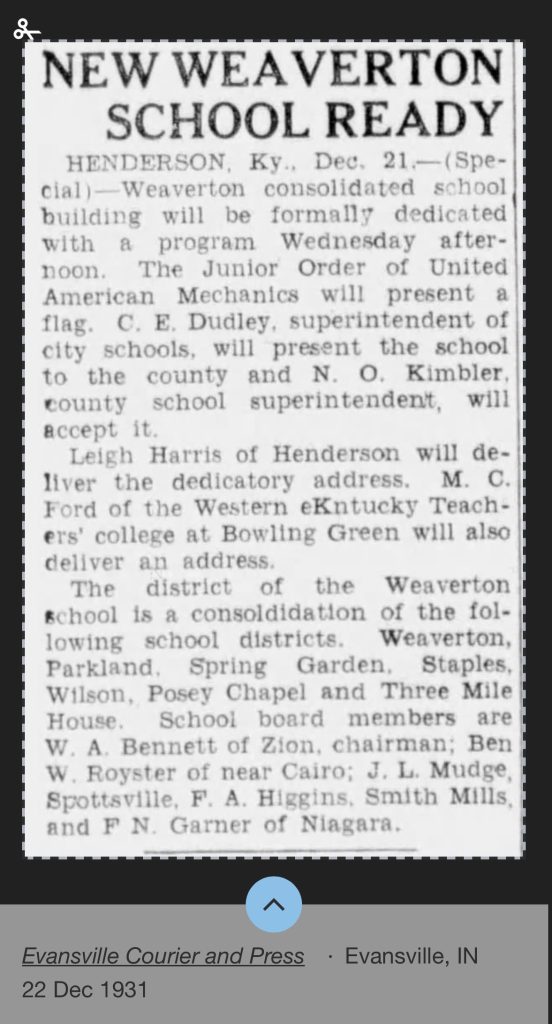
The new Weaverton School brought the seven districts together in 1931. A December 22 newspaper report announced its dedication for the following afternoon. The scheduled program included a flag presentation by the Junior Order of United American Mechanics, presentation of the school to the county by city superintendent C. E. Dudley, and acceptance by Kimbler. Leigh Harris was to deliver the dedicatory address, with M. C. Ford of Western Kentucky Teachers’ College also speaking. HistoricHenderson’s account, drawing on Frank Boyett’s reporting, records that Weaverton began with eleven teachers and 575 students. [12, 13]
Three Mile’s founding date, final day of classes, and building’s fate remain uncertain. Its newspaper record preserves something more personal: teachers pursuing further education, neighbors repairing their school, parents organizing, and children debating, celebrating, and competing. Their district’s inclusion in Weaverton carried that small-school history into a larger chapter of Henderson County education. [1, 7, 8, 11, 12]
Historical map
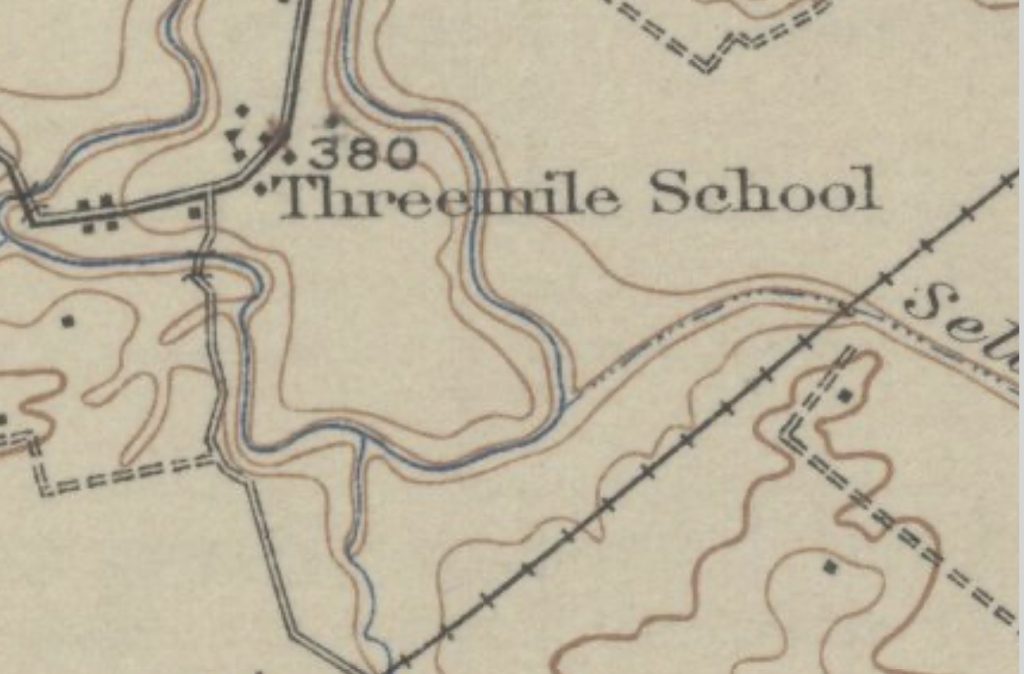
“Three mile School” by a road and creek on the USGS Henderson quadrangle (1914 survey, 1916 edition).
Sources:
1. Henderson Morning Gleaner, November 1, 1924, “Progressive Air at 3 Mile House.”
2. U.S. Geological Survey, Henderson quadrangle (survey 1914; edition 1916, reprint 1947). Perry-Castañeda Library Map Collection, University of Texas at Austin.
3. Kentucky Transportation Cabinet, State Primary Road System: Henderson, Henderson County, map revised January 2019. South Collier Road, Canoe Creek, and the railroad corridor.
4. Henderson Morning Gleaner, October 17, 1909, “For Sale.”
5. Henderson Morning Gleaner, March 23, 1910, “Edgewood School House Transferred.”
6. The Gleaner, March 5, 1911, “School Closes Wednesday”; Evansville Press, March 7, 1911, Three Mile school-term notice.
7. The Gleaner, March 20, 1912, “Will Go to Bowling Green.”
8. Henderson Morning Gleaner, November 2, 1924, “P. T. Association Is Organized.”
9. Henderson Morning Gleaner, September 29, 1927, advertisement for a burgoo and ice supper at Three Mile School.
10. Evansville Courier and Press, December 7, 1928, “Districts Must Raise $10,000 for Building.”
11. Evansville Press, March 17, 1929, “Henderson News,” reporting the March 16 teachers’ meeting and spelling bee.
12. Evansville Courier and Press, December 22, 1931, “New Weaverton School Ready.”
13. Frank Boyett’s October 26, 2019 history of Weaverton School.

Leave a Reply