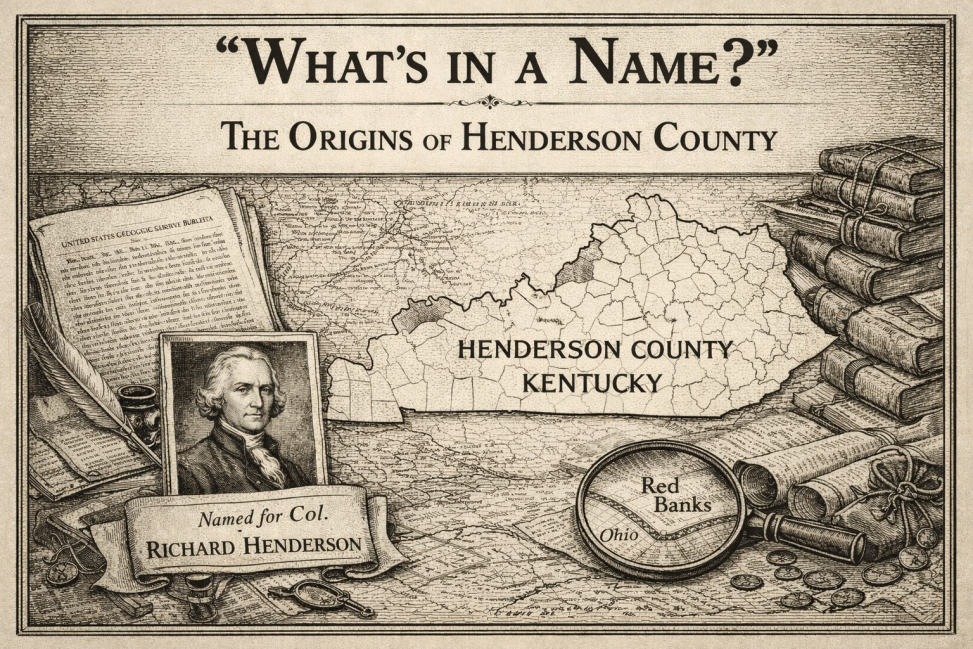
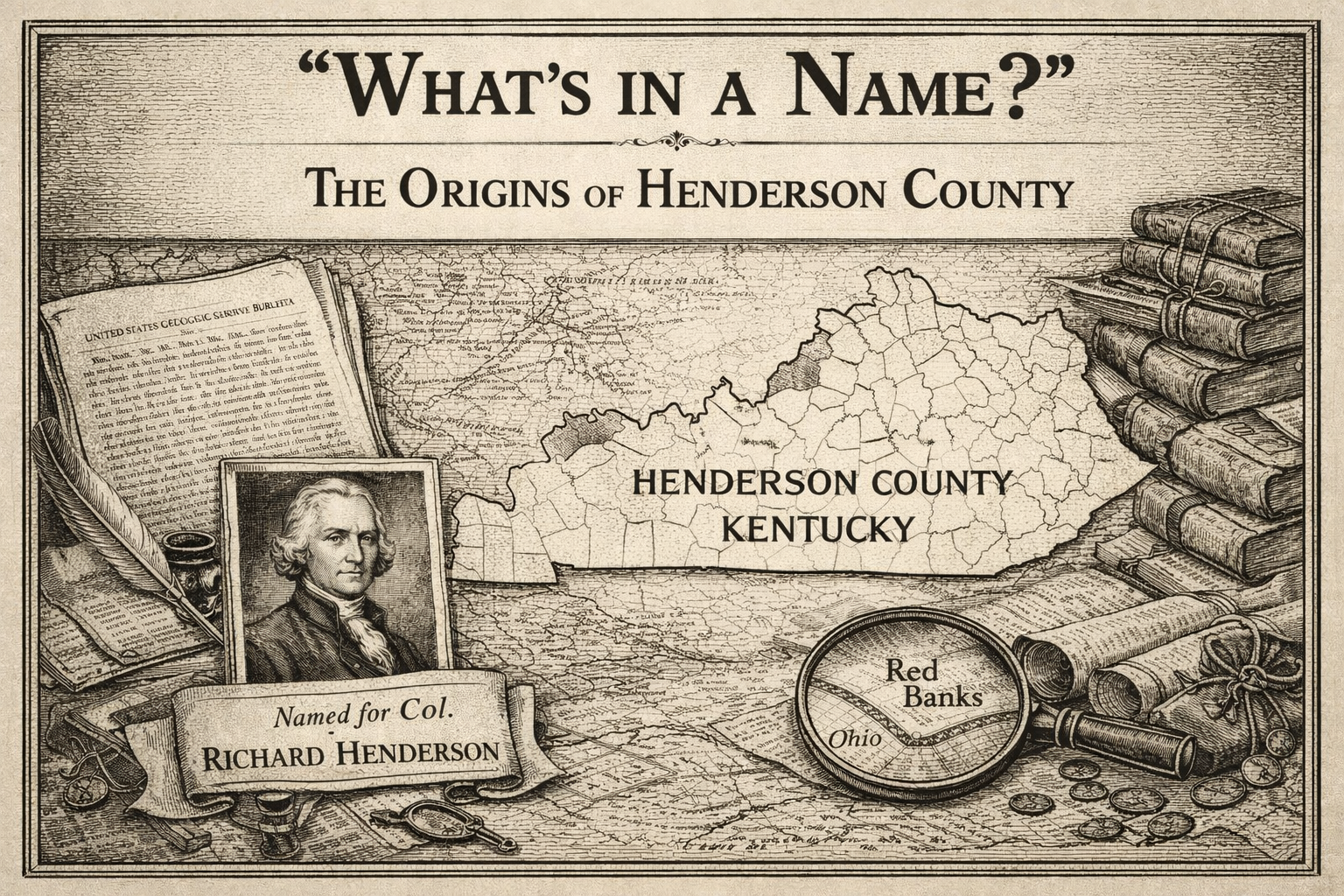
Long before it appeared on maps as Henderson, the settlement along the Ohio River was known as Red Banks, named for the reddish clay bluffs rising above the water. In 1797, the town was formally laid out by Samuel Hopkins and surveyor Thomas Allin on land associated with the former Transylvania Company, a speculative enterprise tied to Judge Richard Henderson. Though Henderson’s original 1775 land purchase from the Cherokee was later voided by Virginia, the company was compensated with a substantial land grant at the mouth of the Green River. From this grant emerged Henderson County in 1798, and the town that followed took its name in honor of Richard Henderson.
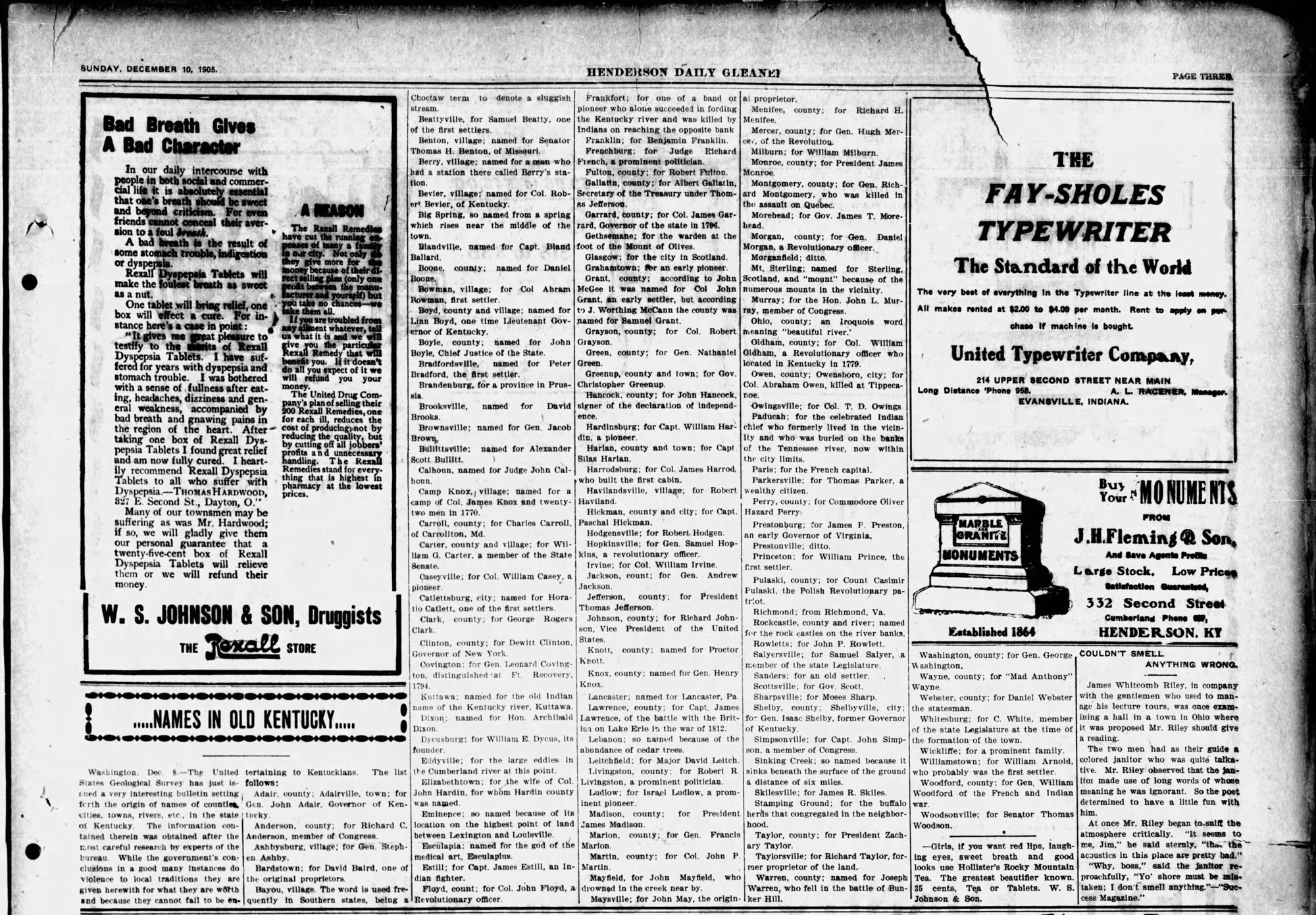
Ever wonder where other county and city names come from? Below is a list found in the Henderson Daily Gleaner of Sunday, December 10, 1905:
The United States Geological Survey has just issued a very interesting bulletin setting forth the origin of names of counties, cities, towns, rivers, etc., in the state of Kentucky. The information contained therein was obtained after the most careful research by experts of the bureau. While the government’s conclusions in a good many instances do violence to local traditions they are given herewith for what they are worth and because they cannot fail to be entertaining to Kentuckians. The list follows:
Adair, county; Adairville, town; for Gen. John Adair, Governor of Kentucky.
Anderson, county; for Richard C. Anderson, member of Congress.
Ashbysburg, village; for Gen. Stephen Ashby.
Bardstown; for David Baird, one of the original proprietors.
Bayou, village. The word is used frequently in Southern states, being a Choctaw term to denote a sluggish stream.
Beattyville, for Samuel Beatty, one of the first settlers.
Benton, village; named for Senator Thomas H. Benton, of Missouri.
Berry, village; named for a man who had a station there called Berry’s station.
Bevier, village; named for Col. Robert Bevier, of Kentucky.
Big Spring, so named from a spring which rises near the middle of the town.
Blandville, named for Capt. Bland Ballard.
Boone, county; named for Daniel Boone.
Bowman, village; for Col. Abram Bowman, first settler.
Boyd, county and village; named for Linn Boyd, one time Lieutenant Governor of Kentucky.
Boyle, county; named for John Boyle, Chief Justice of the State.
Bradfordsville, named for Peter Bradford, the first settler.
Brandenburg, for a province in Prussia.
Brooksville, named for David Brooks.
Brownsville; named for Gen. Jacob Brown.
Bullittsville; named for Alexander Scott Bullitt.
Calhoun, named for Judge John Calhoun.
Camp Knox, village; named for a camp of Col. James Knox and twenty-two men in 1770.
Carroll, county; for Charles Carroll, of Carrollton, Md.
Carter, county and village; for William G. Carter, a member of the State Senate.
Caseyville; for Col. William Casey, a pioneer.
Catlettsburg, city; named for Horatio Catlett, one of the first settlers.
Clark, county; for George Rogers Clark.
Clinton, county; for Dewitt Clinton, Governor of New York.
Covington; for Gen. Leonard Covington, distinguished at Ft. Recovery, 1794.
Kuttawa; named for the old Indian name of the Kentucky river, Kuttawa.
Dixon; named for Hon. Archibald Dixon.
Dycusburg; for William E. Dycus, its founder.
Eddyville; for the large eddies in the Cumberland river at this point.
Elizabethtown; for the wife of Col. John Hardin, for whom Hardin county was named.
Eminence; so named because of its location on the highest point of land between Lexington and Louisville.
Esculapia; named for the god of the medical art, Esculapius.
Estill; for Capt. James Estill, an Indian fighter.
Floyd, county; for Col. John Floyd, a Revolutionary officer.
Frankfort; for one of a band of pioneer who alone succeeded in fording the Kentucky river and was killed by Indians on reaching the opposite bank.
Franklin; for Benjamin Franklin.
Frenchburg; for Judge Richard French, a prominent politician.
Fulton, county; for Robert Fulton.
Gallatin, county; for Albert Gallatin, Secretary of the Treasury under Thomas Jefferson.
Garrard, county; for Col. James Garrard, Governor of the state in 1796.
Gethsemane; for the warden at the foot of the Mount of Olives.
Glasgow; for the city in Scotland.
Grahamsville; for an early pioneer.
Grant, county; according to John McGee it was named for Col. John Grant, an early settler, but according to J. Worthing McCann the county was named for Samuel Grant.
Grayson, county; for Col. Robert Grayson.
Green, county; for Gen. Nathaniel Green.
Greenup, county and town; for Gov. Christopher Greenup.
Hancock, county; for John Hancock, signer of the declaration of independence.
Hardinsburg; for Capt. William Hardin, a pioneer.
Harlan, county and town; for Capt. Silas Harlan.
Harrodsburg; for Col. James Harrod, who built the first cabin.
Havilandsville, village; for Robert Haviland.
Hickman, county and city; for Capt. Paschal Hickman.
Hodgenville; for Robert Hodgen.
Hopkinsville; for Gen. Samuel Hopkins, a revolutionary officer.
Irvine; for Col. William Irvine.
Jackson, county; for Gen. Andrew Jackson.
Jefferson, county; for President Thomas Jefferson.
Johnson, county; for Richard Johnson, Vice President of the United States.
Knott, county; named for Proctor Knott.
Knox, county; named for Gen. Henry Knox.
Lancaster; named for Lancaster, Pa.
Lawrence, county; for Capt. James Lawrence, of the battle with the British on Lake Erie in the war of 1812.
Lebanon; so named because of the abundance of cedar trees.
Leitchfield; for Major David Leitch.
Livingston, county; for Robert R. Livingston, a prominent politician.
Ludlow; for Israel Ludlow, a prominent pioneer.
Madison, county; for President James Madison.
Marion, county; for Gen. Francis Marion.
Martin, county; for Col. John P. Martin.
Mayfield; for John Mayfield, who drowned in the creek near by.
Maysville; for John May, the original proprietor.
Menifee, county; for Richard H. Menifee.
Mercer, county; for Gen. Hugh Mercer, of the Revolution.
Milburn; for William Milburn.
Monroe, county; for President James Monroe.
Montgomery, county; for Gen. Richard Montgomery, who was killed in the assault on Quebec.
Morehead; for Gov. James T. Morehead.
Morgan, county; for Gen. Daniel Morgan, a Revolutionary officer.
Morganfield; ditto.
Mt. Sterling; named for Sterling, Scotland, and “mount” because of the numerous mounts in the vicinity.
Murray; for the Hon. John L. Murray, member of Congress.
Ohio, county; an Iroquois word meaning “beautiful river.”
Oldham, county; for Col. William Oldham, Revolutionary officer who located in Kentucky in 1779.
Owen, county; Owensboro, city; for Col. Abraham Owen, killed at Tippecanoe.
Owingsville; for Col. T. D. Owings.
Paducah; for the celebrated Indian chief who formerly lived in the vicinity and who was buried on the banks of the Tennessee river, now within the city limits.
Paris; for the French capital.
Parkersville; for Thomas Parker, a wealthy citizen.
Perry, county; for Commodore Oliver Hazard Perry.
Prestonburg; for James F. Preston, an early Governor of Virginia.
Prestonville; ditto.
Princeton; for William Prince, the first settler.
Pulaski, county; for Count Casimir Pulaski, the Polish Revolutionary patriot.
Richmond; from Richmond, Va.
Rockcastle, county and river; named for the rock castles on the river banks.
Rowletts; for John P. Rowlett.
Salversville; for Samuel Salver, a member of the state Legislature.
Sanders; for an old settler.
Scottsville; for Gov. Scott.
Sharpsville; for Moses Sharp.
Shelby, county; Shelbyville, city; for Gen. Isaac Shelby, former Governor of Kentucky.
Simpsonville; for Capt. John Simpson, a member of Congress.
Sinking Creek; so named because it sinks beneath the surface of the ground a distance of six miles.
Skilesville; for James R. Skiles.
Stamping Ground; for the buffalo herds that congregated in the neighborhood.
Taylor, county; for President Zachary Taylor.
Taylorsville; for Richard Taylor, former proprietor of the land.
Warren, county; named for Joseph Warren, who fell in the battle of Bunker Hill.
Washington, county; for Gen. George Washington.
Wayne, county; for “Mad Anthony” Wayne.
Webster, county; for Daniel Webster the statesman.
Whitesburg; for C. White, member of the state Legislature at the time of the formation of the town.
Wickliffe; for a prominent family.
Williamstown; for William Arnold, who probably was the first settler.
Woodford, county; for Gen. William Woodford of the French and Indian war.
Woodsonville; for Senator Thomas Woodson