845 Second Street: A Neighborhood Storefront for 125 Years
From groceries and fresh meat to crafts, rare books, flowers, and children’s clothing, the two-story brick building at 845 Second Street served Henderson’s East End for generations before its demolition in 2016.
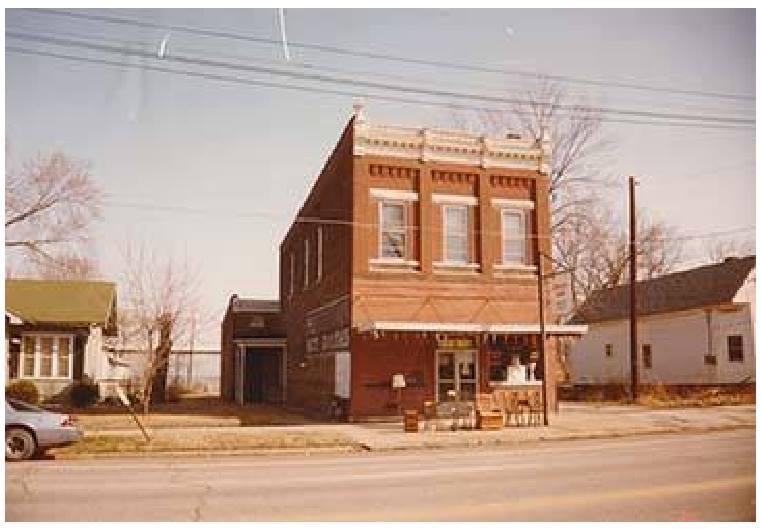
For many years, the building at 845 Second Street was one of those neighborhood landmarks that seemed to have always been there. Its narrow, two-story brick front rose above the surrounding houses, with three tall upper windows, brick pilasters, and an ornate cornice. The business below changed repeatedly, but the basic form of the building remained recognizable through old photographs.
The records gathered so far span 125 years, from an 1891 grocery advertisement to the building’s demolition in 2016. For much of that history, 845 Second Street was exactly what a neighborhood needed: a place to buy groceries, meat, produce, household goods, and animal feed without traveling downtown. Later generations knew it as a craft shop, a used and rare bookstore, a florist, and finally a children’s consignment shop.
A grocery at 845 Second Street by 1891
The earliest record currently identified is an advertisement published in The Gleaner on November 25, 1891. A. R. Bucholz—whose surname appeared as Buchholz in later newspaper accounts, announced a holiday shipment at his grocery at 845 Second Street.
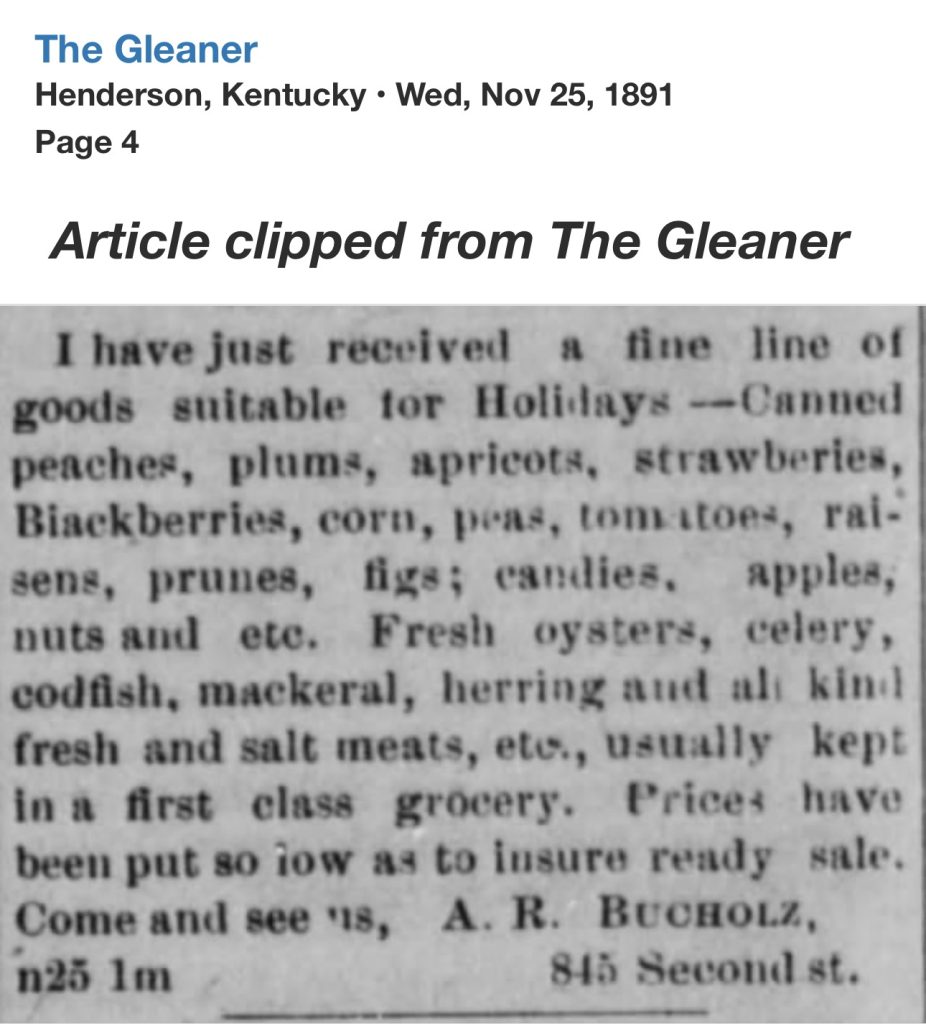
The selection was remarkably broad. Bucholz advertised canned peaches, plums, apricots, strawberries, blackberries, corn, peas, and tomatoes, along with raisins, prunes, figs, candy, apples, and nuts. The store also carried fresh oysters, celery, codfish, mackerel, herring, and fresh and salted meats. It was not merely a place to pick up a few staples; it offered the neighborhood a substantial range of fresh, preserved, and specialty foods.
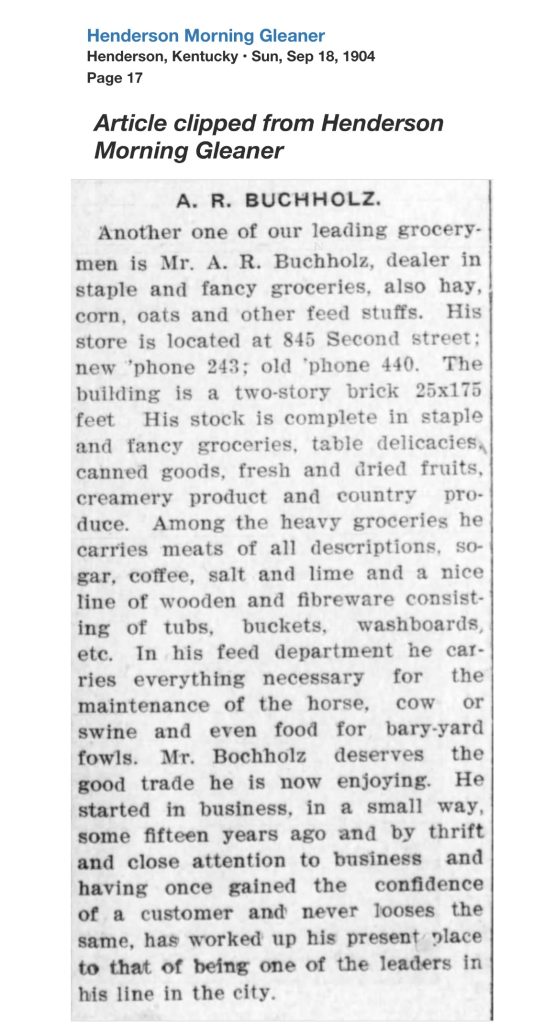
A detailed profile in the Henderson Morning Gleaner on September 18, 1904, called A. R. Buchholz one of Henderson’s leading grocerymen. It described his place at 845 Second Street as a two-story brick building measuring 25 by 175 feet. In addition to staple and fancy groceries, the store sold hay, corn, oats, and other feed. Customers could buy canned goods, fresh and dried fruit, creamery products, country produce, meat, sugar, coffee, salt, lime, tubs, buckets, and washboards. The feed department supplied provisions for horses, cattle, hogs, and poultry.
The 1904 profile stated that Buchholz had entered business in a small way about fifteen years earlier, or around 1889, and had built a loyal trade through thrift and close attention to his customers. That statement helps establish the age of his business, although it does not prove that he spent all fifteen years at 845 Second Street.
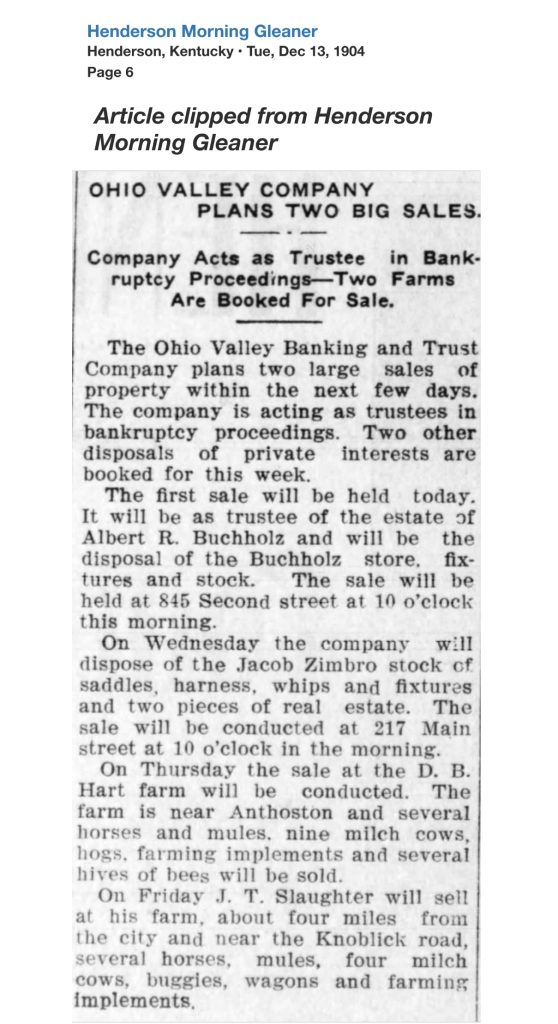
Only a few months after that favorable profile, the business suffered an abrupt reversal. On December 13, 1904, the newspaper reported that the Ohio Valley Banking and Trust Company, acting as trustee in the bankruptcy of Albert R. Buchholz, would sell the store’s stock and fixtures at 845 Second Street. The sale ended the first documented chapter of the address’s grocery history.
The Heineman years
By November 1911, the address was occupied by Heineman Grocery. A classified advertisement from that year directed replies to “Heineman Groc., 845 Second street.” In January 1914, another advertisement listed Ed Heineman at the address as one of the Henderson merchants selling M. M. Hancock’s burrstone corn meal.
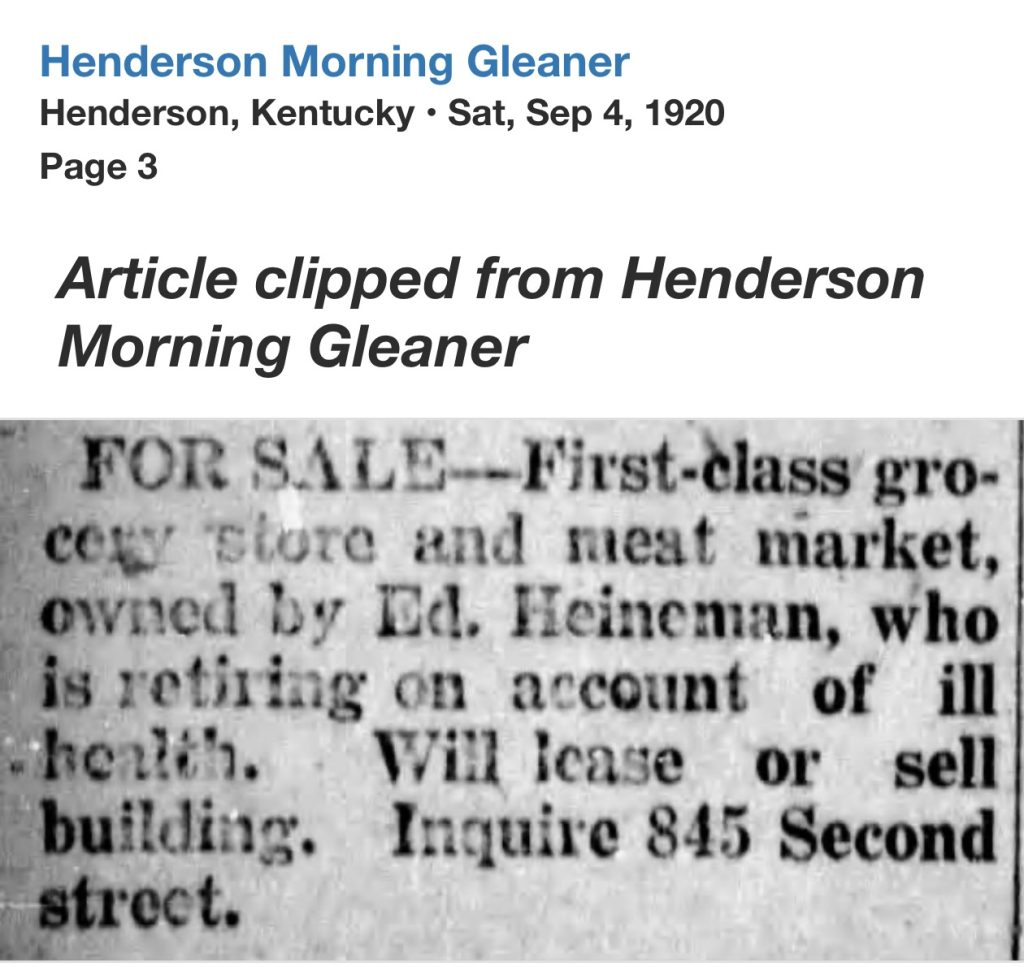
Heineman continued operating a grocery and meat market there through at least 1920. On September 4 of that year, an advertisement offered the “first-class grocery store and meat market” for sale. It explained that Ed Heineman was retiring because of ill health and was willing to lease or sell the building.
The advertisement is important because it shows that 845 Second Street was more than a short-lived retail location. By then, the address had already supported a neighborhood grocery under at least two operators for nearly three decades.
Watson’s Grocery and the building above the store
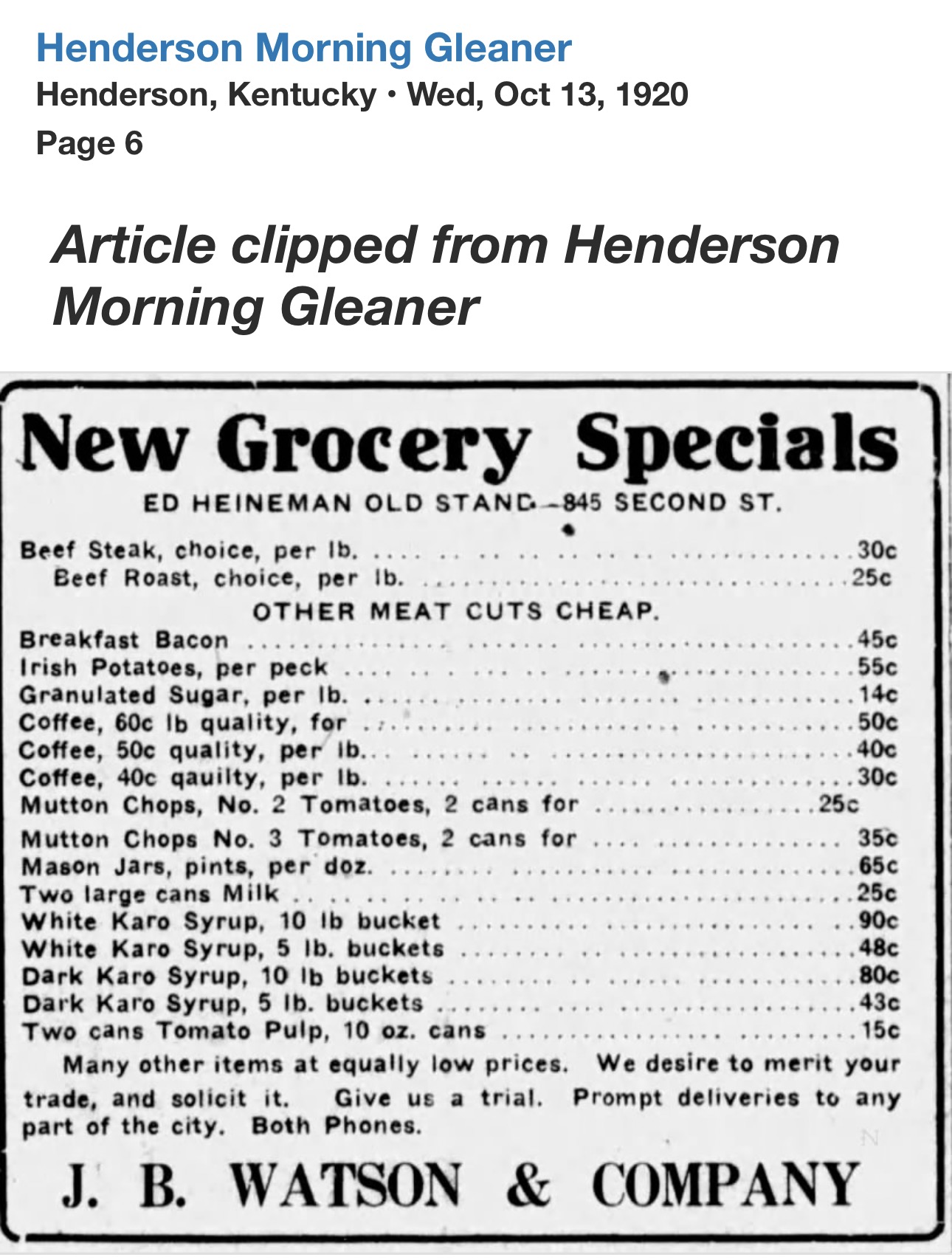
J. B. Watson & Company soon took over. An October 13, 1920, advertisement promoted “New Grocery Specials” at the “Ed Heineman old stand” at 845 Second Street. Watson offered meat, potatoes, sugar, coffee, canned tomatoes, milk, syrup, and other staples, while promising prompt delivery anywhere in the city.
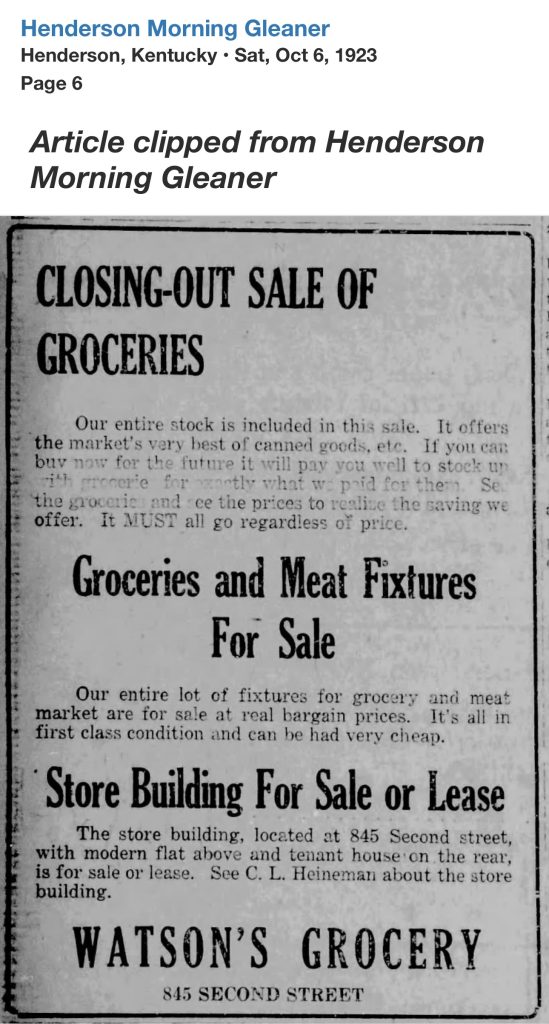
The grocery remained there for roughly three years. In October 1923, Watson’s Grocery announced a closing-out sale of its stock and its grocery and meat-market fixtures. The same advertisement also offered the property for sale or lease and described it as a store building with a “modern flat above” and a tenant house at the rear. Interested parties were directed to C. L. Heineman about the real estate.
That description reveals the building’s mixed use. The first floor served customers, while the upper story contained living space. A separate residence stood behind the store. The May 1923 Sanborn fire-insurance map likewise depicts a substantial brick commercial building at the address with additional structures extending into the deep lot, consistent with the newspaper descriptions of the property.
Willie Weiner’s Grocery and Meat Market
The closing of Watson’s did not end the address’s long grocery tradition. By February 1925, Willie Weiner’s Grocery and Meat Market was operating at 845 Second Street. Its advertisements emphasized coffee, fresh and cured meats, canned goods, fruits, vegetables, reasonable prices, and home delivery throughout Henderson.
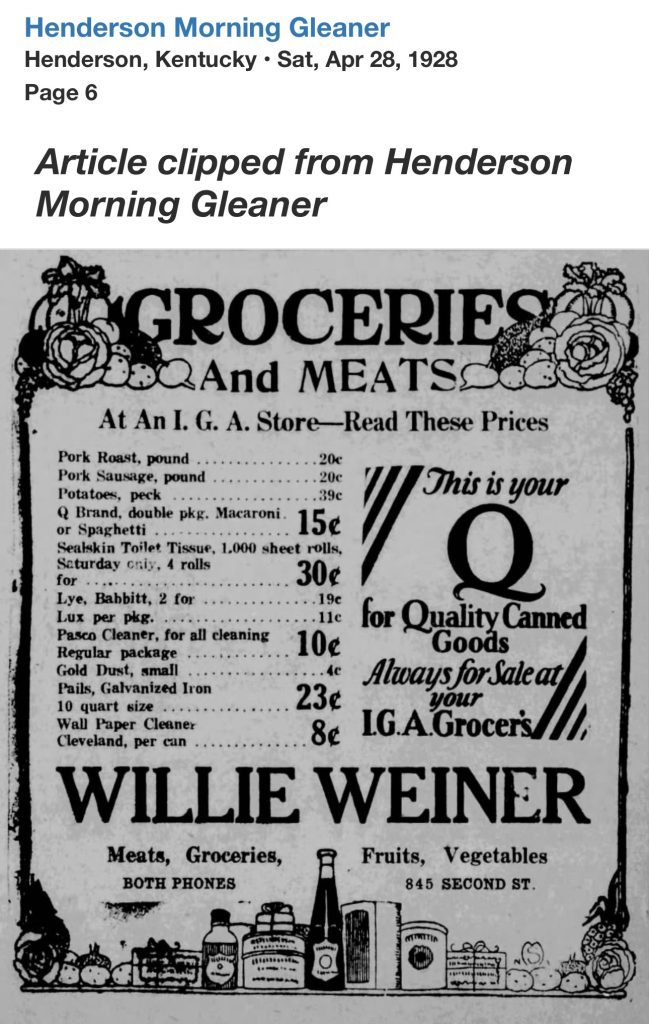
By April 1928, Weiner’s business was advertising as an I.G.A. store. A large newspaper advertisement offered pork roast, sausage, potatoes, pasta, household cleaners, and other everyday goods. The store remained both a grocery and a meat market, serving the surrounding residential neighborhood by telephone as well as over the counter.
An August 1932 advertisement identified Willie Weiner Grocery and Meat Market as an authorized Plee-Zing distributor. It invited customers traveling to the races at Dade Park to buy their groceries and meats at the store and again advertised delivery service. By that time, 845 Second Street had been documented as a grocery location for more than forty years.
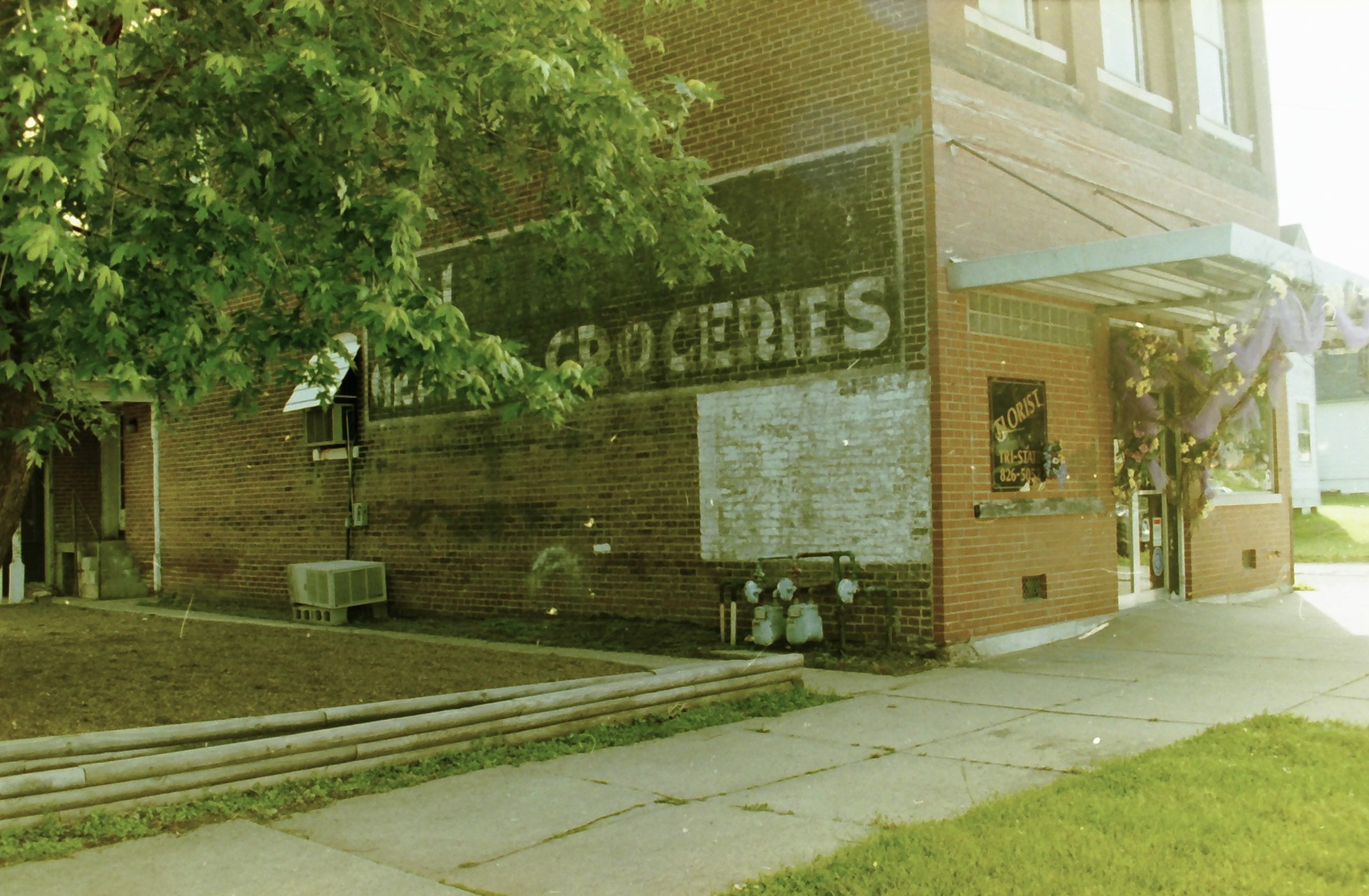
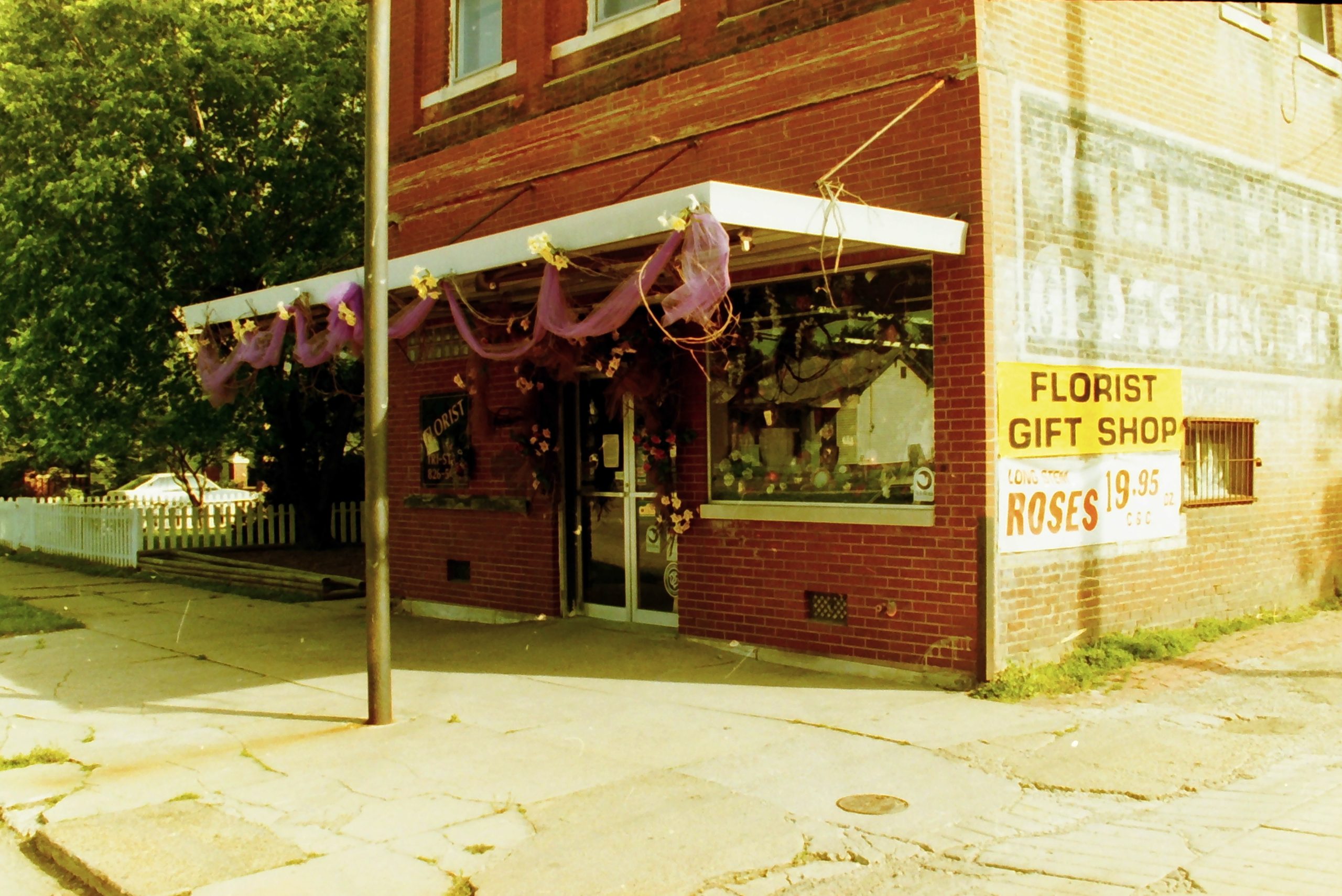
Later photographs preserved traces of this era. Even after the building had been converted to other uses, faded grocery lettering could still be seen on its brick side walls, a ghost sign left from the years when neighborhood residents came there for meat, produce, canned goods, and coffee.
From groceries to crafts, books, and flowers
The available material does not yet establish when the grocery finally closed or identify every occupant between the 1930s and 1970s. By the mid-1970s, however, the building had entered a very different retail period.
In December 1976, Dee’s Crafts advertised handcrafted “colonial primitives,” furniture, and accessories at 845 Second Street. An undated color photograph appears to show the building during this general specialty retail period, with furniture or merchandise arranged on the sidewalk beneath the storefront awning.
In December 1989, Pepper’s Old & Rare Books announced that it was newly open at the address. The shop specialized in genealogy, history, war titles, out-of-print novels, and other used books. It also invited the public to sell good old books to the store. For a building that had once supplied the neighborhood’s dinner tables, the transition to local history and rare books was a fitting new chapter.
By 1996, 845 Second Street housed Tri-State Floral, Inc. A March advertisement announced a “Get to Know You Celebration” introducing June Miller as the new owner and Ann Webster, formerly of Colonial Gardens, as head designer. Photographs from the floral-shop period show the first floor remodeled with broad display windows and a metal canopy, while the upper façade and decorative brickwork remained largely intact. The old grocery lettering was still visible behind the newer florist and gift-shop signs.
Patty Cakes and the end of the building
The final business identified in the available material was Patty Cakes Children’s Consignment Shop. By then, the building had survived well over a century of changing merchants and customers.
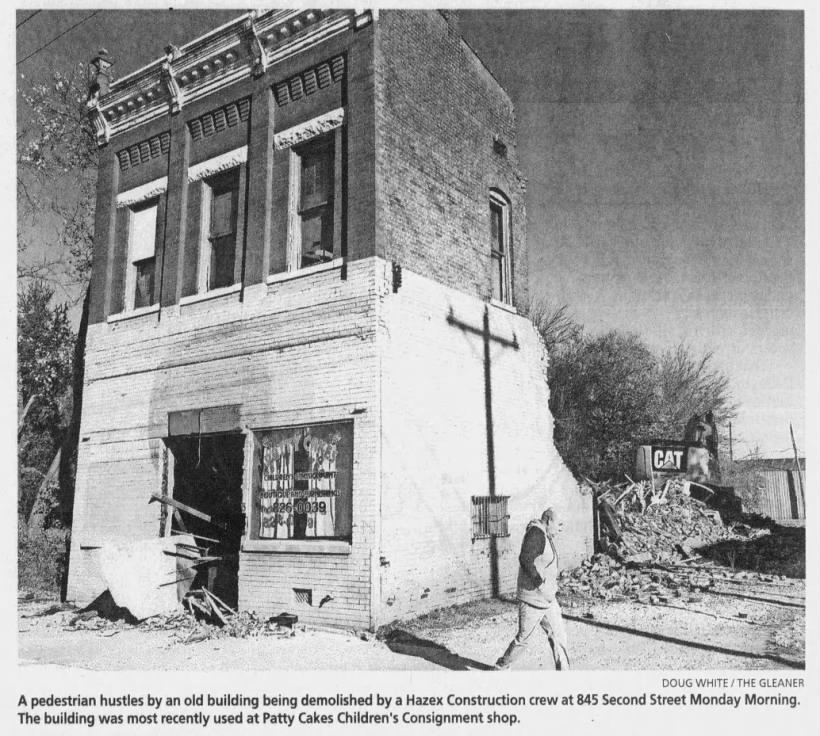
Its story ended in 2016. The City of Henderson’s November building report listed a commercial demolition permit for 845 Second Street, with Kimber Hedden as the applicant and Hazex Construction as the contractor. The reported project cost was $25,140. A photograph by Gleaner photographer Doug White captured the demolition in progress. Part of the long building had already been reduced to rubble while the decorated two-story front still stood beside the sidewalk. The published caption noted that Patty Cakes had been its most recent use.
The demolition removed a distinctive piece of the East End streetscape, but the surviving advertisements, map, and photographs preserve an unusually detailed record of its life. They show how one building adapted as Henderson changed: first as an all purpose neighborhood grocery and meat market, then as a home for independent specialty shops.
For at least 125 years, 845 Second Street was not simply an address. It was a place where residents ordered groceries by telephone, had meat and produce delivered to their homes, browsed handcrafted furniture and old books, bought flowers and gifts, and shopped for their children. Its businesses changed, but its purpose remained remarkably consistent, it was a small, locally operated place serving the people who lived around it.
Sources:
The Gleaner, November 25, 1891, p. 4.
Henderson Morning Gleaner, September 18, 1904, p. 17.
Henderson Morning Gleaner, December 13, 1904, p. 6.
Henderson Morning Gleaner, November 8, 1911, p. 7.
The Gleaner, January 7, 1914, p. 3.
Henderson Morning Gleaner, September 4, 1920, p. 3.
Henderson Morning Gleaner, October 13, 1920, p. 6.
Sanborn Fire Insurance Map of Henderson, Kentucky, May 1923, sheets 33–34.
Henderson Morning Gleaner, October 6, 1923, p. 6.
Henderson Morning Gleaner, February 1, 1925, p. 8.
Henderson Morning Gleaner, April 28, 1928, p. 6.
Henderson Morning Gleaner, August 10, 1932, p. 3.
Evansville Press, December 5, 1976, p. 36.
Evansville Courier and Press, December 2, 1989, p. 24.
Evansville Courier and Press, March 17, 1996, p. 42.
Doug White, demolition photograph and caption, The Gleaner.
Leave a Reply