A Separate Door to Knowledge
Henderson’s 1904 library branch for African American readers
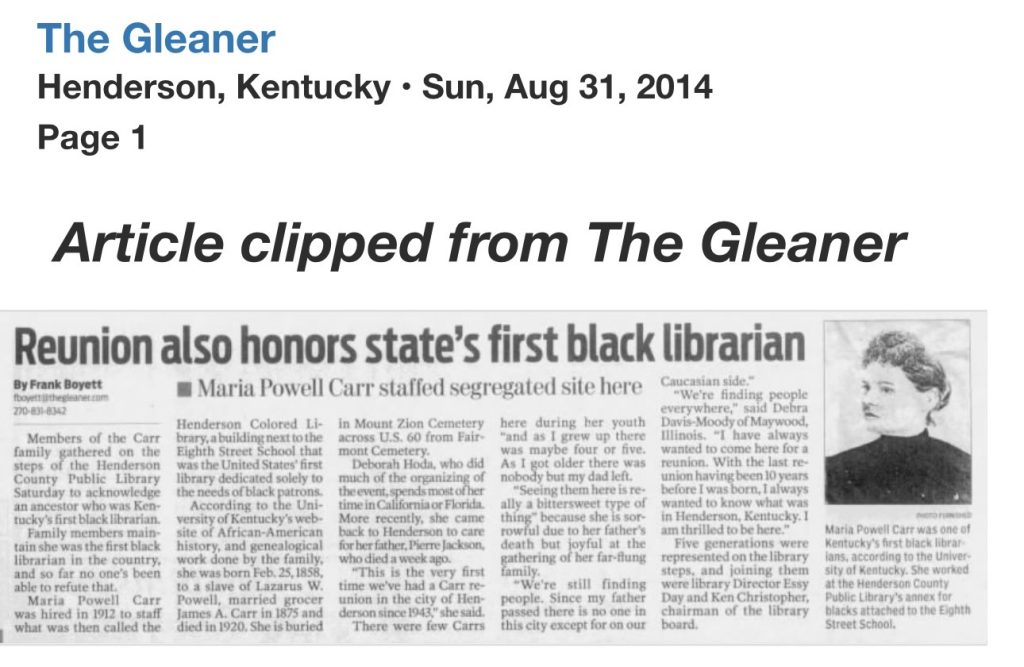
A 2014 Gleaner feature brought renewed attention to Maria Powell Carr and Henderson’s segregated Eighth Street library branch. (The Gleaner, August 31, 2014)
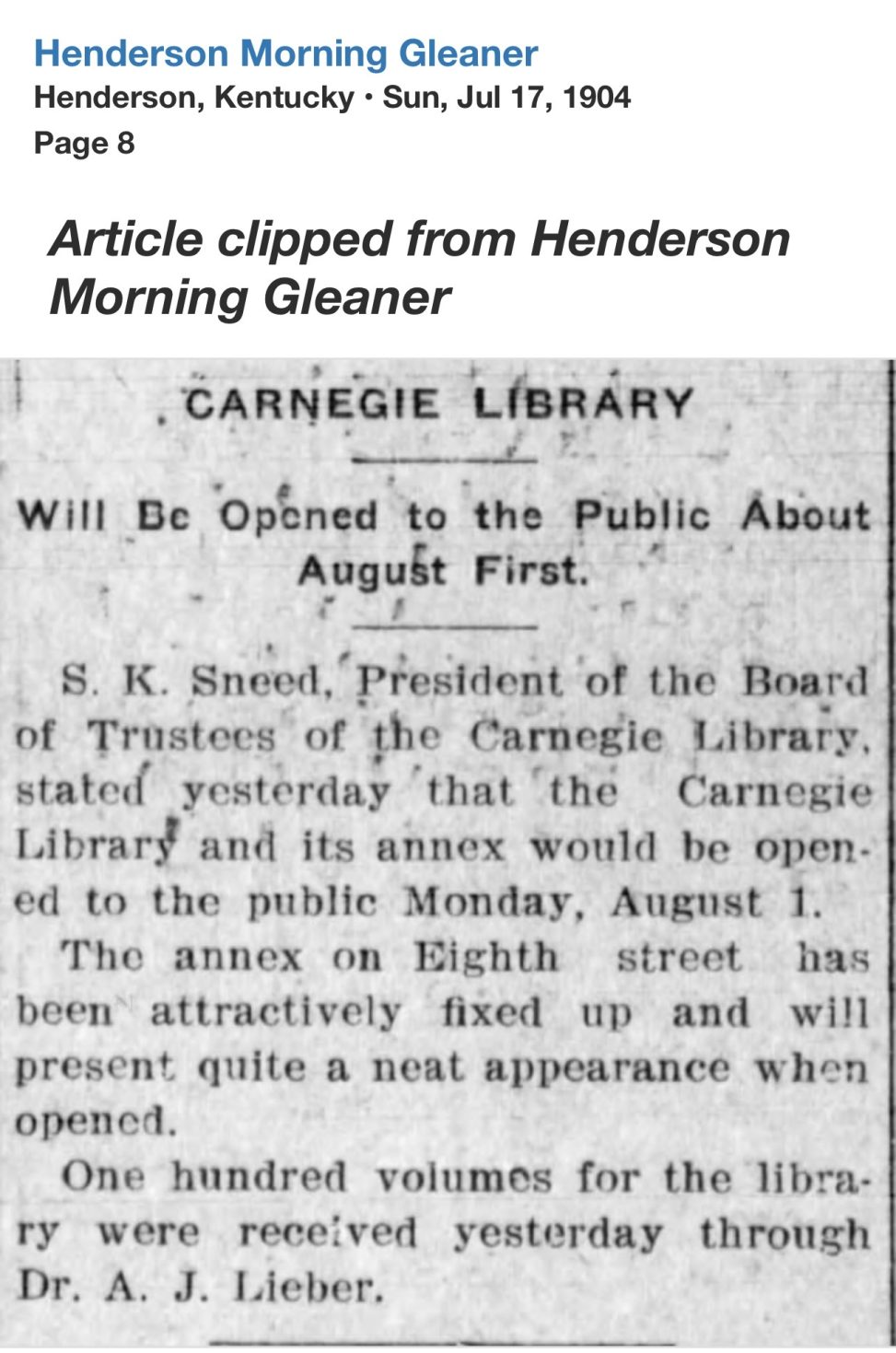
On an August afternoon in 1904, Black Hendersonians gathered at the Eighth Street Colored School for the opening of a small public library. The room held only about 100 books. Its creation nevertheless placed Henderson near the beginning of organized public-library service for African Americans in the United States and began a local story sustained by educators and library workers including Eugenia A. Mundy, Maria Powell Carr and Helen Sheets.
Two openings in one segregated city
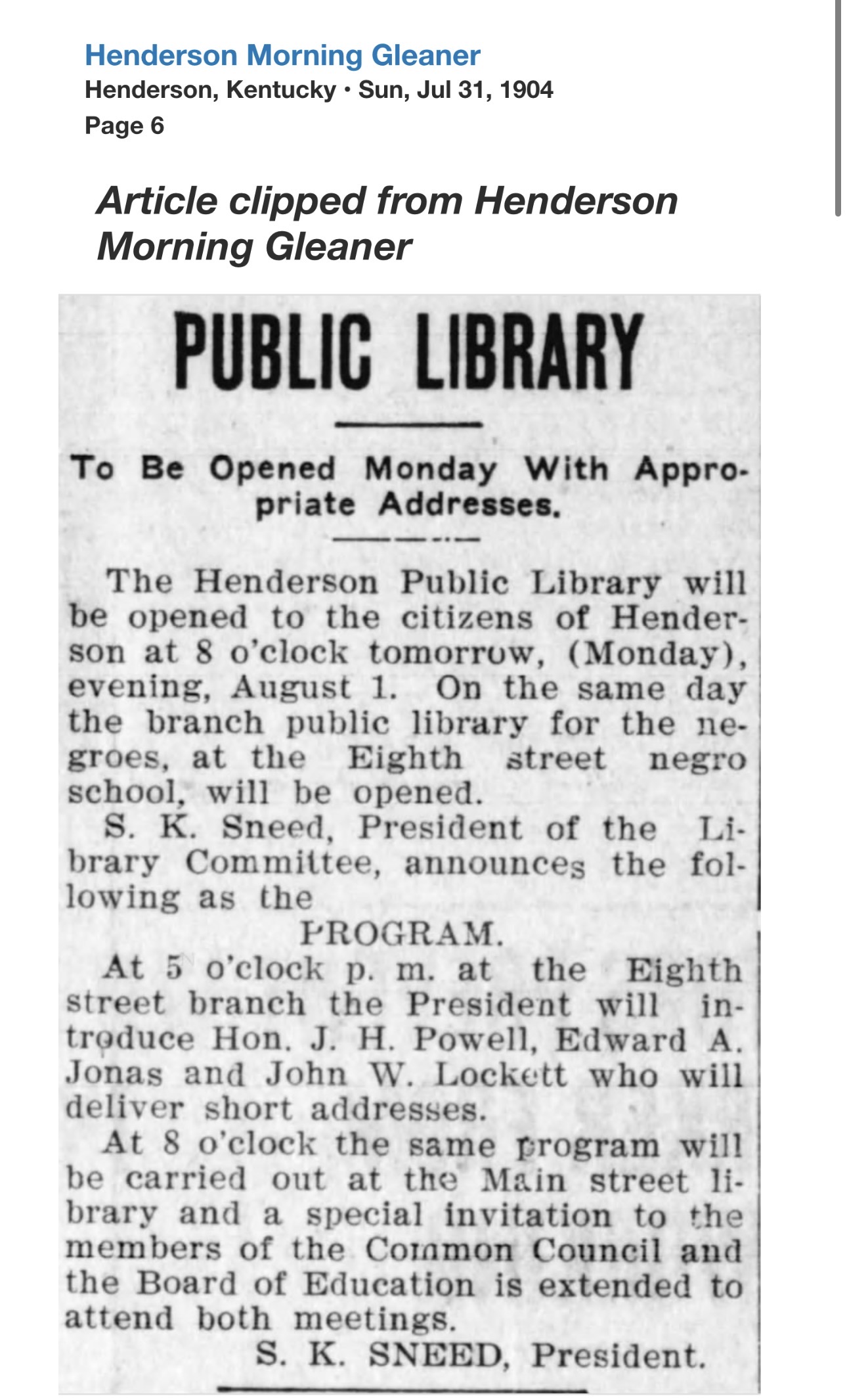
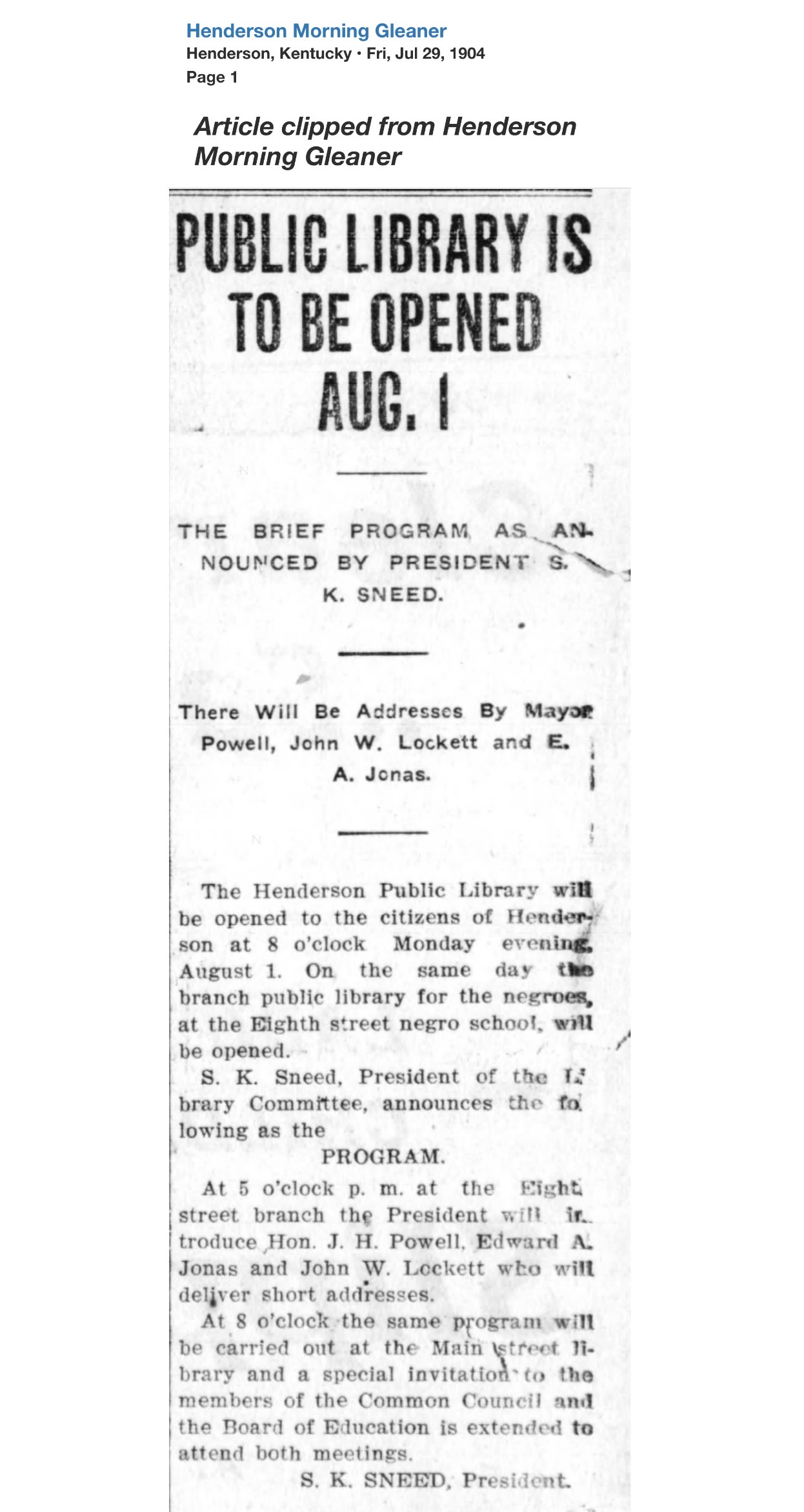
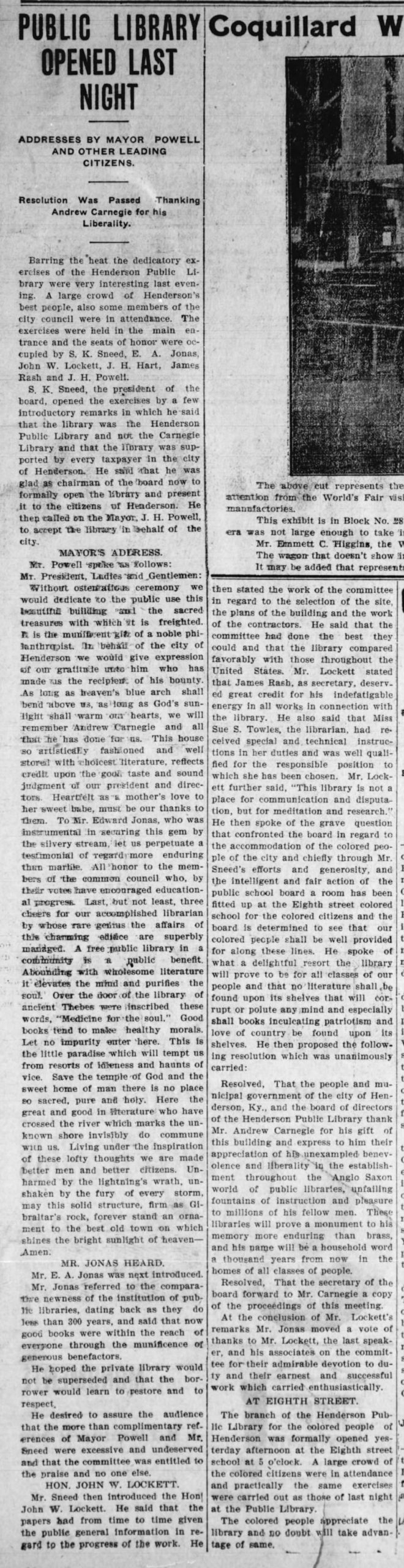
At 5 p.m. on Monday, August 1, 1904, a crowd assembled in the annex of the Eighth Street School, at Eighth and Elm streets. Three hours later, Henderson formally opened its new Carnegie-funded public-library building for white patrons. The two ceremonies followed nearly the same program: library director S. K. Sneed introduced former governor John H. Powell, attorney Edward A. Jonas and board member John W. Lockett for short addresses.
The paired openings captured both the achievement and the contradiction. Henderson had created public-library service for Black residents at an unusually early date, but it did so within the color line. African American readers were directed to a separate facility in a Black school rather than admitted to the main building.
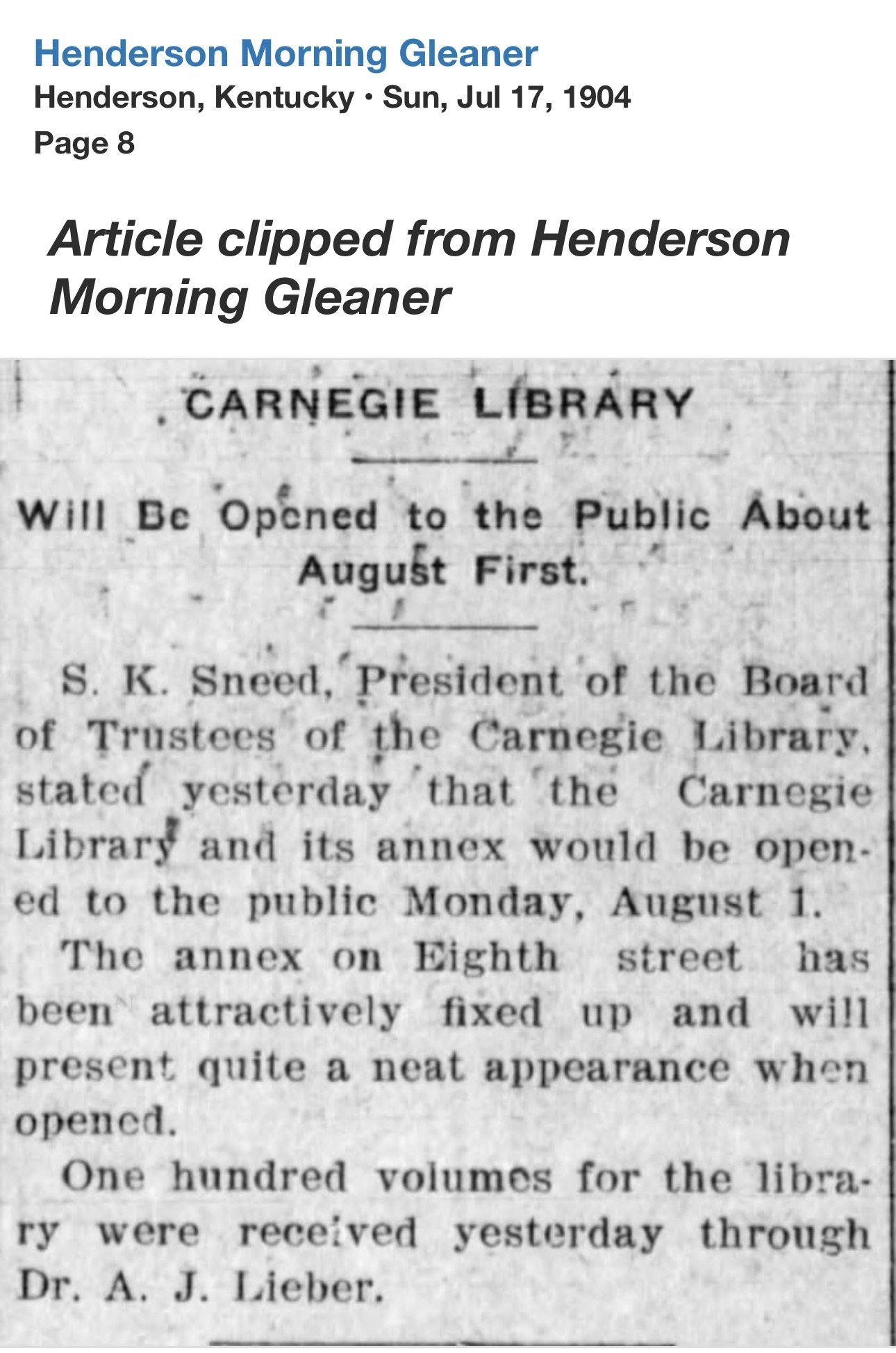
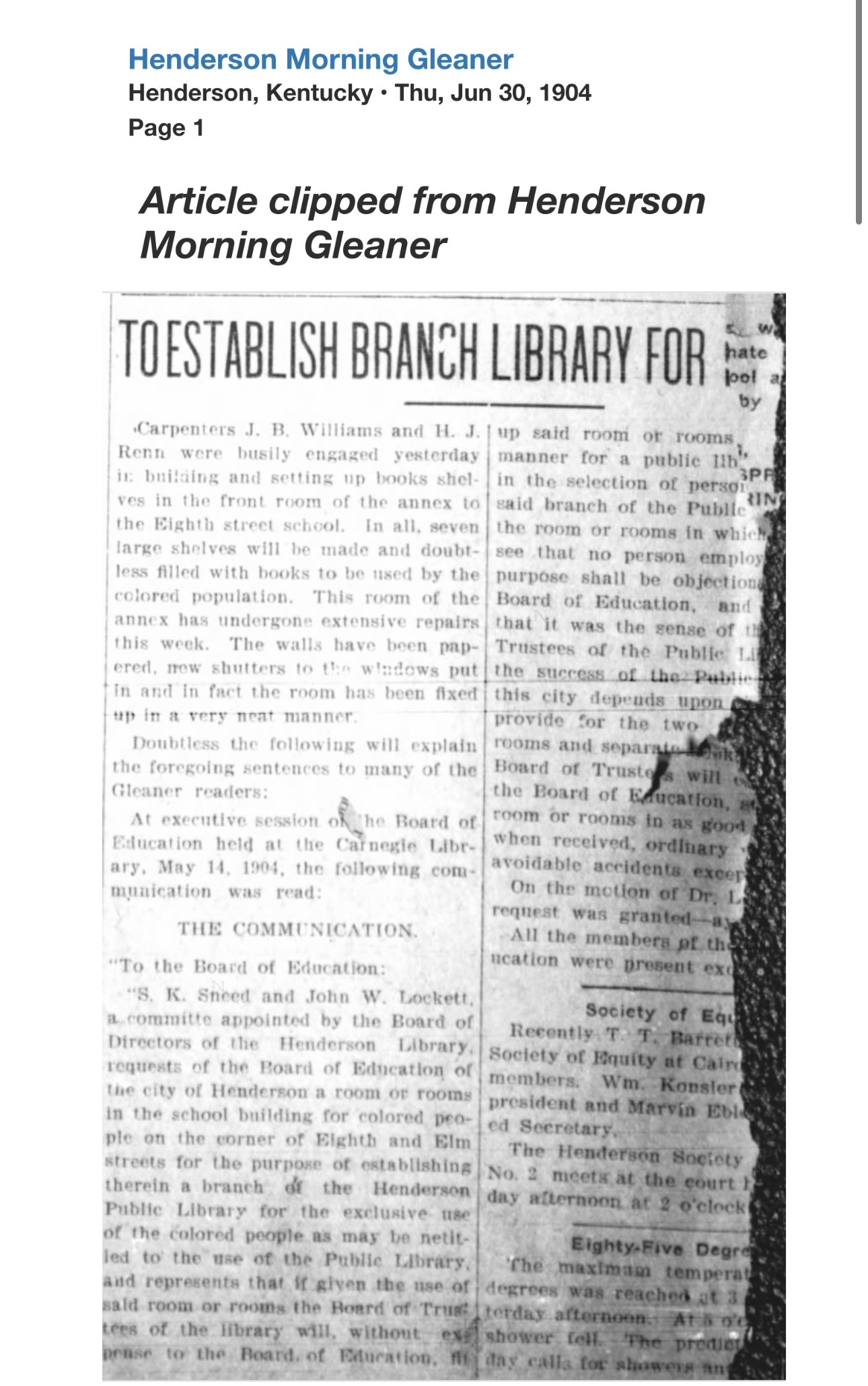
The Eighth Street branch had taken shape quickly. On June 30, the Morning Gleaner reported that the Henderson Library Association had asked the Board of Education for a room in the school annex “for the exclusive use of the colored people” entitled to library service. The library board promised to fit the room at no cost to the school board. Carpenters installed seven large shelves; the room was repaired, papered and fitted with shutters. By mid-July, about 100 books had been received for the branch, and the newspaper announced an August 1 opening.
The opening-day account described a large attendance and said Black residents expressed appreciation for the new service. The paper also recorded Lockett’s hope that the branch would be well used. That aspiration would soon be measurable in circulation reports.
Was it the first in the nation?
The Henderson County Public Library and the University of Kentucky’s Notable Kentucky African Americans database identify the Eighth Street branch as the first library structure in the United States specifically established for African Americans. That is a meaningful distinction, but it should be stated carefully.
The surviving 1904 reports describe a remodeled room in an annex of an existing school, not a freestanding library building commissioned from the ground up. Henderson therefore should not be called, without qualification, the first public library for African Americans. Louisville’s Western Colored Branch, opened in rented rooms in 1905, is often identified as the nation’s first free public-library branch devoted to Black readers; its purpose-built Carnegie building opened in 1908. Henderson’s strongest documented claim is narrower: its Eighth Street facility was an exceptionally early public library space deliberately fitted for African American use, and later Kentucky library histories have credited it as the nation’s first such library structure.
That nuance does not diminish the local achievement. It makes the story more accurate, and reveals how Black library history developed through different kinds of spaces: school rooms, rented quarters and, later, dedicated buildings.
The women behind the shelves
The institutional story becomes clearer when the women who performed the daily work are placed at its center. The surviving record does not yet yield a complete staff roster, but four names can be documented.
| Name | Documented service | Role |
| Eugenia A. Mundy | 1904; documented again in 1919 | Oversaw daily operation of the Eighth Street branch and was described as “in charge.” |
| Maria Powell Carr | By 1912 | Had charge of the branch; the 1912 annual report credited her with increased circulation. |
| Helen Sheets | From 1950 | Hired as branch librarian when the collection moved to the Isadore Center. |
| Susan Starling Towles | 1904–1948 | Head librarian of the Henderson system—not the Eighth Street branch librarian—but responsible for the broader institution during most of the branch era. |
The list reflects names currently documented in the available sources; it may not be a complete roster.
Eugenia A. Mundy: the first documented attendant
Henderson County Public Library’s institutional history identifies Eugenia A. Mundy as the woman who oversaw the branch’s day-to-day operation when it opened in 1904. The University of Kentucky’s biographical index likewise says she was placed in charge. Mundy was an educator and a graduate of Hampton Institute’s class of 1899. A 1919 issue of The Southern Workman again described Henderson’s “Colored Branch Library” as being in her charge.
Mundy’s documented role matters because later retellings have sometimes presented Maria Carr as the first librarian. The available evidence instead places Mundy at the opening. It also leaves a question: Carr was in charge by 1912, while Mundy was again named in 1919. Their exact dates of service, and whether duties ever overlapped, remain to be established.
Maria Powell Carr: growth under her care
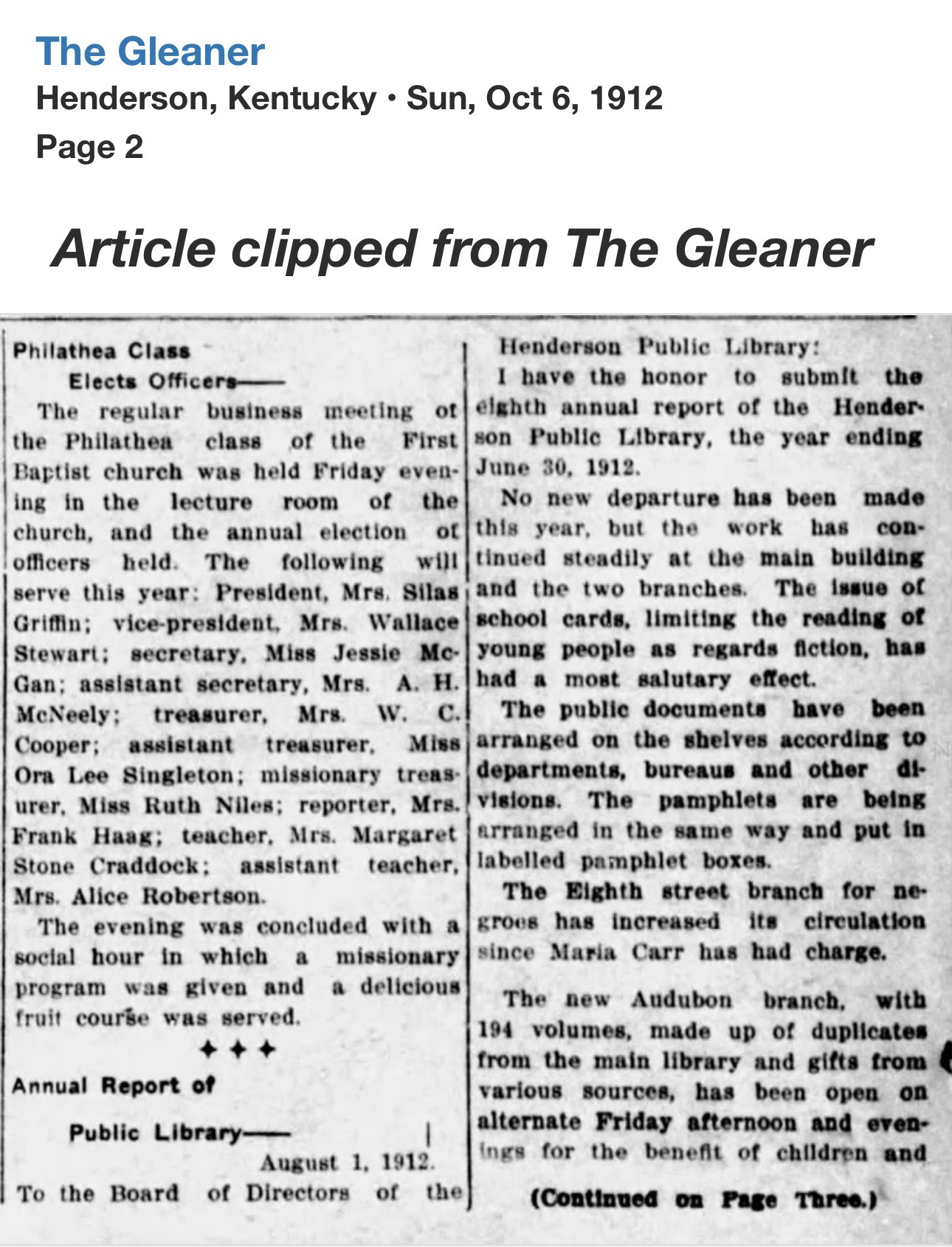
Maria Powell Carr was born February 25, 1858, and married Henderson grocer James A. Carr in 1875. By 1912 she had charge of the Eighth Street branch. The library’s annual report did more than list her name: it stated that the branch “has increased its circulation since Maria Carr has had charge.” That brief sentence is the strongest contemporary assessment of her work.
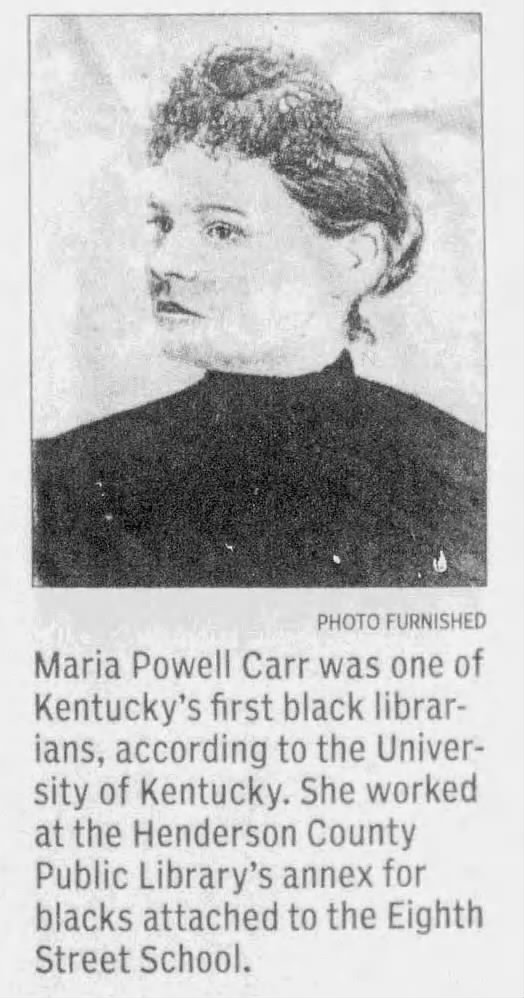
Maria Powell Carr, pictured in a 2014 Gleaner feature on a Carr family reunion. The caption identified her as one of Kentucky’s first African American librarians. (The Gleaner, August 31, 2014)
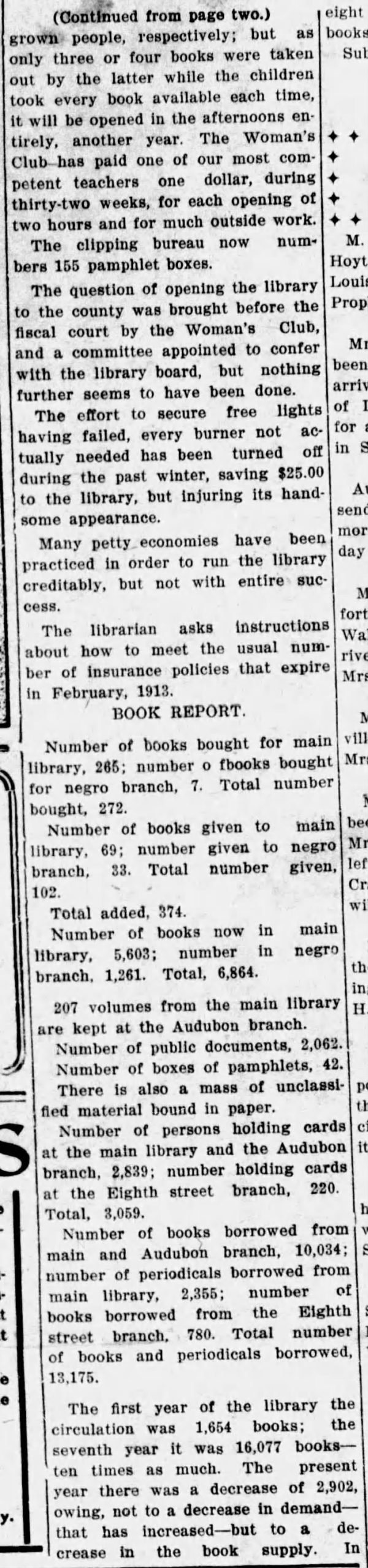
The same report offers context for that praise. The branch then held 1,261 books, more than twelve times its opening collection. It had 220 registered cardholders and recorded 780 book loans during the reporting year. Yet its new acquisitions were modest: seven purchased books and 33 gifts, compared with 265 purchases and 69 gifts for the main library. The numbers show both community use and the unequal scale of investment within the segregated system.
Carr is best described as one of Kentucky’s earliest African American women to serve as a public-library attendant. She died on August 13, 1920, and is buried with her family in Henderson’s Mt. Zion Cemetery. Her place in library history rests not merely on being present, but on the documented growth of circulation while she was responsible for the branch.
From Eighth Street to the Isadore Center
The branch remained at the Eighth Street School for nearly half a century. In 1950 it moved to the upper floor of the Isadore Center at Alvasia and Dixon streets, and Helen Sheets was hired as branch librarian. Four years later, the main and branch collections were merged. The separate branch ceased to exist as an administrative unit in 1954, ending a fifty-year chapter in Henderson’s library history.
Susan Starling Towles provides the connecting institutional thread. She began as Henderson’s head librarian in 1904 and served for 44 years. She should not be confused with the women who operated the Eighth Street branch, but the branch existed for most of her long tenure at the head of the system.
A legacy of access and separation
Henderson’s Eighth Street branch deserves remembrance for two truths at once. It offered Black residents a public collection, reading space and library service at a time when such access was rare. It was also a product of segregation: the city opened a separate door because the main door was not open to everyone.
Within those limits, Black women made the institution work. Mundy brought the experience of a trained educator. Carr increased circulation and helped turn a 100 book beginning into an established community service. Sheets carried the branch into its final location and final years. Their work transformed a repaired schoolroom into a lasting part of Henderson’s civic memory.
The historical record is still incomplete. City directories, school records, library minutes, family papers and community memories may reveal additional attendants or clarify the sequence of service between 1904 and 1950. HistoricHenderson welcomes photographs, library cards, letters and recollections that can help restore those names to the story.
Sources and further reading
• Henderson Morning Gleaner, June 30, July 17, July 31 and August 2, 1904; The Gleaner, October 6, 1912; The Gleaner, August 31, 2014. Henderson County Public Library newspaper archive.
• Henderson County Public Library, “History of the Library,” https://www.hcpl.org/about-the-library
• University of Kentucky, Notable Kentucky African Americans Database, “Henderson Colored Library” and “Carr, Maria Powell,” https://nkaa.uky.edu/nkaa/items/show/769 and https://nkaa.uky.edu/nkaa/items/show/758
• The Southern Workman, May 1919, p. 280, digitized at Virginia Chronicle, https://www.virginiachronicle.com/?a=d&d=SWM19190501.1.48
• Roots of Community: Segregated Carnegie Libraries as Spaces for Learning and Community Making in the American South, University of Southern Mississippi, https://aquila.usm.edu/rocprofiles/

Leave a Reply