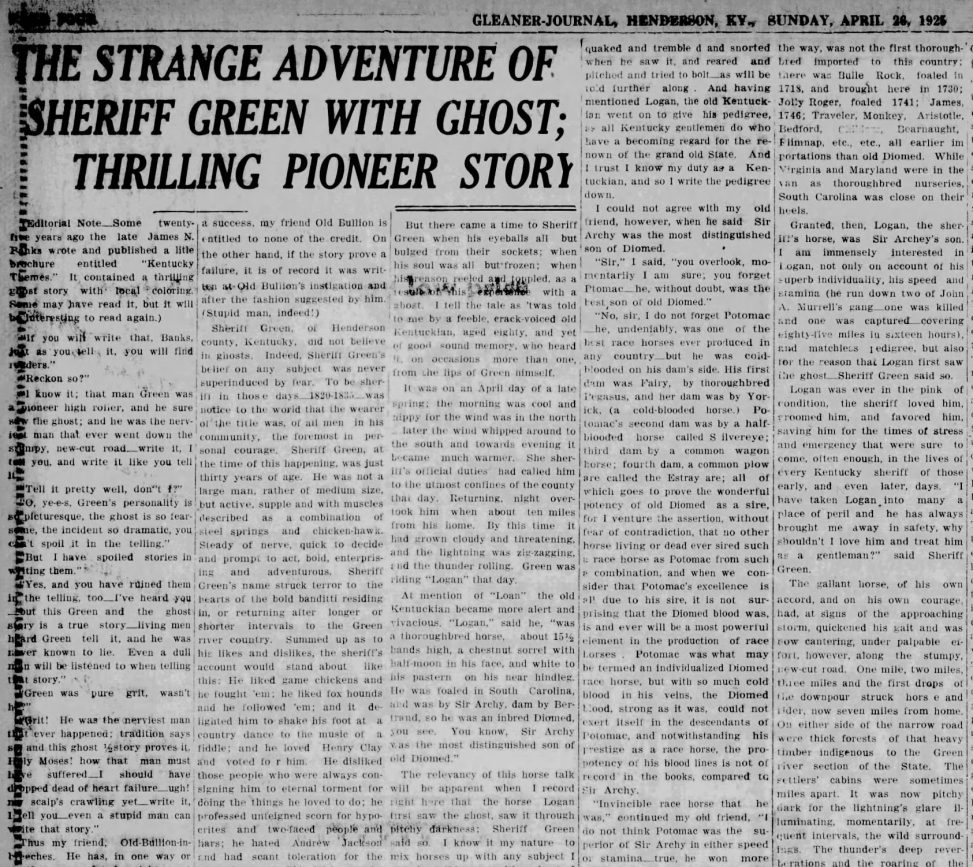
THE STRANGE ADVENTURE OF SHERIFF GREEN WITH GHOST; THRILLING PIONEER STORY
Gleaner-Journal, Henderson, Kentucky
Sunday, April 26, 1925, page 10
(Editorial Note—Some twenty-five years ago the late James N. Banks wrote and published a little brochure entitled “Kentucky Themes.” It contained a thrilling ghost story with local coloring. Some may have read it, but it will be interesting to read again.)
“If you will write that, Banks, just as you tell it, you will find readers.”
“Reckon so?”
“I know it; that man Green was a pioneer high roller, and he sure saw the ghost; and he was the nerviest man that ever went down the stumpy, new-cut road—write it, I tell you, and write it like you tell it.”
“Tell it pretty well, don’t I?”
“O, ye-e-s, Green’s personality is so picturesque, the ghost is so fearsome, the incident so dramatic, you can’t spoil it in the telling.”
“But I have spoiled stories in writing them.”
“Yes, and you have ruined them in the telling, too—I’ve heard you—but this Green and the ghost story is a true story—living men heard Green tell it, and he was never known to lie. Even a dull man will be listened to when telling that story.”
“Green was pure grit, wasn’t he?”
“Grit! He was the nerviest man that ever happened; tradition says so, and this ghost story proves it. Holy Moses! how that man must have suffered—I should have dropped dead of heart failure—ugh! my scalp’s crawling yet—write it, I tell you—even a stupid man can write that story.”
Thus my friend, Old-Bullion-in-breeches. He has, in one way or another, accumulated a right smart lot of promiscuous plunder and now feels competent to advise and criticize—even subjects literary. Some say he is manifestly “upity.”
I meant to write the story all along, in my own way; in fact, just as it appears below; so if it prove a success, my friend Old Bullion is entitled to none of the credit. On the other hand, if the story prove a failure, it is of record it was written at Old Bullion’s instigation and after the fashion suggested by him. (Stupid man, indeed!)
Sheriff Green, of Henderson county, Kentucky, did not believe in ghosts. Indeed, Sheriff Green’s belief on any subject was never superinduced by fear. To be sheriff in those days—1820-1835—was notice to the world that the wearer of the title was, of all men in his community, the foremost in personal courage. Sheriff Green, at the time of this happening, was just thirty years of age. He was not a large man, rather of medium size, but active, supple and with muscles described as a combination of steel springs and chicken-hawk. Steady of nerve, quick to decide and prompt to act, bold, enterprising and adventurous, Sheriff Green’s name struck terror to the hearts of the bold banditti residing in, or returning after longer or shorter intervals to the Green river country. Summed up as to his likes and dislikes, the sheriff’s account would stand about like this: He liked game chickens and he fought ’em; he liked fox hounds and he followed ’em; and it delighted him to shake his foot at a country dance to the music of a fiddle; and he loved Henry Clay and voted for him. He disliked those people who were always consigning him to eternal torment for doing the things he loved to do; he professed unfeigned scorn for hypocrites and two-faced people and liars; he hated Andrew Jackson and had scant toleration for the supporters of Old Hickory; he abominated a hog thief, or any other sort of thief or law-breaker, and with merry laugh and flaunting words he, with covert sarcasm and scornful speech, mocked at those of his pioneer associates who believed in “hants” and “ghosts.”
But there came a time to Sheriff Green when his eyeballs all but bulged from their sockets; when his soul was all but frozen; when his reason reeled and toppled, as a result of his experience with a ghost. I tell the tale as ’twas told to me by a feeble, crack-voiced old Kentuckian, aged eighty, and yet of good sound memory, who heard it, on occasions more than one, from the lips of Green himself.
It was on an April day of a late spring; the morning was cool and nippy for the wind was in the north—later the wind whipped around to the south and towards evening it became much warmer. The sheriff’s official duties had called him to the utmost confines of the county that day. Returning, night overtook him when about ten miles from his home. By this time it had grown cloudy and threatening, and the lightning was zig-zagging, and the thunder rolling. Green was riding “Logan” that day.
At mention of “Loan” the old Kentuckian became more alert and vivacious. “Logan,” said he, “was a thoroughbred horse, about 15½ hands high, a chestnut sorrel with half-moon in his face, and white to his pastern on his near hindleg. He was foaled in South Carolina, and was by Sir Archy, dam by Bertrand, so he was an inbred Diomed, you see. You know, Sir Archy was the most distinguished son of old Diomed.”
The relevancy of this horse talk will be apparent when I record right here that the horse Logan first saw the ghost, saw it through pitchy darkness; Sheriff Green said so. I know it my nature to mix horses up with any subject I may be talking or writing about; I am also aware that when I am discussing horses I rigidly exclude all other subjects as irrelevant. But I did not drag Logan into this story, nobody dragged him in; he is indispensable, for he saw the ghost before Sheriff Green did; and he quaked and trembled and snorted when he saw it, and reared and pitched and tried to bolt—as will be told further along. And having mentioned Logan, the old Kentuckian went on to give his pedigree, as all Kentucky gentlemen do who have a becoming regard for the renown of the grand old State. And I trust I know my duty as a Kentuckian, and so I write the pedigree down.
I could not agree with my old friend, however, when he said Sir Archy was the most distinguished son of Diomed.
“Sir,” I said, “you overlook, momentarily I am sure, you forget Potomac—he, without doubt, was the best son of old Diomed.”
“No, sir, I do not forget Potomac—he, undeniably, was one of the best race horses ever produced in any country—but he was cold-blooded on his dam’s side. His first dam was Fairy, by thoroughbred Pegasus, and her dam was by Yorick, (a cold-blooded horse.) Potomac’s second dam was by a half-blooded horse called Silvereye; third dam by a common wagon horse; fourth dam, a common plow mare called the Estray mare; all of which goes to prove the wonderful potency of old Diomed as a sire, for I venture the assertion, without fear of contradiction, that no other horse living or dead ever sired such a race horse as Potomac from such a combination, and when we consider that Potomac’s excellence is all due to his sire, it is not surprising that the Diomed blood was, is and ever will be a most powerful element in the production of race horses. Potomac was what may be termed an individualized Diomed race horse, but with so much cold blood in his veins, the Diomed blood, strong as it was, could not exert itself in the descendants of Potomac, and notwithstanding his prestige as a race horse, the propotency of his blood lines is not of record in the books, compared to Sir Archy.
“Invincible race horse that he was,” continued my old friend, “I do not think Potomac was the superior of Sir Archy in either speed or stamina—true, he won more races, but he was longer on the turf. Yet, compare the two as sires—Sir Archy sired Timoleon, Timoleon sired Boston, Boston sired Lexington, who was the Emperor of race horses. Potomac sired—well, some of his daughters were producers—but I tell you, sir, he is not to be mentioned alongside of Sir Archy as a sire.”
When the old Kentuckian paused, I felt like a smart Aleck, so completely was I turned down; and yet I cannot seriously regard myself as “Alecky” in anything—certainly not Alecky when talking or writing of horses; for my knowledge of horses and horse history is, I confidently assert, more exact and extensive than nine out of ten of those who will read this story.
To hide my discomfiture and in some measure to get even with the old Kentuckian, I sought to trap him.
“When was Diomed foaled? And when was he brought to this country?”
Without hesitation, the answer came correct. “Foaled in 1777—brought to Virginia in 1799, when 22 years old, died in 1808, at the [age] of 31 years. He won the first English Derby in 1780. His son, Sir Archey, was foaled in 1805, and died in 1833, aged 28.”
My courteous old friend now slyly turned inquisitive. “Do you recall Diomed’s pedigree?” he asked.
“Oh, yes; he was by Florizel (son of Herod), dam sister to Juno, by Spectator, out of sister to Horatius, by Blank, and so on to the seventh cross, a mare by Spanker.”
“Quite right,” asserted my old friend, and yet his manner fairly implied that my answer would have been more satisfactory had it specifically named all of Diomed’s dams, even those comprehensively embraced in the “so on to the seventh [cross].” But he did not word his discontent. Suspicious and incredulous people may entertain some misgivings as to my offhand competency to name all of old Diomed’s dams. Let me seriously remind these that this is a story of Sheriff Green and the ghost. (Until I heard this story I was as skeptical in regard to ghosts as was Sheriff Green himself before his adventure. I first heard the story one night after supper, and I did not sleep any that night. And it harrows my feelings up to tell the story now and, maybe, I am shying off a bit as I come to the ghost, but I mean to tell the tale to the last harrowing syllable, even though it cause an epidemic of insomnia. Children should not be allowed to read this story.) What time, then, for naming all the dams of a thoroughbred horse, even so distinguished a horse as Diomed. He, by the way, was not the first thoroughbred imported to this country; there was Bulle Rock, foaled in 1718, and brought here in 1730; Jolly Roger, foaled 1741; James, 1746; Traveler, Monkey, Aristotle, Bedford, [illegible], Bearnaught, Flimnap, etc., etc., all earlier importations than old Diomed. While Virginia and Maryland were in the van as thoroughbred nurseries, South Carolina was close on their heels.
Granted, then, Logan, the sheriff’s horse, was Sir Archey’s son. I am immensely interested in Logan, not only on account of his superb individuality, his speed and stamina (he run down two of John A. Murrell’s gang—one was killed and one was captured—covering eighty-five miles in sixteen hours), and matchless pedigree, but also for the reason that Logan first saw the ghost—Sheriff Green said so.
Logan was ever in the pink of condition, the sheriff loved him, groomed him, and favored him, saving him for the times of stress and emergency that were sure to come, often enough, in the lives of every Kentucky sheriff of those early, and even later, days. “I have taken Logan into many a place of peril and he has always brought me away in safety, why shouldn’t I love him and treat him as a gentleman?” said Sheriff Green.
The gallant horse, of his own accord, and on his own courage, had, at signs of the approaching storm, quickened his gait and was now cantering, under palpable effort, however, along the stumpy, new-cut road. One mile, two miles, three miles and the first drops of the downpour struck horse and rider, now seven miles from home. On either side of the narrow road were thick forests of that heavy timber indigenous to the Green river section of the State. The settlers’ cabins were sometimes miles apart. It was now pitchy dark for the lightning’s glare illuminating, momentarily, at frequent intervals, the wild surroundings. The thunder’s deep reverberations and the roaring of the wind were interspersed by the hooting of the owls, and now and again the howling of hungry wolves were heard, for the winter had been long and severe, and these suffering brutes were boldly hunting in packs that black night. The sheriff, however, fancied himself in more danger from falling limbs and trees than from any other source and hastily resolved to push on for a half mile and there leave the road to seek shelter from the storm in a country church, distant some three hundred yards off the road. Logan responded gamely to the call and covered the distance so swiftly that Green had thrown the reins over a swinging limb and, with saddle on arm, had reached the church door, pushed it open, and stood, safe and comparatively dry, yet within the building, when the cloudburst came. He had really expected to enter through a window, but thought to try the door first, and to his surprise found it unlocked. The sheriff, out-of-doors man that he was, and habituated to frequent and long journeys by night, afterwards declared that he had never known a wilder, louder storm or a blacker night. The wind was blowing a hurricane, screaming through the trees and howling around the church.
The tired, hungry sheriff was fairly content now—he would wait until the storm subsided and the rain abated, and then a bold push for home, a short hour’s work for Logan. The weary man’s respite from exertion and anxiety was of short duration, however. The pouring, wind-driven rain on the board roof of the church, sounded like a roaring Niagara, the trees writhed and groaned like giants in pain, and over and above all, like the booming of great cannon over the rattle of musketry, came the continuous crash and roar of the thunder. The sheriff stood with his back to the interior of the church. All was dark and black to sight save when brilliant and frequent flashes of lightning lit up to view the wild and stormy surroundings.
The strange behavior of the horse attracted Sheriff Green’s attention, and disquieted and perplexed him. Logan was distant only about ten or twelve feet from the door of the church and the sheriff could hear him snorting with fear and pawing furiously; and when the flash of lightning came Green could see from the bulging eyes, red, distended nostrils, pointed ears and trembling, crouching attitude that Logan was affrighted and terror-stricken. The sheriff noted, too, that the horse seemed to be staring in the church. “I called to him,” said Green, “to quiet and soothe him, but failed to calm him in the slightest.” Green conjectured first that the horse’s alarm was occasioned by wolves, and strained his every sense to detect the presence of these savage brutes. Another flash of lightning revealed Logan in the same quaking, trembling attitude of fear, staring with blazing eyes right in the church, staring right by and beyond Green. “I had then,” said the sheriff, “a presentiment amounting to conviction that I was in imminent, deadly peril—and that the cruel, murderous thing, man or beast or serpent, threatening my life, was in the church.” The brave sheriff faced the interior of the church; he was thinking clearly and rapidly now. “Can it be that wolves,” he asked himself, “seeing the door open have sought refuge from the storm in the church, and now, cushion-footed, are advancing noiselessly in the dark, to spring on me and tear me to pieces?” or “more probable, and more frightful, can it be members of that Murrell band of murderers who have sworn to have my life? If so, they have already recognized me by the lightning’s flash and will attack when the next flash comes.” These and a thousand other thoughts swept through the officer’s mind as he stood, with his long-barreled, flintlock pistol clutched in his right hand, facing the interior of the church. He realized, however, he could place little dependence on his gun, for it was almost certain the powder priming was damp. A flash of lightning, and the sheriff’s eyes swept over every nook and cranny of the church and then he saw the—ghost. I sincerely wish I could reproduce, word for word, the language of the old Kentuckian in describing the ghost; the weird, uncanny movements of the ghost, together with all the horrors experienced by Sheriff Green on that, to him, eventful night. For the old man’s words were so vivid and graphic, I am sure he remembered and unconsciously quoted with verbal exactness the very language of Sheriff Green himself—just as it fell hot from his lips some fifty odd years ago.
The ghost was standing in the pulpit at the far end of the church. It seemed to be a very tall woman, clad all in white, with pallid and emaciated features, her great black eyes were wide open and appeared to be staring straight at the sheriff, her hair, black as the crow’s wing, was long and abundant and poured its cloven tide on either side below her waist. This much Green saw during that momentary flash. He felt his scalp contract and the skin on his forehead tighten, his heart seemed to stand still and—another flash!
The ghost had moved and was standing on the floor of the church with one foot on the bottom step leading to the pulpit, with its right hand on the pulpit—still staring at the sheriff with its great, black, wide-open, unwinking eyes. Seen at full length it still seemed to be a very tall dead woman standing erect—a woman who had been shrouded for the grave, but who had in some manner escaped from the coffin. The awful dread of the sheriff was intensified at second sight of the fearsome apparition. Skeptic as he was, he could not doubt the evidence of his own senses—here, undeniably, was a ghost. In the interval of darkness the man’s characteristic courage and intrepidity were manifest from the resolution he formed—he resolved to stay where he was and abide the issue. He had never heard, he said, of a ghost doing bodily harm to anyone in any way—those who believed in them, he said, regarded them as unembodied spirits and awe-inspiring apparitions. He would never doubt again the existence of ghosts and, humiliating as he knew it would be, he, the avowed skeptic, resolved if he survived that night to publicly confess his error, and nothing withholding, relate every detail of his experience. He knew, he said, the ghost would continue to advance—he was sure it would confront him right face to face, within touch, indeed, if only the thing were tangible. In the short interval of blackness his thoughts were instantaneous and multitudinous. And when again the lightning lit the church, he saw what he was expecting—the ghost was standing in the aisle fully ten feet nearer him—was standing motionless with hands clasped in front, looking fixedly right into the eyes of the sheriff.
Surely the man will fly now! Daring and dauntless, he has been known to face great dangers unflinchingly. Different to all this, however, and sustained by a higher order of courage, is the standing passive, stock still in somber darkness, confronting an impending and undefined peril, awaiting an issue with the supernatural. Surely the ofttried bravery of the bold, intrepid man may decline this superhuman test and yet remain untainted and unsullied. But how vain and futile the effort to forecast the actions of an original man. The undaunted man stands unmoved, unyielding. He has laid aside his pistol for the thought of using either rifle, knife or pistol seemed, he said, irreverent and irrational. During the stress and strain of these supreme moments the thoughts and sensations of the sore-tried man were instantaneous, multitudinous; he, the imperious, dominant man, accustomed to command, so alone and helpless now, and yet so imminently threatened by—he knew not what. He wished, he afterwards remembered, he had been kinder to, and more considerate of, his fellow-man—he had been harsh at times; and abrupt and peremptory sometimes, in the discharge of his official duties. He distinctly heard the horse Logan tramping and threshing around like a horse possessed. In that short interval he seemed to review all his past life, as he stood with raised arms and clenched hands in attitude of defense; tense, alert, scarcely breathing he stood!—during that brief, black interval and then the blazing light came and—there!—all but touching—right against—
The man struck out with clenched right hand spasmodically—so close was the object his effort was more of a violent push than a blow. His hand did not pass unresistingly through a spirit or a ghost, but touched real, solid flesh and there followed a woman’s shrill scream—and another! and another! that made the rafters ring.
And then the sheriff realized the ghost was never a ghost at all, but a veritable, live woman. But who? How came she there on that wild night? Sobs and groans, and incoherent ravings were the answers to his questions.
Little remains to be told. The woman was the wife of a settler, who had lived about one mile from the church. Death had recently visited the household and claimed two children, their only ones, both under six years of age, and the little ones now lay buried in the churchyard. The bereaved mother moped and mourned and wept unceasingly. Under the grief her mind gave way, and whenever she could escape the vigilance of her husband she wandered to the church, vainly searching for and calling to her little ones. ’Ere the storm ceased, the husband appeared in search of his wife.
The serious and thoughtful deportment, so characteristic of Sheriff Green in his later years, dated from that memorable night.
Leave a Reply