Lost Cities of Henderson County Were 8 in Number; What Has Become of Them?
Some of Them Were Only On Paper, While Others Had Promising Starts. One Sold Under Court Order
By Spalding Trafton
Comparable to the Lost Atlantis and the mighty continent that joined Australia to Asia, which lost to human eyes now lies in the depths of the sea, we may well inquire as to the Lost Cities of Henderson county.
Solon, the Grecian law-giver tells, or is quoted that the empire of Atlantis was a great country of which the Mediterranean was the harbor, and that there was a great earthquake, and that the island with its warrior race sank into the depths of the sea.
Then there is the story of the Lost Continent that connected Australia with the Asiatic mainland which now lies four and a half miles deep on the bottom of the sea, leaving Australia an island continent.
However, no freak of nature pertained as to the Lost Cities of Henderson county, of which there were eight.
They were all, for the most part, planned and started with the bright hopes of a glorious and prosperous future, but were all relegated by the tide of time to the “voiceless silence of the dreamless dust” and are now an indistinct memory in the minds of many of those who now plant crops on these city sites of by-gone days.
Mortallies, the Model City
The most recent of these lost cities, and the last one to be interred in the graveyard of municipalities was that of Mortallies, known here in Henderson as the White City.
A judgment in the Henderson circuit court on or about the first of the year 1912, with attendant judicial rites closed the obsequies of the White City, and all that was mortal of Mortallies was numbered with the other seven cities that have passed away.
The location or site of Mortallies was in the Ohio river bottoms of Henderson county, in the section known as Horseshoe Bend, nearly opposite Evansville, Indiana.
The records show that during April 1910, T. J. Mann and wife of Vanderburg county, Indiana, deeded to Kate Hawley, J. A. Crawford, and William R. Carroll, ten acres of land in Horseshoe Bend for $2,000. Five hundred was paid cash and a lien retained for the balance of the purchase money, and an option taken on ten more acres at $200 an acre.
The negotiations appear to have been conducted by a well-dressed quiet gentleman, J. A. Brown, who is said to have come from New York.
The site of this proposed Model City or White City was in the lowlands that overflowed with almost the slightest high water.
Here was the marsh staked off for a modern Utopia.
According to J. A. Brown it was to have a brotherhood charter and a community government—in fact it was to be a model city from which greed, graft and poverty were to be forever banished. Brown used the Evansville newspapers to emblazon his scheme to the world. The lowlands were to be filled with sand pumped from the bottom of the Ohio river.
He proposed ideal schools, and said there would be churches and theatres.
“There will be restrictions which will set the town apart from others,” he said.
“The new city shall be restricted against the residence here of negroes, saloons, stores, shacks, and in fact, all undesirables. The community will do all the business done, itself.”
The administration building and power house which were blown down shortly after erection, were rebuilt at great cost. About this time the newspapers of Henderson, and in Evansville, treated the White City as a joke. It was hinted that it might perhaps become a Monte Carlo wherein money and other articles of value were won and lost. County Judge S. A. Young who presided over the destinies of Henderson county during that period sent word to the promoters of Mortallies that they would be haled into his august “tribunal” if gambling was permitted in that so-called Utopia.
Promoter Brown said at the time that he had the support of several wealthy people. Chief among them, he said, is James A. Crawford of Terre Haute; Mrs. Kate Hawley, of New York, and William R. Carroll, who Mr. Brown said, was connected with the U. S. Steel Corporation.
Just what became of Brown is not known, but it is known that the once beautifully appointed administration building with all of its gay colors, abandoned, is the dilapidated habitat of the bats and owls, and that the Utopian bubble blown by Brown into beautiful bright hues has burst.
The site of Mortallies, the Model City, has through the various processes of court fallen into other hands and is now owned by M. D. Helfrich, Evansville, Indiana, who assesses the ten acres for $600 and the improvements at $2,500.
McClain Land Lottery
In about the years of 1868 to 1870 the town of Marble City was surveyed, plotted and laid off in 504 lots.
The land, on which Marble City was located, is on the Ohio River within a third of a mile of the mouth of Green river; in the heart of a rich agricultural region; distant from Evansville ten miles by water, and by land distant from Henderson six miles, with inexhaustible beds of limestone and marble of the finest quality in its immediate vicinity, and workable seams of the best coal underlying it close to the surface. Prof. Cox’s geological reports are referred to in the literature promoting the scheme. It is recommended as an advantageous site with all the benefits of travel and commerce to be derived from the Ohio and Green rivers.
The plotting of this land was part of a great land sale put on by William McClain. Through an act of the General Assembly in February 1868 he was authorized to dispose of certain lands and the town lots of Marble City at a lottery or drawing. This “Great Land Sale” included seven splendid Ohio river bottom farms to be disposed of in shares.
This was one of the greatest land schemes ever attempted before or since in this section. The capital prize was a 523 acre farm valued at $150,000, and the smallest was an eighty dollar lot in Marble City.
The 511 prizes were valued at $314,000. Tickets at $5 were placed on sale, and agencies for the sale of them were opened in every state in the Union according to a statement made in the publicity matter then issued.
The scheme was endorsed by Governor Stevenson of Kentucky, and many other notables, namely, United States Senators Thomas C. McCreery, and Garrett Davis; Hon. Arch Dixon, Henderson; Hon. John T. Bunch, Louisville; Judge W. P. Fowler, Smithland; P. B. Matthews, mayor of Henderson; Judge Ben P. Cissell, Joseph Adams, John H. Barret, Richard Soaper, and Jacob Held of Henderson; Dr. M. J. Bray, Charles Viele, John S. Hopkins, and Samuel Bayard, of Evansville, Indiana, and Mayor William H. Walker of Evansville, and others.
The commissioners named to conduct the drawing or sale were: David Banks, William S. Holloway, R. T. Glass, W. S. Elam, and Grant Green, all of Henderson. L. H. Lyne, cashier of the Farmers’ Bank here was named as financial agent. The prospectus shows that books for the sale of tickets were opened at several points in Kentucky as follows: R. B. Alexander, Commercial Bank, Louisville; Thomas E. Brooks, Covington; John C. Latham, Hopkinsville; Bank of Hopkinsville; James L. Dallam, Commercial Bank, Paducah; B. G. Thomas, Lexington, and H. G. Tyler, Deposit Bank, Greensboro.
Prizes Listed
The first or capital prize was a highly improved farm of 523 acres, valued at $150,000.
The second and third prizes were farms of 100 acres each, valued at $27,500 each.
The next four prizes were farms of 50 acres each of which was valued at $13,750.
Five hundred and four town lots were listed in Marble City as follows: Nos. 1 to 280 inclusive—280 town lots, 30 by 150 feet, at $120 each—$33,600. 140 town lots, 30 by 150, Nos. 281 to 420 inclusive, $100 each—$14,000. 84 town lots, 50 by 150 at $80 each—$6,720.
The voluminous circulars advertising the scheme set forth how the awards would be made as follows:
“Sixty-two thousand, eight hundred and sixty-four numbers representing the corresponding number of certificates offered for sale, will be placed in one wheel, and 511 tickets with the premiums inscribed on them will be placed in another. From one a number will be drawn, and from the other a premium will be drawn at the same time; and the number drawn will take the premium drawn with it in each case. The premiums will be ready for delivery immediately upon the result of the award being known.”
The date of the drawing was set for January 14, 1869, in the Masonic Temple at Louisville, Ky., but the tickets were not all sold on that date and the drawing did not take place until July 7, 1870.
Prizes Awarded
The results of the drawing as shown by the records of the county clerk’s office and Starling’s History of Henderson County, are as follows:
Ticket No. 8553, held by Robert T. McGlaughling of St. Mary’s parish, Louisiana, drew the capital prize of a 523 acre farm, and $10,000 in cash.
The second prize, a 100 acre farm, was awarded on a ticket No. 7176 purchased by Robert Hunt and B. F. Karsner of Louisville. The records show that this ticket or award was later transferred to Jackson McClain.
The third prize of 100 acres was awarded to H. Brown of Mobile, Alabama.
The fourth award was 50 acres which went to the Thomas P. Porter, of Versailles, Ky., the number of the ticket being 61,061.
There is no record available showing who drew the fifth and sixth prizes.
Mrs. Mary D. Brown of Mobile, Alabama, was awarded a fifty acre farm on ticket No. 31,259, which was the seventh prize.
Deeds are of record showing the transfer of the property to the several parties herein named.
Concerning the 504 town lots in Marble City, the proposed boom town, the county court records show nine lots deeded to various parties as the result of this land lottery.
And Marble City with its 504 lots is numbered with the still-born cities of other days.
Tallmadge, the Silk City
Tallmadge, the proposed silk manufacturing center, is another of the “lost cities.”
Back in 1838, David Hart Cowan, William G. Taylor, Edmund H. Hopkins and others plotted and laid off the town of Tallmadge, 12 miles east of Henderson, not a great way past Zion.
These men together with others had planned this as a silk growing community and formed a stock company capitalized at $250,000 to promote this enterprise, with the late Governor Lazarus W. Powell, and Lieutenant Governor Archibald Dixon being among the stockholders.
Edmund H. Hopkins, a surveyor, laid off the town in lots and streets. The promoters interested a number of eastern people in this alluring scheme, and lots were sold at prices ranging from $25 to $270 each. The records show that some 87 or more lots were sold, mostly to people around Kingston, New York. Birdsey Gibbs, grandfather of the writer, fell for the smooth silken proposition, and was instrumental in selling a considerable number of lots.
In the plat of Tallmadge there is shown to be a public square where community gatherings could be held, and where children of the silk culturists could engage in healthful recreation. A few names of the streets are of record, namely, Broad street, and Milton street, the latter being named for Milton, Litchfield County, Connecticut, the home town of Birdsey Gibbs.
Tallmadge was named for Benjamin Tallmadge, a Revolutionary officer and politician. He was born in Brookhaven, New York, in 1754, and died March 7, 1835 in Litchfield, Connecticut.
The tract on which Tallmadge was located contained 450 acres, inherited by David Hart Cowan. The purpose of the Kentucky Silk Manufacturing company was the “cultivating the different kinds of mulberry trees, raising silkworms and manufacturing silk.”
Mulberry trees in great numbers had been planted out and other improvements made. Timbers for the erection of a proposed college and silk houses had been hewn out, but those timbers for the most part are said to have rotted on the ground without ever being used.
One of the big plans of this company was the construction of a canal from Green river to the Ohio, a distance of approximately 15 miles. This canal was never built.
In 1840 or thereabouts this company went on the financial rocks, as did about that period, many other similar silk concerns in Kentucky and in other states.
The silk experiment at Tallmadge as elsewhere, seemed to demonstrate that two things stood in the way of profitable silk culture. First the price of labor in the United States would prevent any profit from this industry because it comes in competition with the cheap labor in foreign silk producing countries. Second, that the climate in this country was not conducive to the raising and propagation of silk worms and cocoons.
The property of Tallmadge came to the hands of the Sublett family in 1860, and the house erected thereon is now owned by Ed Ijames (pronounced Imes). Nothing remains except a few mulberry trees to indicate that an attempt had been made to establish a silk growing company and community.
Other Lost Cities
Coming on down, or perhaps going further on back, it is found that an order was entered on the county court records incorporating the town of Lafayette. The date of this order was February 17, 1840, and recites that this town was platted on the plan of George W. King, who with Payne Dixon, W. P. Grayson, W. Y. Nelson, and Harbison Butler, are named as trustees. The site of Lafayette is described as being on the Ohio river above Evansville. No further mention of Lafayette is to be found on the county court records.
On February 27, 1837, Steamport on Green river, was incorporated upon plans by Isaac Harmon. The trustees were Isaac Harmon, Owen Thomas, John McElroy, J. M. Edwards, and James Thomas.
The plat shows six blocks of eight lots to a block, with streets 66 feet wide. It was filed by Willie Sugg, deputy surveyor in June 1839.
Steamport must have been somewhat of a town in its day as in 1842 the General Assembly designated it as a voting precinct. Few, if any landmarks remain to show its existence.
In May 1804, John Gray and Willie Morgan executed bond to the county court in the sum of one thousand pounds sterling (English money) for an order to establish a town on their land purchased of Thomas B. Evans of Louisville on the Ohio river near Highland Creek. Six hundred acres were contained in this tract which is in the southwest portion of this county.
As far as could be ascertained this was also a town on paper. It was not even dignified with a name.
Then there were Felixville and Bellville, towns of mushroom growth in 1820 that also faded away like the morning mist before the glorious rising sun over the eastern slopes of the verdant Green river hills.
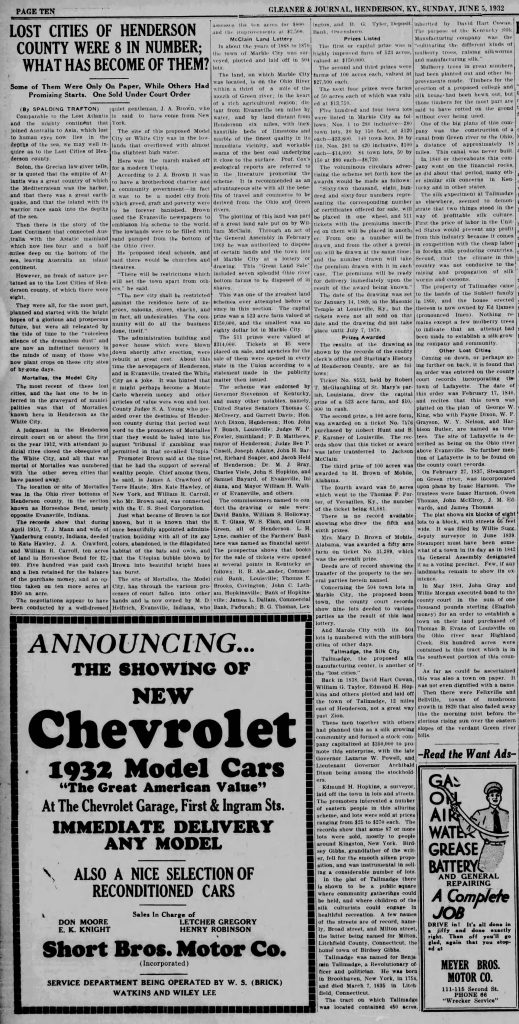
Source: Gleaner & Journal, Henderson, Kentucky, Sunday, June 5, 1932, page 10.
Leave a Reply