Last arrest of Al Capone’s main foe happened in Henderson in 1946
Yesterday’s News by Frank Boyett
The Gleaner, Sunday, July 4, 2021
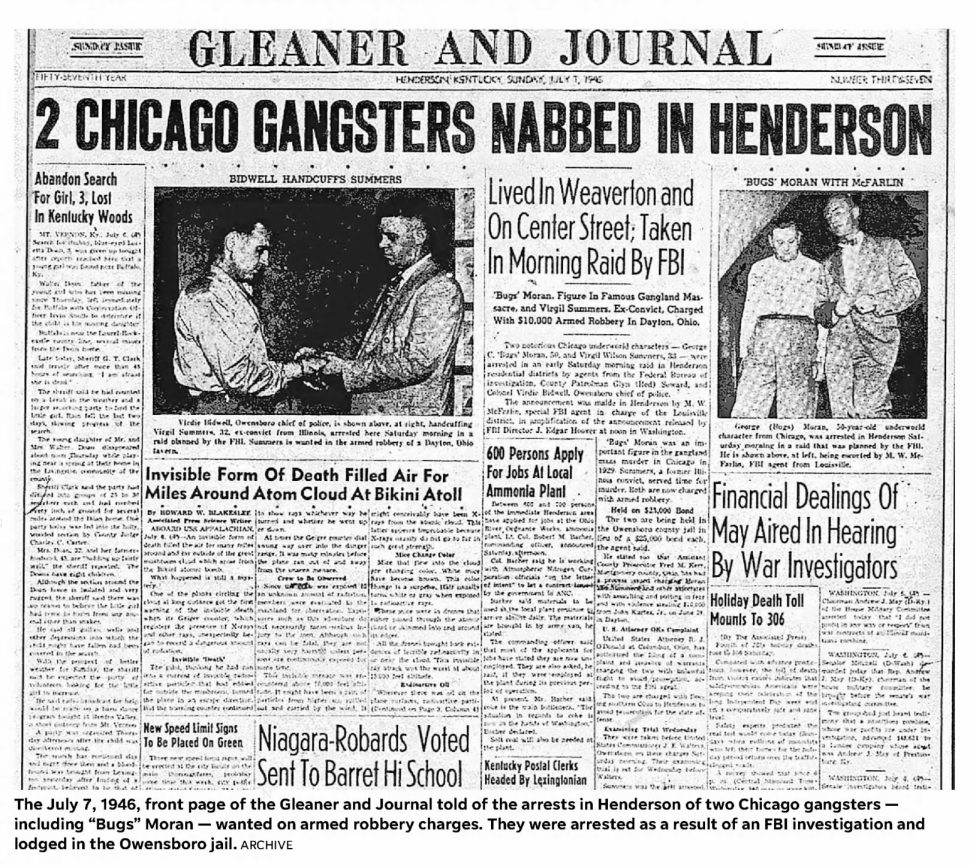
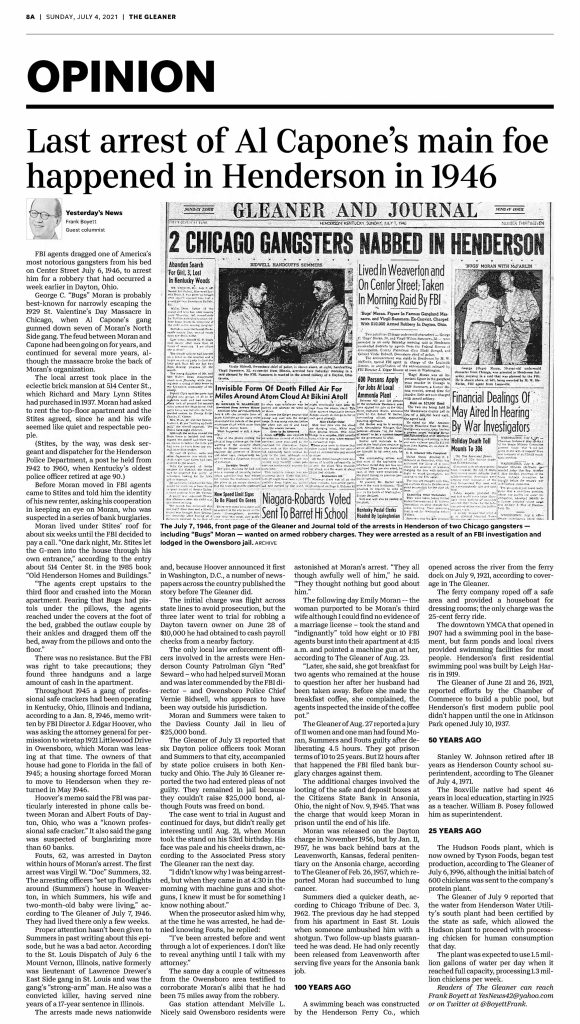
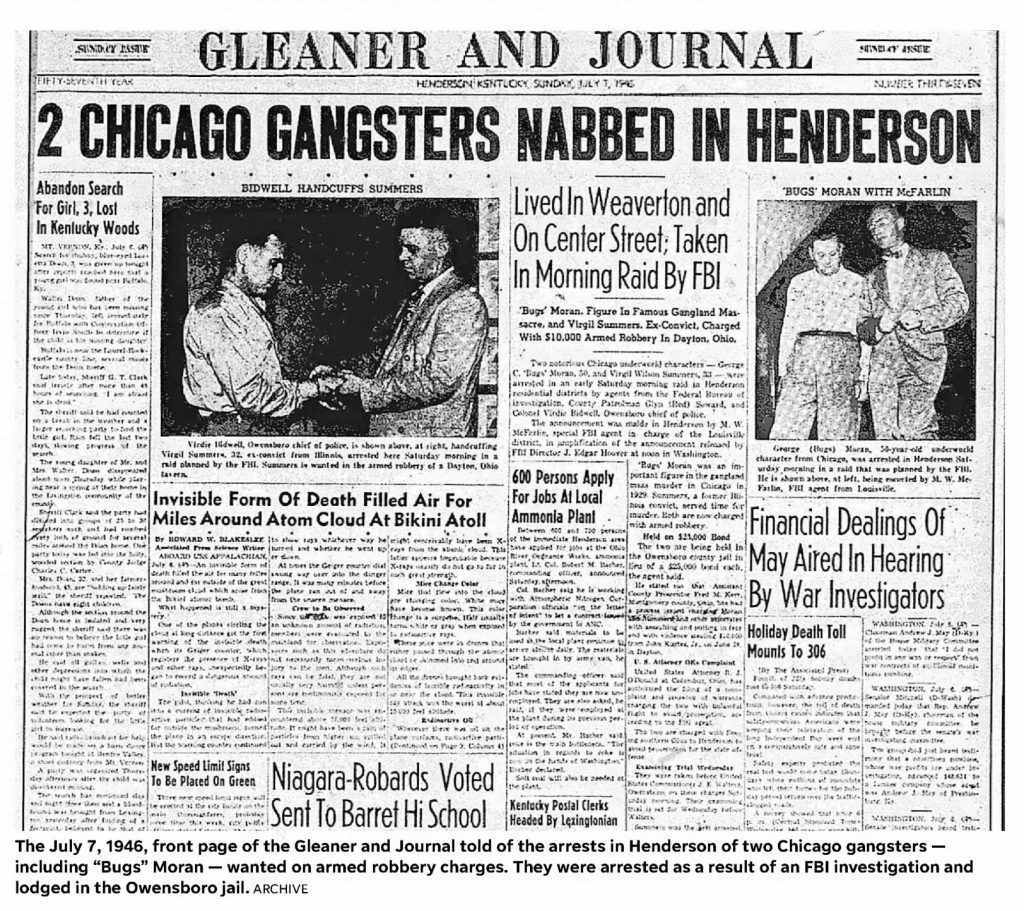
FBI agents dragged one of America’s most notorious gangsters from his bed on Center Street July 6, 1946, to arrest him for a robbery that had occurred a week earlier in Dayton, Ohio.
George C. “Bugs” Moran is probably best-known for narrowly escaping the 1929 St. Valentine’s Day Massacre in Chicago, when Al Capone’s gang gunned down seven of Moran’s North Side gang. The feud between Moran and Capone had been going on for years, and continued for several more years, although the massacre broke the back of Moran’s organization.
The local arrest took place in the eclectic brick mansion at 514 Center St., which Richard and Mary Lynn Stites had purchased in 1937. Moran had asked to rent the top-floor apartment and the Stites agreed, since he and his wife seemed like quiet and respectable people.
(Stites, by the way, was desk sergeant and dispatcher for the Henderson Police Department, a post he held from 1942 to 1960, when Kentucky’s oldest police officer retired at age 90.)
Before Moran moved in FBI agents came to Stites and told him the identity of his new renter, asking his cooperation in keeping an eye on Moran, who was suspected in a series of bank burglaries.
Moran lived under Stites’ roof for about six weeks until the FBI decided to pay a call. “One dark night, Mr. Stites let the G-men into the house through his own entrance,” according to the entry about 514 Center St. in the 1985 book “Old Henderson Homes and Buildings.”
“The agents crept upstairs to the third floor and crashed into the Moran apartment. Fearing that Bugs had pistols under the pillows, the agents reached under the covers at the foot of the bed, grabbed the outlaw couple by their ankles and dragged them off the bed, away from the pillows and onto the floor.”
There was no resistance. But the FBI was right to take precautions; they found three handguns and a large amount of cash in the apartment.
Throughout 1945 a gang of professional safe crackers had been operating in Kentucky, Ohio, Illinois and Indiana, according to a Jan. 8, 1946, memo written by FBI Director J. Edgar Hoover, who was asking the attorney general for permission to wiretap 1921 Littlewood Drive in Owensboro, which Moran was leasing at that time. The owners of that house had gone to Florida in the fall of 1945; a housing shortage forced Moran to move to Henderson when they returned in May 1946.
Hoover’s memo said the FBI was particularly interested in phone calls between Moran and Albert Fouts of Dayton, Ohio, who was a “known professional safe cracker.” It also said the gang was suspected of burglarizing more than 60 banks.
Fouts, 62, was arrested in Dayton within hours of Moran’s arrest. The first arrest was Virgil W. “Doc” Summers, 32. The arresting officers “set up floodlights around (Summers’) house in Weaverton, in which Summers, his wife and two-month-old baby were living,” according to The Gleaner of July 7, 1946. They had lived there only a few weeks.
Proper attention hasn’t been given to Summers in past writing about this episode, but he was a bad actor. According to the St. Louis Dispatch of July 6 the Mount Vernon, Illinois, native formerly was lieutenant of Lawrence Drewer’s East Side gang in St. Louis and was the gang’s “strong-arm” man. He also was a convicted killer, having served nine years of a 17-year sentence in Illinois.
The arrests made news nationwide and, because Hoover announced it first in Washington, D.C., a number of newspapers across the country published the story before The Gleaner did.
The initial charge was flight across state lines to avoid prosecution, but the three later went to trial for robbing a Dayton tavern owner on June 28 of $10,000 he had obtained to cash payroll checks from a nearby factory.
The only local law enforcement officers involved in the arrests were Henderson County Patrolman Glyn “Red” Seward — who had helped surveil Moran and was later commended by the FBI director — and Owensboro Police Chief Vernie Bidwell, who appears to have been way outside his jurisdiction.
Moran and Summers were taken to the Daviess County Jail in lieu of $25,000 bond.
The Gleaner of July 13 reported that six Dayton police officers took Moran and Summers to that city, accompanied by state police cruisers in both Kentucky and Ohio. The July 16 Gleaner reported the two had entered pleas of not guilty. They remained in jail because they couldn’t raise $25,000 bond, although Fouts was freed on bond.
The case went to trial in August and continued for days, but didn’t really get interesting until Aug. 21, when Moran took the stand on his 53rd birthday. His face was pale and his cheeks drawn, according to the Associated Press story The Gleaner ran the next day.
“I didn’t know why I was being arrested, but when they came in at 4:30 in the morning with machine guns and shotguns, I knew it must be for something I know nothing about.”
When the prosecutor asked him why, at the time he was arrested, he had denied knowing Fouts, he replied:
“I’ve been arrested before and went through a lot of experiences. I don’t like to reveal anything until I talk with my attorney.”
The same day a couple of witnesses from the Owensboro area testified to corroborate Moran’s alibi that he had been 75 miles away from the robbery.
Gas station attendant Melville L. Nicely said Owensboro residents were astonished at Moran’s arrest. “They all though awfully well of him,” he said. “They thought nothing but good about him.”
The following day Emily Moran — the woman purported to be Moran’s third wife although I could find no evidence of a marriage license — took the stand and “indignantly” told how eight or 10 FBI agents burst into their apartment at 4:15 a.m. and pointed a machine gun at her, according to The Gleaner of Aug. 23.
“Later, she said, she got breakfast for two agents who remained at the house to question her after her husband had been taken away. Before she made the breakfast coffee, she complained, the agents inspected the inside of the coffee pot.”
The Gleaner of Aug. 27 reported a jury of 11 women and one man had found Moran, Summers and Fouts guilty after deliberating 4.5 hours. They got prison terms of 10 to 25 years. But 12 hours after that happened the FBI filed bank burglary charges against them.
The additional charges involved the looting of the safe and deposit boxes at the Citizens State Bank in Ansonia, Ohio, the night of Nov. 9, 1945. That was the charge that would keep Moran in prison until the end of his life.
Moran was released on the Dayton charge in November 1956, but by Jan. 11, 1957, he was back behind bars at the Leavenworth, Kansas, federal penitentiary on the Ansonia charge, according to The Gleaner of Feb. 26, 1957, which reported Moran had succumbed to lung cancer.
Summers died a quicker death, according to Chicago Tribune of Dec. 3, 1962. The previous day he had stepped from his apartment in East St. Louis when someone ambushed him with a shotgun. Two follow-up blasts guaranteed he was dead. He had only recently been released from Leavenworth after serving five years for the Ansonia bank job.
100 YEARS AGO
A swimming beach was constructed by the Henderson Ferry Co., which opened across the river from the ferry dock on July 9, 1921, according to coverage in The Gleaner.
The ferry company roped off a safe area and provided a houseboat for dressing rooms; the only charge was the 25-cent ferry ride.
The downtown YMCA that opened in 1907 had a swimming pool in the basement, but farm ponds and local rivers provided swimming facilities for most people. Henderson’s first residential swimming pool was built by Leigh Harris in 1919.
The Gleaner of June 21 and 26, 1921, reported efforts by the Chamber of Commerce to build a public pool, but Henderson’s first modern public pool didn’t happen until the one in Atkinson Park opened July 10, 1937.
50 YEARS AGO
Stanley W. Johnson retired after 18 years as Henderson County school superintendent, according to The Gleaner of July 4, 1971.
The Boxville native had spent 46 years in local education, starting in 1925 as a teacher. William B. Posey followed him as superintendent.
25 YEARS AGO
The Hudson Foods plant, which is now owned by Tyson Foods, began test production, according to The Gleaner of July 6, 1996, although the initial batch of 600 chickens was sent to the company’s protein plant.
The Gleaner of July 9 reported that the water from Henderson Water Utility’s south plant had been certified by the state as safe, which allowed the Hudson plant to proceed with processing chicken for human consumption that day.
The plant was expected to use 1.5 million gallons of water per day when it reached full capacity, processing 1.3 million chickens per week.
Leave a Reply