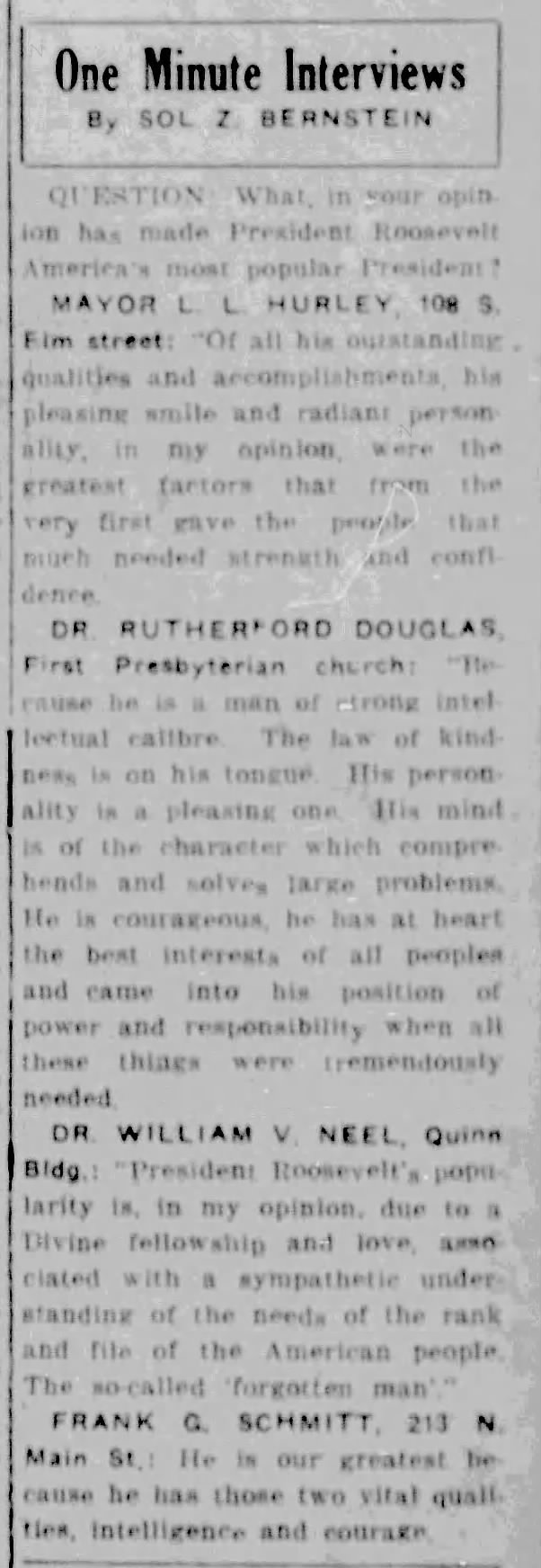
One Minute Interviews — By Sol Z. Bernstein
Henderson Morning Gleaner, Henderson, Kentucky — November 13, 1934.
Question: What, in your opinion has made President Roosevelt America’s most popular President?
Mayor L. L. Hurley, 104 S. Elm street: “Of all his outstanding qualities and accomplishment, his pleasing smile and radiant personality, in my opinion, were the greatest factors that from the very first gave the people that much needed strength and confidence.”
Dr. Rutherford Douglas, First Presbyterian church: “Because he is a man of strong intellectual calibre. ‘The law of kindness is on his tongue.’ His personality is a pleasing one. His mind is of the character which comprehends and solves large problems. He is courageous, he has at heart the best interests of all peoples and came into his position of power and responsibility when all these things were tremendously needed.”
Dr. William V. Neel, Quinn Bldg.: “President Roosevelt’s popularity is, in my opinion, due to a Divine fellowship and love, associated with a sympathetic understanding of the needs of the rank and file of the American people. The so-called ‘forgotten man.’”
Frank G. Schmitt, 213 N. Main St.: “He is our greatest because he has those two vital qualities, intelligence and courage.”
One Minute Interviews — By Sol Z. Bernstein
Henderson Morning Gleaner, Henderson, Kentucky — November 14, 1934.
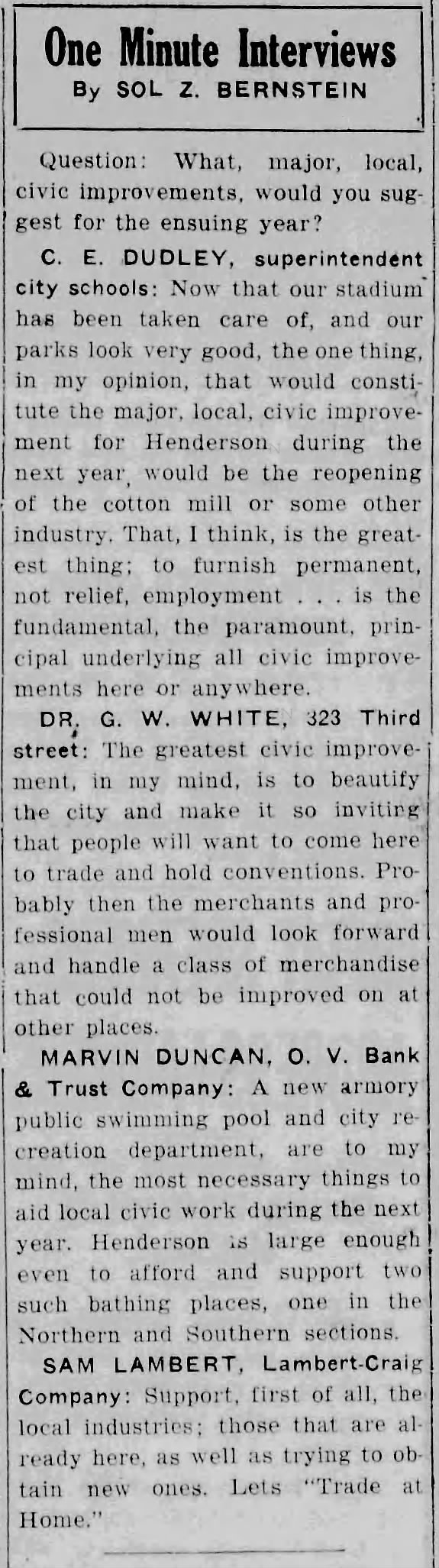
Question: What, major, local, civic improvements, would you suggest for the ensuing year?
C. E. Dudley, superintendent city schools: “Now that our stadium has been taken care of, and our parks look very good, the one thing, in my opinion, that would constitute the major local civic improvement for Henderson during the next year, would be the reopening of the cotton mill or some other industry. That, I think, is the greatest thing; to furnish permanent, not relief, employment . . . is the fundamental, the paramount, principal underlying all civic improvements here or anywhere.”
Dr. G. W. White, 323 Third street: “The greatest civic improvement, in my mind, is to beautify the city and make it so inviting that people will want to come here to trade and hold conventions. Probably then the merchants and professional men would look forward and handle a class of merchandise that could not be improved on at other places.”
Marvin Duncan, O. V. Bank & Trust Company: “A new armory public swimming pool and city recreation department, are to my mind, the most necessary things to aid local civic work during the next year. Henderson is large enough even to afford and support two such bathing places, one in the Northern and Southern sections.”
Sam Lambert, Lambert-Craig Company: “Support, first of all, the local industries; those that are already here, as well as trying to obtain new ones. Lets ‘Trade at Home.’”
One Minute Interviews — By Sol Z. Bernstein
Henderson Morning Gleaner, Henderson, Kentucky — November 15, 1934.
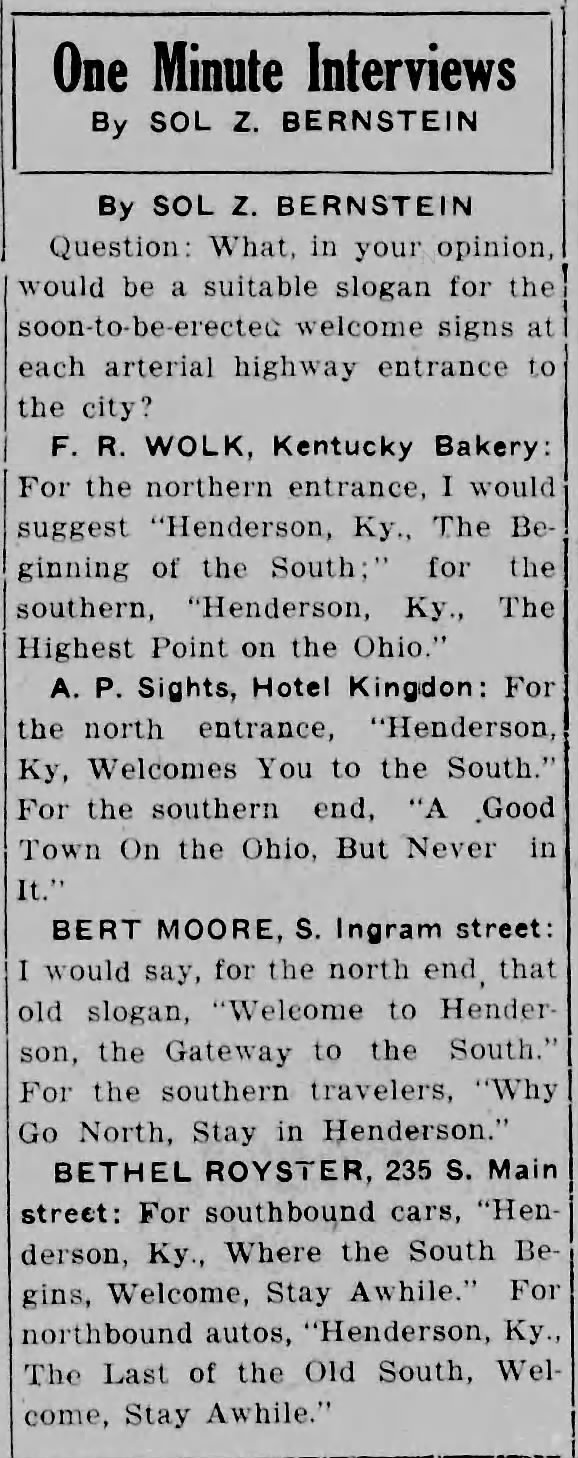
Question: What, in your opinion, would be a suitable slogan for the soon-to-be-erected welcome signs at each arterial highway entrance to the city?
F. R. Wolk, Kentucky Bakery: “For the northern entrance, I would suggest ‘Henderson, Ky., The Beginning of the South;’ for the southern, ‘Henderson, Ky., The Highest Point on the Ohio.’”
A. P. Sights, Hotel Kingdon: “For the north entrance, ‘Henderson, Ky, Welcomes You to the South.’ For the southern end, ‘A Good Town On the Ohio, But Never in It.’”
Bert Moore, S. Ingram street: “I would say, for the north end, that old slogan, ‘Welcome to Henderson, the Gateway to the South.’ For the southern travelers, ‘Why Go North, Stay in Henderson.’”
Bethel Royster, 235 S. Main street: “For southbound cars, ‘Henderson, Ky., Where the South Begins, Welcome, Stay Awhile.’ For northbound autos, ‘Henderson, Ky., The Last of the Old South, Welcome, Stay Awhile.’”
One Minute Interviews — By Sol Z. Bernstein
Henderson Morning Gleaner, Henderson, Kentucky — November 16, 1934.
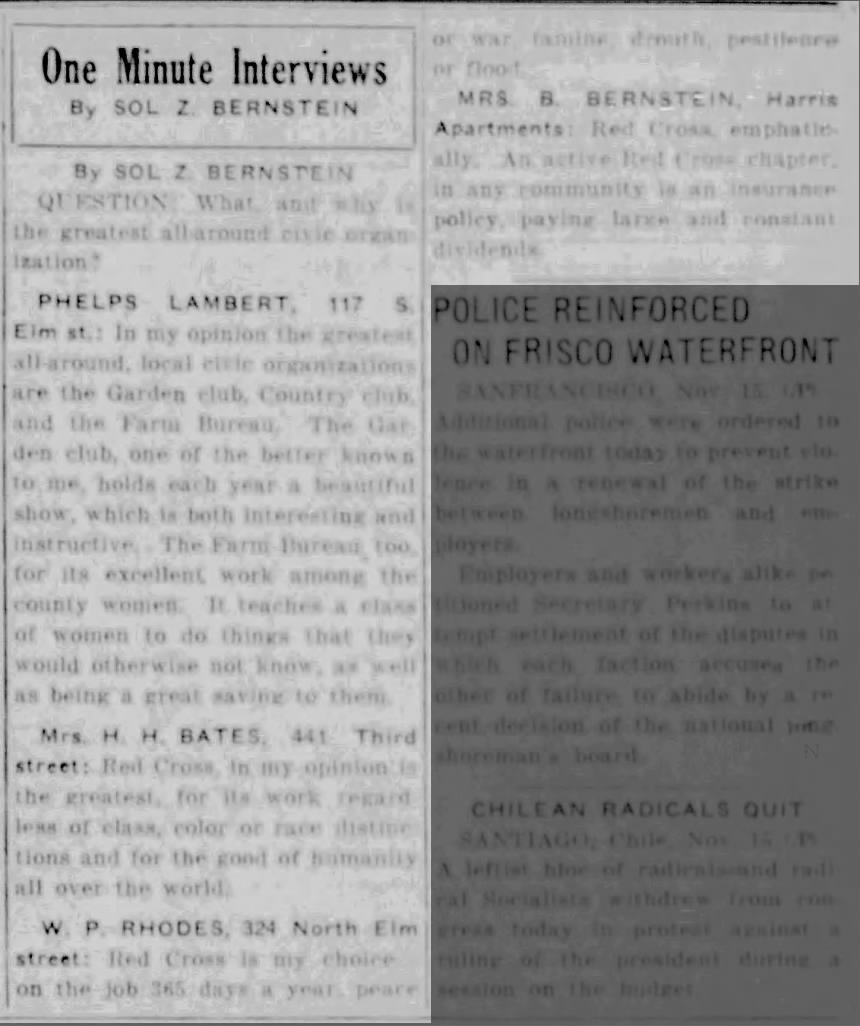
Question: What, and why is the greatest allaround civic organization?
Phelps Lambert, 117 S. Elm st.: “In my opinion the greatest all-around, local civic organizations are the Garden club, Country club, and the Farm Bureau. The Garden club, one of the better known to me, holds each year a beautiful show, which is both interesting and instructive. The Farm Bureau too, for its excellent work among the county women. It teaches a class of women to do things that they would otherwise not know, as well as being a great saving to them.”
Mrs. H. H. Bates, 441 Third street: “Red Cross, in my opinion is the greatest, for its work, regardless of class, color or race distinctions and for the good of humanity all over the world.”
W. P. Rhodes, 324 North Elm street: “Red Cross is my choice—on the job 365 days a year, peace or war, famine, drouth, pestilence or flood.”
Mrs. B. Bernstein, Harris Apartments: “Red Cross, emphatically. An active Red Cross chapter, in any community is an insurance policy paying large and constant dividends.”
One Minute Interviews — By Sol Z. Bernstein
Henderson Morning Gleaner, Henderson, Kentucky — November 17, 1934.
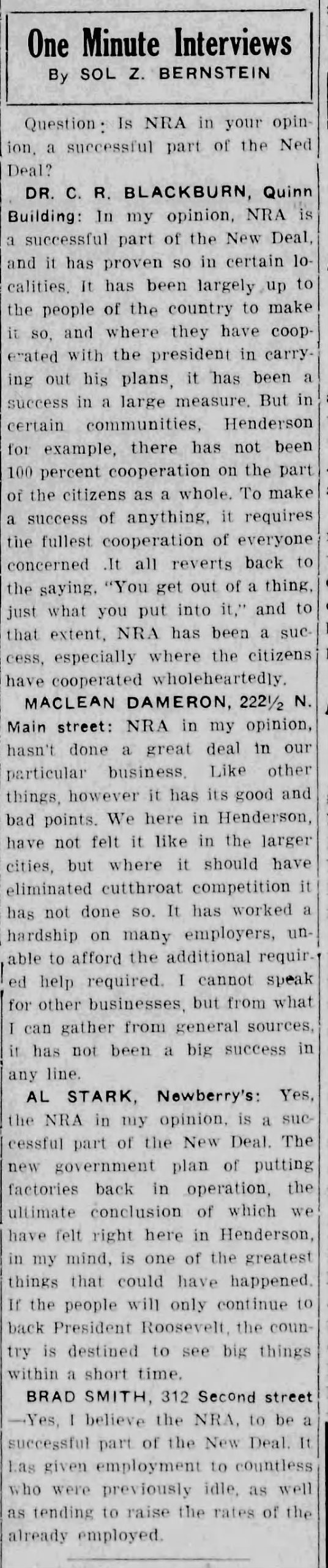
Question: Is NRA in your opinion, a successful part of the New Deal?
Dr. C. R. Blackburn, Quinn Building: “In my opinion, NRA is a successful part of the New Deal, and it has proven so in certain localities. It has been largely up to the people of the country to make it so, and where they have cooperated with the president in carrying out his plans, it has been a success in a large measure. But in certain communities, Henderson for example, there has not been 100 percent cooperation on the part of the citizens as a whole. To make a success of anything, it requires the fullest cooperation of everyone concerned. It all reverts back to the saying, ‘You get out of a thing, just what you put into it,’ and to that extent, NRA has been a success, especially where the citizens have cooperated wholeheartedly.”
Maclean Dameron, 222½ N. Main street: “NRA in my opinion, hasn’t done a great deal in our particular business. Like other things, however it has its good and bad points. We here in Henderson, have not felt it like in the larger cities, but where it should have eliminated cutthroat competition it has not done so. It has worked a hardship on many employers, unable to afford the additional required help required. I cannot speak for other businesses, but from what I can gather from general sources, it has not been a big success in any line.”
Al Stark, Newberry’s: “Yes, the NRA in my opinion, is a successful part of the New Deal. The new government plan of putting factories back in operation, the ultimate conclusion of which we have felt right here in Henderson, in my mind, is one of the greatest things that could have happened. If the people will only continue to back President Roosevelt, the country is destined to see big things within a short time.”
Brad Smith, 312 Second street: “Yes, I believe the NRA, to be a successful part of the New Deal. It has given employment to countless who were previously idle, as well as tending to raise the rates of the already employed.”
One Minute Interviews — By Sol Z. Bernstein
Henderson Morning Gleaner, Henderson, Kentucky — November 18, 1934.
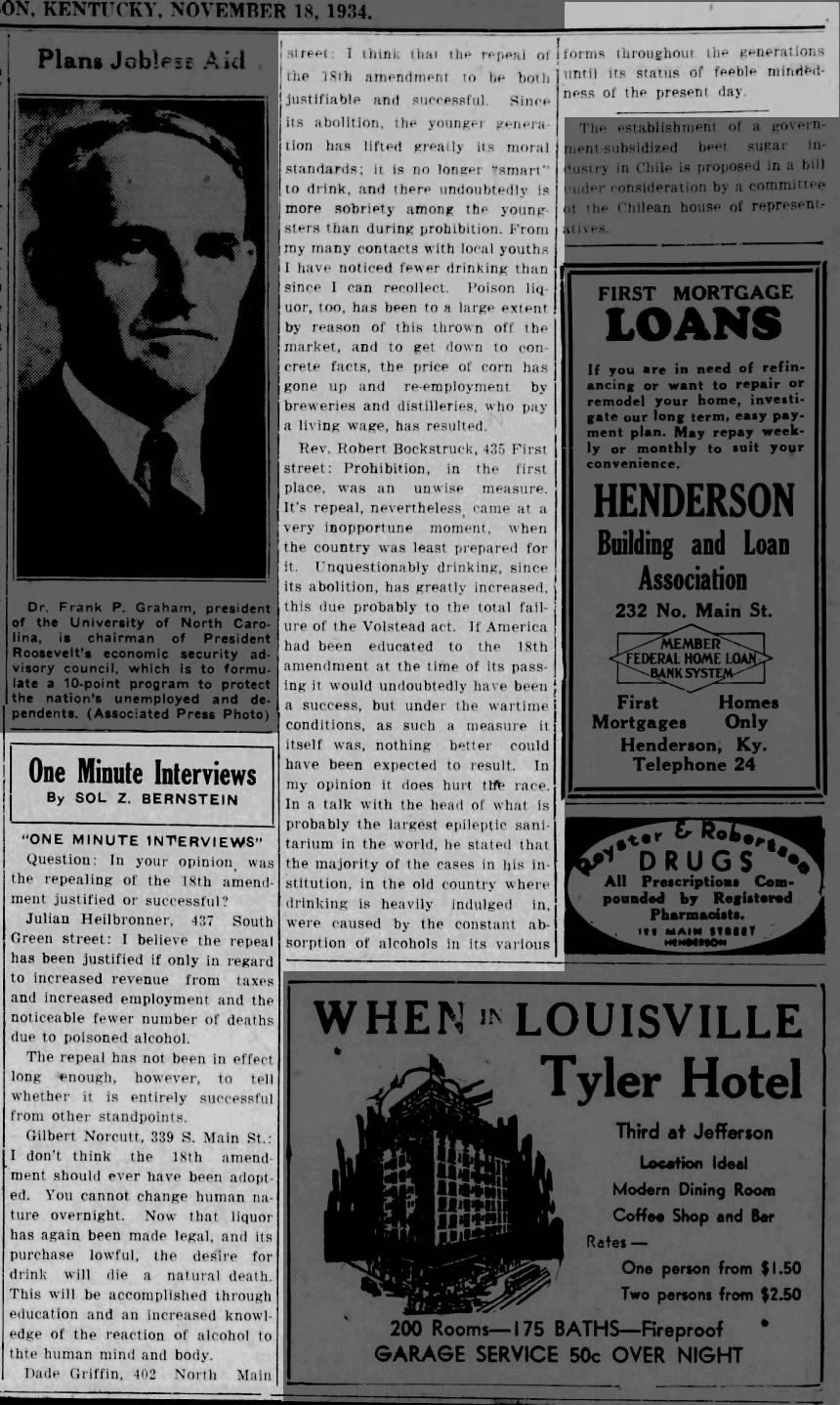
Question: In your opinion, was the repealing of the 18th amendment justified or successful?
Julian Heilbronner, 437 South Green street: “I believe the repeal has been justified if only in regard to increased revenue from taxes and increased employment and the noticeable fewer number of deaths due to poisoned alcohol.
“The repeal has not been in effect long enough, however, to tell whether it is entirely successful from other standpoints.”
Gilbert Norcutt, 339 S. Main St.: “I don’t think the 18th amendment should ever have been adopted. You cannot change human nature overnight. Now that liquor has again been made legal, and its purchase lowful, the desire for drink will die a natural death. This will be accomplished through education and an increased knowledge of the reaction of alcohol to the human mind and body.”
Dade Griffin, 402 North Main street: “I think that the repeal of the 18th amendment to be both justifiable and successful. Since its abolition, the younger generation has lifted greatly its moral standards; it is no longer ‘smart’ to drink, and there undoubtedly is more sobriety among the youngsters than during prohibition. From my many contacts with local youths I have noticed fewer drinking than since I can recollect. Poison liquor, too, has been to a large extent by reason of this thrown off the market, and to get down to concrete facts, the price of corn has gone up and re-employment by breweries and distilleries, who pay a living wage, has resulted.”
Rev. Robert Bockstruck, 435 First street: “Prohibition, in the first place, was an unwise measure. It’s repeal, nevertheless, came at a very inopportune moment, when the country was least prepared for it. Unquestionably drinking, since its abolition, has greatly increased, this due probably to the total failure of the Volstead act. If America had been educated to the 18th amendment at the time of its passing it would undoubtedly have been a success, but under the wartime conditions, as such a measure it itself was, nothing better could have been expected to result. In my opinion it does hurt the race. In a talk with the head of what is probably the largest epileptic sanitarium in the world, he stated that the majority of the cases in his institution, in the old country where drinking is heavily indulged in, were caused by the constant absorption of alcohols in its various forms throughout the generations until its status of feeble mindedness of the present day.”
One Minute Interviews — By Sol Z. Bernstein
Henderson Morning Gleaner, Henderson, Kentucky — November 20, 1934.
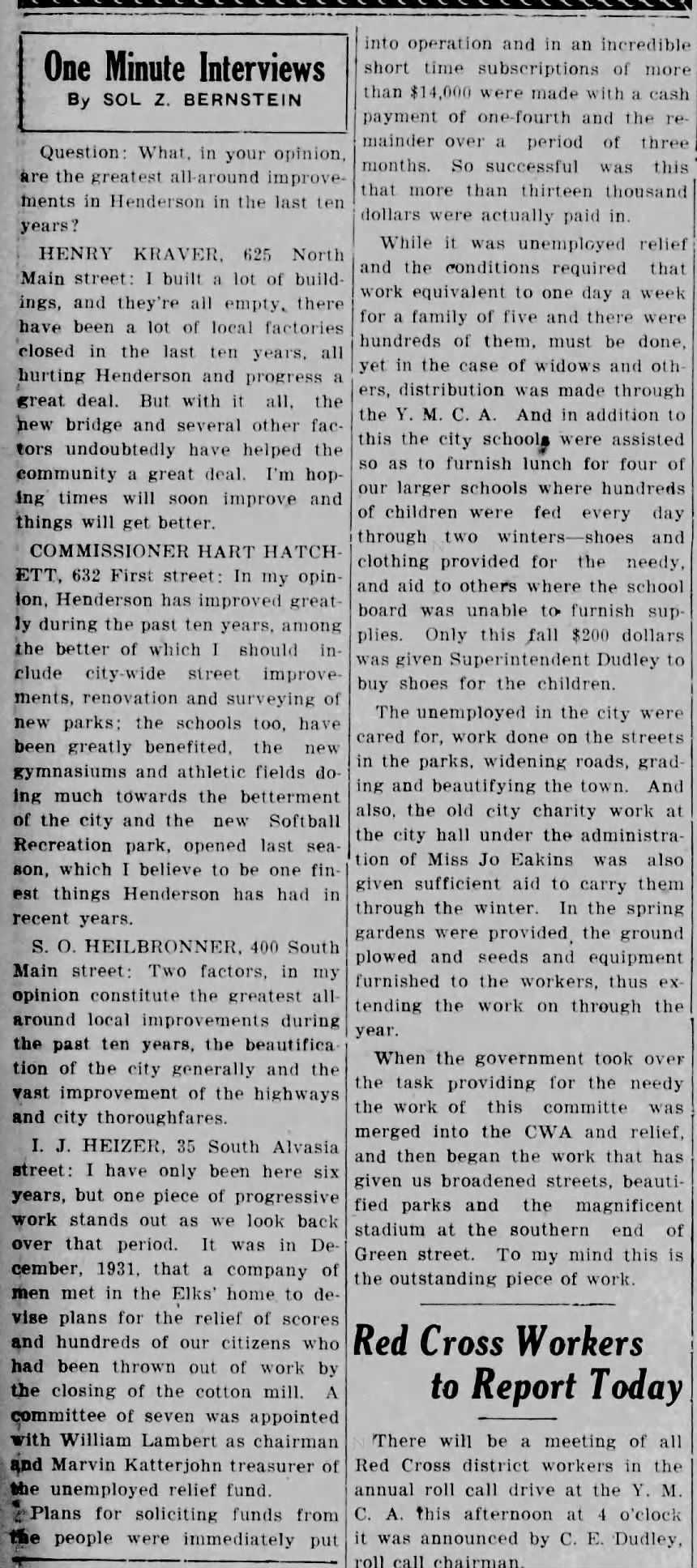
Question: What, in your opinion, are the greatest all-around improvements in Henderson in the last ten years?
Henry Kraver, 625 North Main street: “I built a lot of buildings, and they’re all empty, there have been a lot of local factories closed in the last ten years, all hurting Henderson and progress a great deal. But with it all, the new bridge and several other factors undoubtedly have helped the community a great deal. I’m hoping times will soon improve and things will get better.”
[Compilation note: Kraver disputed portions of this interview in an editor’s note published November 21, 1934. That correction is transcribed at the beginning of the following entry.]
Commissioner Hart Hatchett, 632 First street: “In my opinion, Henderson has improved greatly during the past ten years, among the better of which I should include city-wide street improvements, renovation and surveying of new parks; the schools too, have been greatly benefited, the new gymnasiums and athletic fields doing much towards the betterment of the city and the new Softball Recreation park, opend last season, which I believe to be one finest things Henderson has had in recent years.”
S. O. Heilbronner, 400 South Main street: “Two factors, in my opinion constitute the greatest all-round local improvements during the past ten years, the beautification of the city generally and the vast improvement of the highways and city thoroughfares.”
I. J. Heizer, 35 South Alvasia street: “I have only been here six years, but one piece of progressive work stands out as we look back over that period. It was in December, 1931, that a company of men met in the Elks’ home to devise plans for the relief of scores and hundreds of our citizens who had been thrown out of work by the closing of the cotton mill. A committee of seven was appointed with William Lambert as chairman and Marvin Katterjohn treasurer of the unemployed relief fund.
“Plans for soliciting funds from the people were immediately put into operation and in an incredible short time subscriptions of more than $14,000 were made with a cash payment of one-fourth and the remainder over a period of three months. So successful was this that more than thirteen thousand dollars were actually paid in.
“While it was unemployed relief and the conditions required that work equivalent to one day a week for a family of five and there were hundreds of them, must be done, yet in the case of widows and others, distribution was made through the Y. M. C. A. And in addition to this the city schools were assisted so as to furnish lunch for four of our larger schools where hundreds of children were fed every day through two winters—shoes and clothing provided for the needy, and aid to others where the school board was unable to furnish supplies. Only this fall $200 dollars was given Superintendent Dudley to buy shoes for the children.
“The unemployed in the city were cared for, work done on the streets in the parks, widening roads, grading and beautifying the town. And also, the old city charity work at the city hall under the administration of Miss Jo Eakins was also given sufficient aid to carry them through the winter. In the spring gardens were provided, the ground plowed and seeds and equipment furnished to the workers, thus extending the work on through the year.
“When the government took over the task providing for the needy the work of this committe was merged into the CWA and relief, and then began the work that has given us broadened streets, beautified parks and the magnificent stadium at the southern end of Green street. To my mind this is the outstanding piece of work.”
One Minute Interviews — By Sol Z. Bernstein
Henderson Morning Gleaner, Henderson, Kentucky — November 21, 1934.
Editor’s note: In connection with an interview appearing in this column Tuesday, Henry Kraver, 625 North Main street, said last night that he did not say that all his buildings were empty, and did not intend to convey the impression that the new bridge is helping Henderson’s business. “All my building are rented except the Montgomery-Ward store,” he said. “I have always been for Henderson first, and will continue to be.”
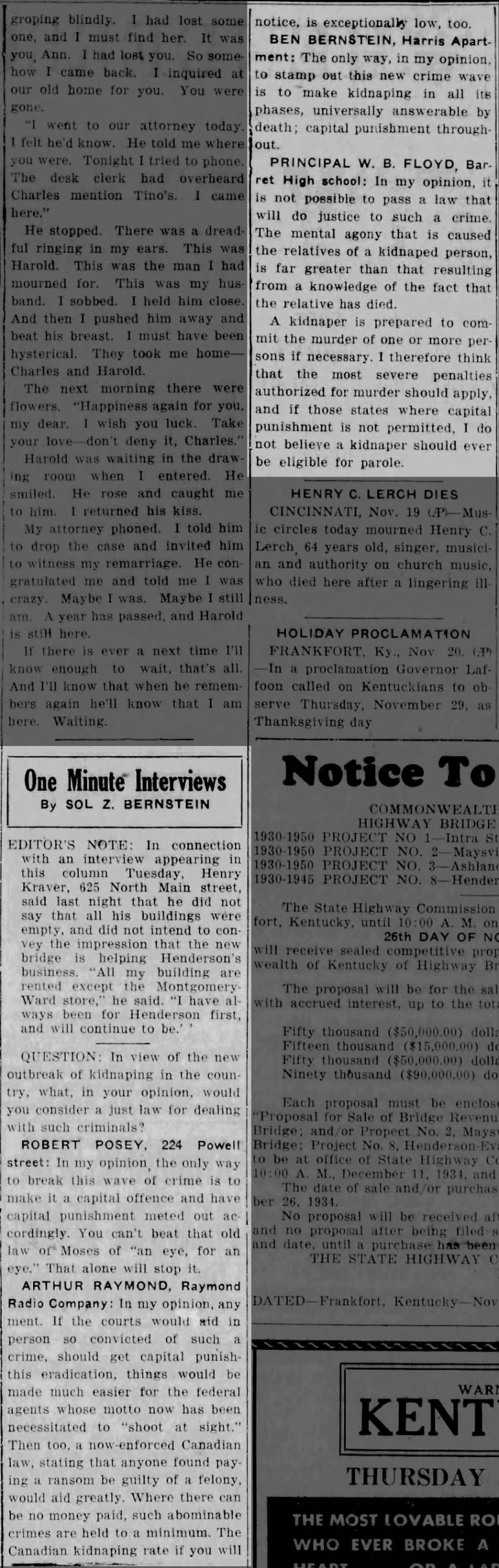
Question: In view of the new outbreak of kidnaping in the country, what, in your opinion, would you consider a just law for dealing with such criminals?
Robert Posey, 224 Powell street: “In my opinion, the only way to break this wave of crime is to make it a capital offence and have capital punishment meted out accordingly. You can’t beat that old law of Moses of ‘an eye, for an eye.’ That alone will stop it.”
Arthur Raymond, Raymond Radio Company: “In my opinion, any person so convicted of such a crime, should get capital punishment. If the courts would aid in this eradication, things would be made much easier for the federal agents whose motto now has been necessitated to ‘shoot at sight.’ Then too, a now-enforced Canadian law, stating that anyone found paying a ransom be guilty of a felony, would aid greatly. Where there can be no money paid, such abominable crimes are held to a minimum. The Canadian kidnaping rate if you will notice, is exceptionally low, too.”
Ben Bernstein, Harris Apartment: “The only way, in my opinion, to stamp out this new crime wave is to make kidnaping in all its phases, universally answerable by death; capital punishment throughout.”
Principal W. B. Floyd, Barret High school: “In my opinion, it is not possible to pass a law that will do justice to such a crime. The mental agony that is caused the relatives of a kidnaped person, is far greater than that resulting from a knowledge of the fact that the relative has died.
“A kidnaper is prepared to commit the murder of one or more persons if necessary. I therefore think that the most severe penalties authorized for murder should apply, and if those states where capital punishment is not permitted, I do not believe a kidnaper should ever be eligible for parole.”
One Minute Interviews — By Sol Z. Bernstein
Henderson Morning Gleaner, Henderson, Kentucky — November 22, 1934.
Question: Who, in your opinion, are the three leading exponents of local football in recent years?
Coaach Arch Riehl, Barret High school: “In my opinion, the three leading exponents of the gridiron in recent years are Basan, of course, whom I consider the most outstanding player Henderson has ever produced. He could do everything and do it well. He was one of the best all-round kickers and passers from this section.
“In second place I would list Danheiser one of the best runners and ball carriers we have ever had, as well as the best quarterback.
“For third place I should name Jimmy Miller, undoubtedly the most [dependable?], best offensive fullback we ever had. He was always best in a crisis, doing his outstanding playing in a hard game.
“It would be unfair in this group to omit the name too, of Fred Schuette, star of two years ago, who comes very close, in my opinion, to the above-named players. Of course this list is compiled during the last few years since I’ve been here. Of the great Trimpe and several other reputedly excellent men, I, of course, have no knowledge.”
Marvin L. Watson, Harris apartments: “It is rather hard to name three outstanding players offhand from the teams that have represented B. M. T. H. S., as there have been some very good men that have romped up and down that old fair grounds field. But as you say in recent years, the three that come to my mind are three men who played outstanding ball while in high school and stood out from the rest of the players, namely: Basan, Schuette and Paul Danheiser.
“From the spectators’ point of view, these boys showed up well and one could tell they took coaching, kept training and took their football seriously, which are three things that help to make a good football player. There have been others back farther, who have meant a lot to B. M. T. H. S., Buddy Duncan, Trimpe—but that’s getting in the baldheaded row and you only asked for three so take it away.”
C. C. Crafton, assistant coach, B. M. T. H. S.: “In my opinion the three leading exponents of local football would be: first, Lucien Trimpe, a boy especially good both as a fullback and as a tackle. His punting, place kicking were both exceptional, because he was a man when you needed the man. No one in my opinion, has come near his record.
“And for the rest of the places I would name Bob Nichols as a good a center and lineman ever graduated by Henderson high; Paul Danheiser, a good leader, one whom the boys would and did follow, a good ball carrier, and general all around A-1 quarterback; and lastly Sam Basan, a boy good on both defensive and offensive and who is one of the best ball carriers the school has ever had.”
W. G. Schoepflin: “Elmer Hopkins, quarterback; Lucien Trimpe, kicking; Sam Basan, all-around play.”
One Minute Interviews — By Sol Z. Bernstein
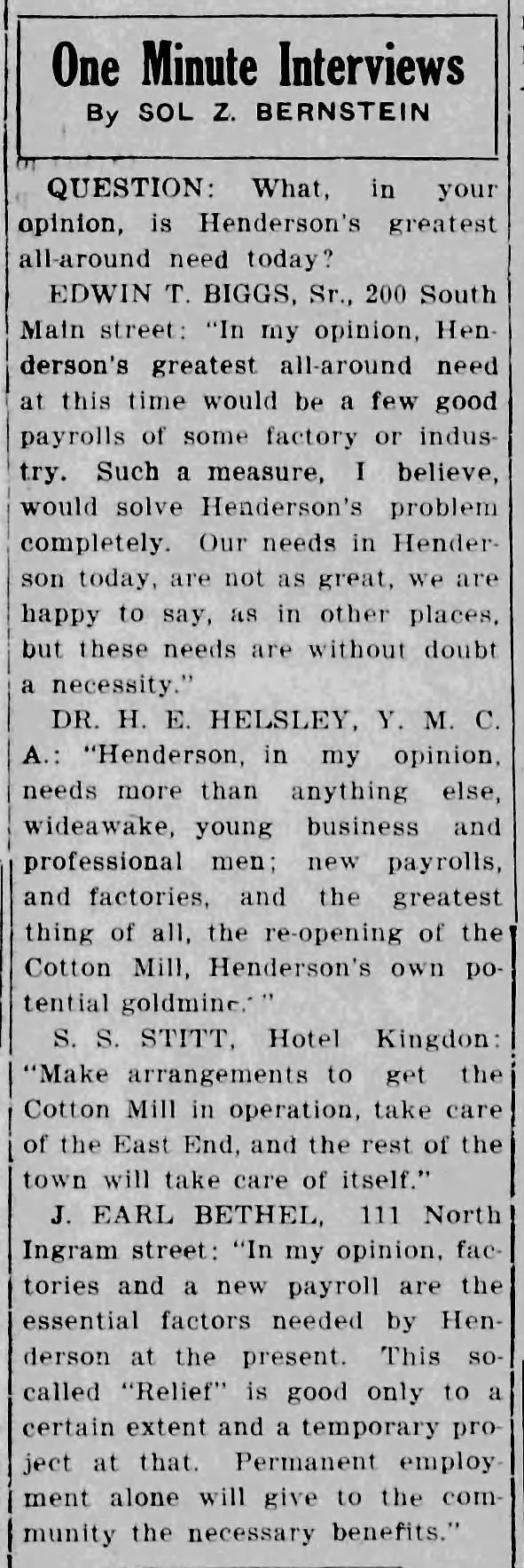
Henderson Morning Gleaner, Henderson, Kentucky — November 23, 1934.
Question: What, in your opinion, is Henderson’s greatest all-around need today?
Edwin T. Biggs, Sr., 200 South Main street: “In my opinion, Henderson’s greatest all-around need at this time would be a few good payrolls of some factory or industry. Such a measure, I believe, would solve Henderson’s problem completely. Our needs in Henderson today, are not as great, we are happy to say, as in other places, but these needs are without doubt a necessity.”
Dr. H. E. Helsley, Y. M. C. A.: “Henderson, in my opinion, needs more than anything else, wideawake, young business and professional men; new payrolls, and factories, and the greatest thing of all, the re-opening of the Cotton Mill, Henderson’s own potential goldmine.”
S. S. Stitt, Hotel Kingdon: “Make arrangements to get the Cotton Mill in operation, take care of the East End, and the rest of the town will take care of itself.”
J. Earl Bethel, 111 North Ingram street: “In my opinion, factories and a new payroll are the essential factors needed by Henderson at the present. This so-called ‘Relief’ is good only to a certain extent and a temporary project at that. Permanent employment alone will give to the community the necessary benefits.”
One Minute Interviews — By Sol Z. Bernstein
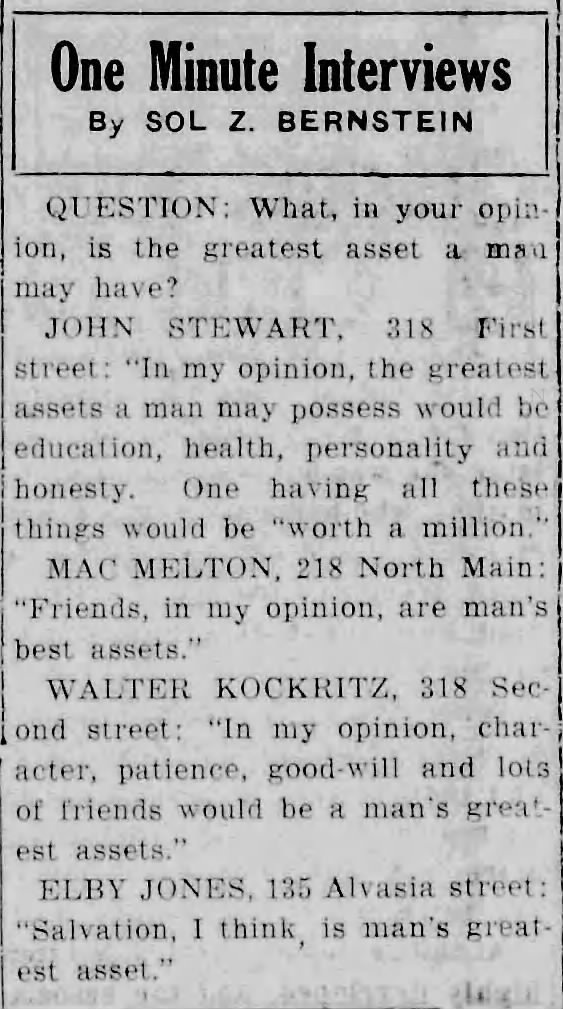
Henderson Morning Gleaner, Henderson, Kentucky — November 24, 1934.
Question: What, in your opinion, is the greatest asset a man may have?
John Stewart, 318 First street: “In my opinion, the greatest assets a man may possess would be education, health, personality and honesty. One having all these things would be ‘worth a million.’”
Mac Melton, 218 North Main: “Friends, in my opinion, are man’s best assets.”
Walter Kockritz, 318 Second street: “In my opinion, character, patience, good-will and lots of friends would be a man’s greatest assets.”
Elby Jones, 135 Alvasia street: “Salvation, I think, is man’s greatest asset.”
One Minute Interviews — By Sol Z. Bernstein
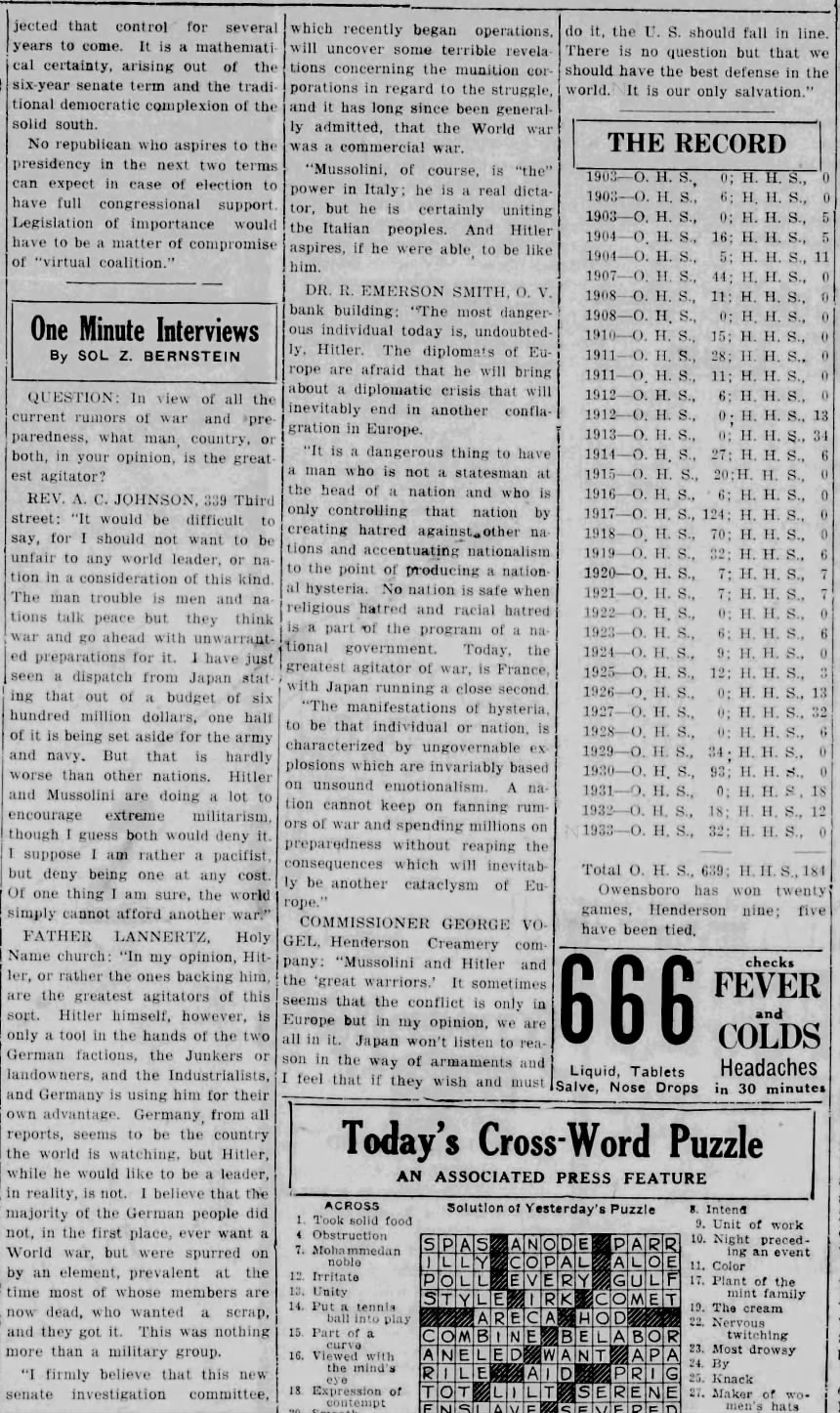
Henderson Morning Gleaner, Henderson, Kentucky — November 27, 1934.
Question: In view of all the current rumors of war and preparedness, what man, country, or both, in your opinion, is the greatest agitator?
Rev. A. C. Johnson, 339 Third street: “It would be difficult to say, for I should not want to be unfair to any world leader, or nation in a consideration of this kind. The man trouble is men and nations talk peace but they think war and go ahead with unwarranted preparations for it. I have just seen a dispatch from Japan stating that out of a budget of six hundred million dollars, one half of it is being set aside for the army and navy. But that is hardly worse than other nations. Hitler and Mussolini are doing a lot to encourage extreme militarism, though I guess both would deny it. I suppose I am rather a pacifist, but deny being one at any cost. Of one thing I am sure, the world simply cannot afford another war.”
Father Lannertz, Holy Name church: “In my opinion, Hitler, or rather the ones backing him, are the greatest agitators of this sort. Hitler himself, however, is only a tool in the hands of the two German factions, the Junkers or landowners, and the Industrialists, and Germany is using him for their own advantage. Germany, from all reports, seems to be the country the world is watching, but Hitler, while he would like to be a leader, in reality, is not. I believe that the majority of the German people did not, in the first place, ever want a World war, but were spurred on by an element, prevalent at the time most of whose members are now dead, who wanted a scrap, and they got it. This was nothing more than a military group.
“I firmly believe that this new senate investigation committee, which recently began operations, will uncover some terrible revelations concerning the munition corporations in regard to the struggle, and it has long since been generally admitted, that the World war was a commercial war.
“Mussolini, of course, is ‘the’ power in Italy; he is a real dictator, but he is certainly uniting the Italian peoples. And Hitler aspires, if he were able, to be like him.”
Dr. R. Emerson Smith, O. V. bank building: “The most dangerous individual today is, undoubtedly, Hitler. The diplomats of Europe are afraid that he will bring about a diplomatic crisis that will inevitably end in another conflagration in Europe.
“It is a dangerous thing to have a man who is not a statesman at the head of a nation and who is only controlling that nation by creating hatred against other nations and accentuating nationalism to the point of producing a national hysteria. No nation is safe when religious hatred and racial hatred is a part of the program of a national government. Today, the greatest agitator of war, is France, with Japan running a close second.
“The manifestations of hysteria, to be that individual or nation, is characterized by ungovernable explosions which are invariably based on unsound emotionalism. A nation cannot keep on fanning rumors of war and spending millions on preparedness without reaping the consequences which will inevitably be another cataclysm of Europe.”
Commissioner George Vogel, Henderson Creamery company: “Mussolini and Hitler and the ‘great warriors.’ It sometimes seems that the conflict is only in Europe but in my opinion, we are all in it. Japan won’t listen to reason in the way of armaments and I feel that if they wish and must do it, the U. S. should fall in line. There is no question but that we should have the best defense in the world. It is our only salvation.”
One Minute Interviews — By Sol Z. Bernstein
Henderson Morning Gleaner, Henderson, Kentucky — November 28, 1934.
Question: What, in your opinion, is President Roosevelt’s greatest work in his present capacity?
G. Kembel, 308 First street: “In my opinion, President Roosevelt’s greatest work, undoubtedly, was the straightening out of the banks.”
Felix B. Smith, 210 Hancock Street: “In my opinion, President Roosevelt’s greatest work since he has been in office, is the Nation-wide Relief Program. The Red Cross is one part of his idea of ‘Service to Humanity.’ He is an idealist with plans for the regeneration of society.”
Hugh Helm, Jr., 703 Center street: “A question of this sort is rather difficult to answer, the excellent works of President Roosevelt being too numerous to list, but of these, the closing of the banks and other measures pertaining to it aided the situation greatly. The Reconstruction Finance Corporation, the C.C.C., and the relieving of the unemployed and then possibly the greatest [thing?] of all, the changing of the attitude of the American people. When he came into office, things looked gloomy, and the people as a whole were downcast, but now I believe the feeling to be much more optimistic, the people have more faith in the government, and the general attitude of everyone has brightened considerably.”
William Dunnigan, Grasty Bldg.: “In my opinion, the C.C.C., H. O. L. C., and other similar economic organizations are President Roosevelt’s greatest works. They have done more than anything else to bring renewed interest of the people and bring the country out of the economic slump into which it had fallen, which may be measured with the recent increase of trade, commerce, etc.”
One Minute Interviews — By Sol Z. Bernstein
Henderson Morning Gleaner, Henderson, Kentucky — December 9, 1934.
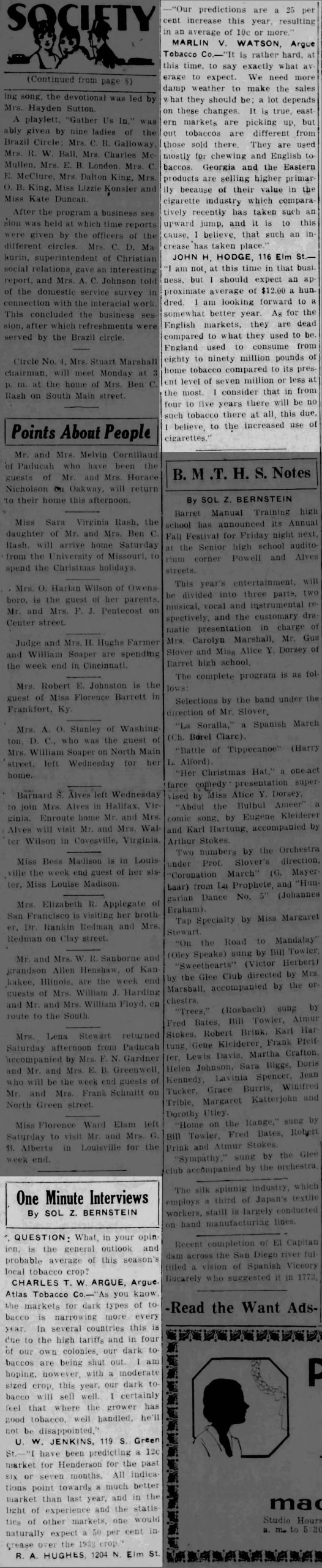
Question: What, in your opinion, is the general outlook and probable average of this season’s local tobacco crop?
Charles T. W. Argue, Argue-Atlas Tobacco Co.: “As you know, the markets for dark types of tobacco is narrowing more every year. In several countries this is due to the high tariffs and in four of our own colonies, our dark tobaccos are being shut out. I am hoping, however, with a moderate sized crop, this year, our dark tobacco will sell well. I certainly feel that where the grower has good tobacco, well handled, he’ll not be disappointed.”
U. W. Jenkins, 119 S. Green St.: “I have been predicting a 12c market for Henderson for the past six or seven months. All indications point towards a much better market than last year, and in the light of experience and the statistics of other markets, one would naturally expect a 50 per cent increase over the 1933 crop.”
R. A. Hughes, 1204 N. Elm St.: “Our predictions are a 25 per cent increase this year, resulting in an average of 10c or more.”
Marlin V. Watson, Argue Tobacco Co.: “It is rather hard, at this time, to say exactly what average to expect. We need more damp weather to make the sales what they should be; a lot depends on these changes. It is true, eastern markets are picking up, but out tobaccos are different from those sold there. They are used mostly for chewing and English tobaccos. Georgia and the Eastern products are selling higher primarily because of their value in the cigarette industry which comparatively recently has taken such an upward jump, and it is to this cause, I believe, that such an increase has taken place.”
John H. Hodge, 116 Elm St.: “I am not, at this time in that business, but I should expect an approximate average of $12.00 a hundred. I am looking forward to a somewhat better year. As for the English markets, they are dead compared to what they used to be. England used to consume from eighty to ninety million pounds of home tobacco compared to its present level of seven million or less at the most. I consider that in from four to five years there will be no such tobacco there at all, this due, I believe, to the increased use of cigarettes.”
One Minute Interviews — By Sol Z. Bernstein
Henderson Morning Gleaner, Henderson, Kentucky — December 12, 1934.
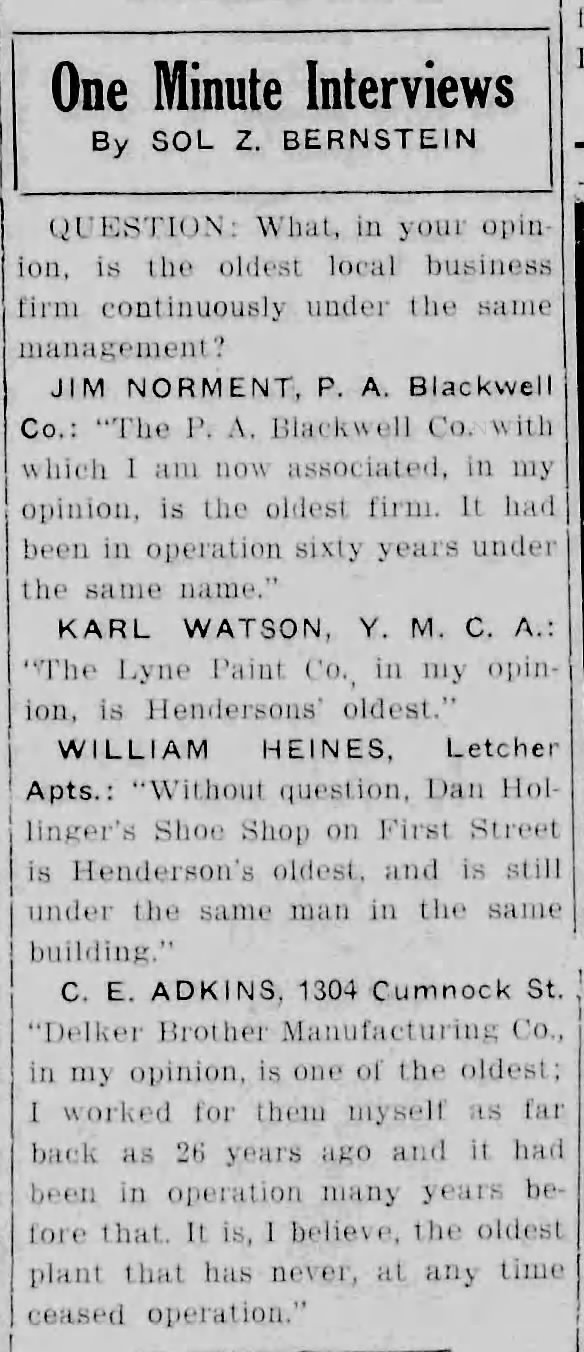
Question: What, in your opinion, is the oldest local business firm continuously under the same management?
Jim Norment, P. A. Blackwell Co.: “The P. A. Blackwell Co. with which I am now associated, in my opinion, is the oldest firm. It had been in operation sixty years under the same name.”
Karl Watson, Y. M. C. A.: “The Lyne Paint Co., in my opinion, is Hendersons’ oldest.”
William Heines, Letcher Apts.: “Without question, Dan Hollinger’s Shoe Shop on First Street is Henderson’s oldest, and is still under the same man in the same building.”
C. E. Adkins, 1304 Cumnock St.: “Delker Brother Manufacturing Co., in my opinion, is one of the oldest; I worked for them myself as far back as 26 years ago and it had been in operation many years before that. It is, I believe, the oldest plant that has never, at any time, ceased operation.”
One Minute Interviews — By Sol Z. Bernstein
Henderson Morning Gleaner, Henderson, Kentucky — December 15, 1934.
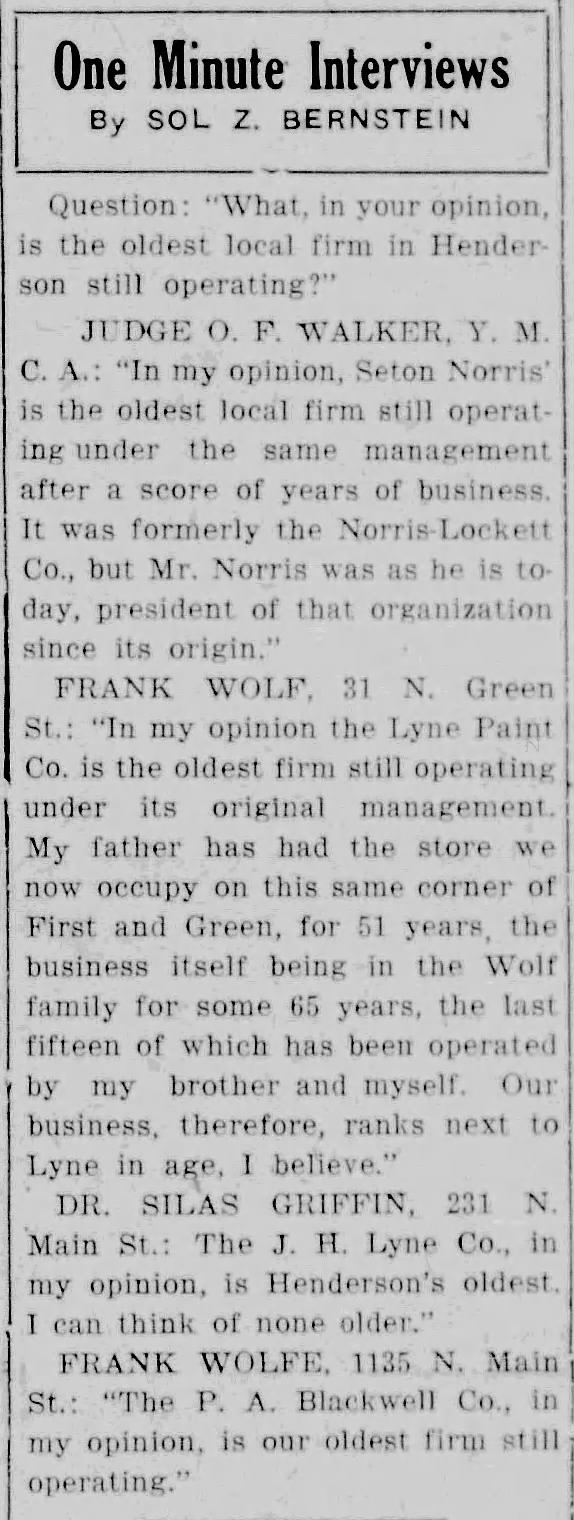
Question: “What, in your opinion, is the oldest local firm in Henderson still operating?”
Judge O. F. Walker, Y. M. C. A.: “In my opinion, Seton Norris’ is the oldest local firm still operating under the same management after a score of years of business. It was formerly the Norris-Lockett Co., but Mr. Norris was as he is today, president of that organization since its origin.”
Frank Wolf, 31 N. Green St.: “In my opinion the Lyne Paint Co. is the oldest firm still operating under its original management. My father has had the store we now occupy on this same corner of First and Green, for 51 years, the business itself being in the Wolf family for some 65 years, the last fifteen of which has been operated by my brother and myself. Our business, therefore, ranks next to Lyne in age, I believe.”
Dr. Silas Griffin, 231 N. Main St.: “The J. H. Lyne Co., in my opinion, is Henderson’s oldest. I can think of none older.”
Frank Wolfe, 1135 N. Main St.: “The P. A. Blackwell Co., in my opinion, is our oldest firm still operating.”
One Minute Interviews — By Sol Z. Bernstein
Henderson Morning Gleaner, Henderson, Kentucky — December 16, 1934.
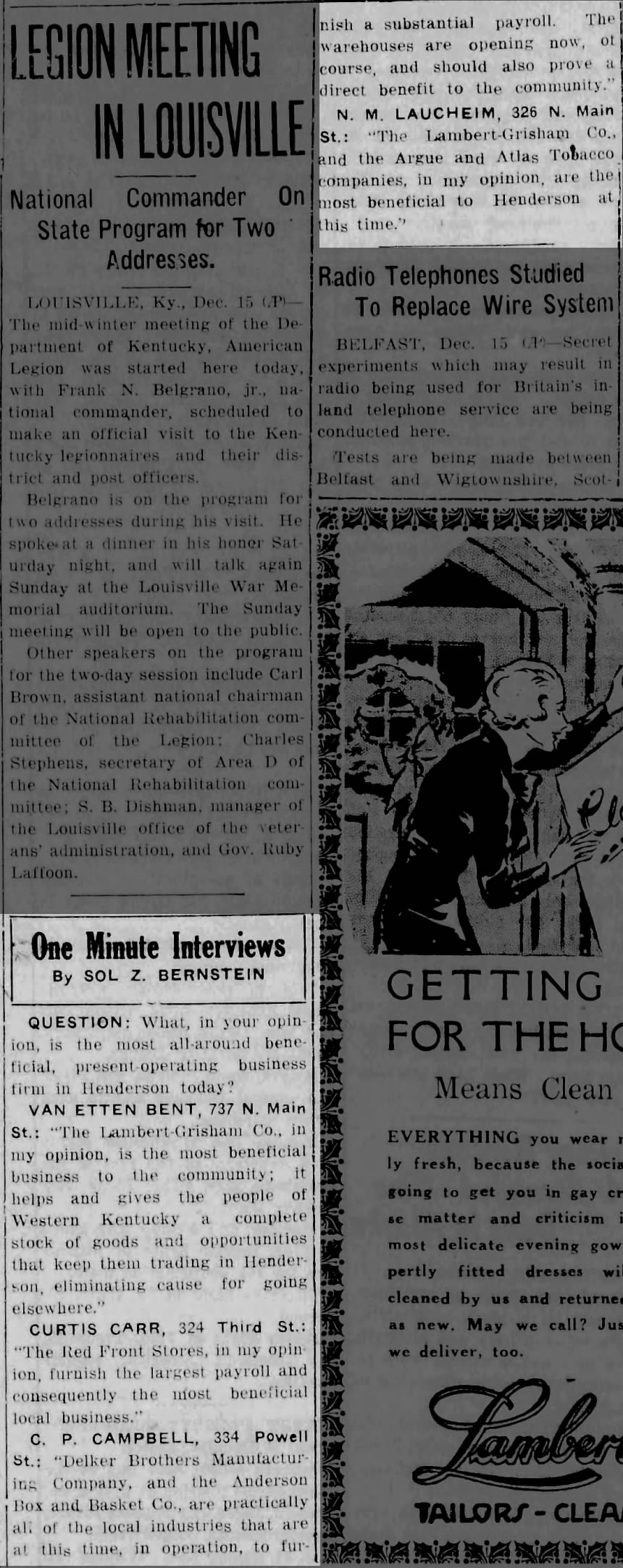
Question: What, in your opinion, is the most all-around beneficial, present-operating business firm in Henderson today?
Van Etten Bent, 737 N. Main St.: “The Lambert-Grisham Co., in my opinion, is the most beneficial business to the community; it helps and gives the people of Western Kentucky a complete stock of goods and opportunities that keep them trading in Henderson, eliminating cause for going elsewhere.”
Curtis Carr, 324 Third St.: “The Red Front Stores, in my opinion, furnish the largest payroll and consequently the most beneficial local business.”
C. P. Campbell, 334 Powell St.: “Delker Brothers Manufacturing Company, and the Anderson Box and Basket Co., are practically all of the local industries that are at this time, in operation, to furnish a substantial payroll. The warehouses are opening now, of course, and should also prove a direct benefit to the community.”
N. M. Lauchheim, 326 N. Main St.: “The Lambert-Grisham Co., and the Argue and Atlas Tobacco companies, in my opinion, are the most beneficial to Henderson at this time.”
One Minute Interviews — By Sol Z. Bernstein
Henderson Morning Gleaner, Henderson, Kentucky — December 25, 1934.
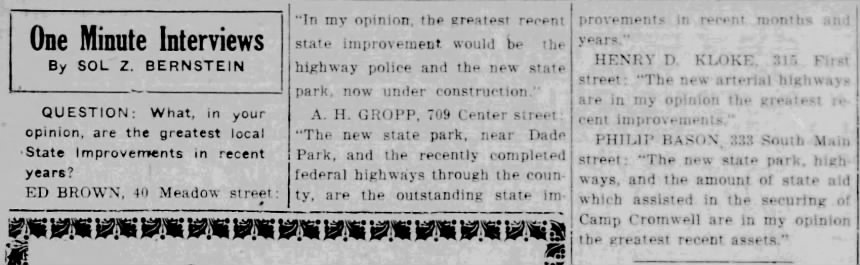
Question: What, in your opinion, are the greatest local State Improvements in recent years?
Ed Brown, 40 Meadow street: “In my opinion, the greatest recent state improvement would be the highway police and the new state park, now under construction.”
A. H. Gropp, 709 Center street: “The new state park, near Dade Park, and the recently completed federal highways through the county, are the outstanding state improvements in recent months and years.”
Henry D. Kloke, 315 First street: “The new arterial highways are in my opinion the greatest recent improvements.”
Philip Bason, 333 South Main street: “The new state park, highways, and the amount of state aid which assisted in the securing of Camp Cromwell are in my opinion the greatest recent assets.”
One Minute Interviews — By Sol. Z. Bernstein
Henderson Morning Gleaner, Henderson, Kentucky — March 17, 1935.
Question: “What, in your opinion, is the value of the Y.M.C.A. to this community?”
Rev. A. C. Johnson, First Methodist Church: “I regard the Y. M. C. A. as an indispensable asset to this city, for the reason that it combines wholesome physical activity with moral teaching and character. And the two can hardly be separated. If we are to develop strong character among the young people of today, we must furnish the proper facilities for the expression of their physical life. life. That, I believe, our ‘Y’ does in a very admirable manner. Surely, such an organization, representing these ideals, deserves the unqualified support of every citizen of this community, regardless of race or creed.”
R. H. Humber, Humber Lumber Co.: “The Y. M. C. A. serves approximately 500 citizens each week. The unselfish attention to all, regardless of church affiliation, is only a part of the well-round program. The ‘Y’ strives always to train the boy in Christian relationships with his fellow playmates, as well as direct his physical growth.”
Ellen G. Young, Seventh St. School: “I hesitate to express my opinion on the work, because I am not as familiar with it as I ought to be, but any institution with an objective like the Y. M. C. A. is of great benefit to a community even though it falls short of its aim. I am sure the Y. M. C. A. is doing far more than any of us realize.”
Judge R. F. Crafton, County Court: “As an ally to the churches, the Y. M. C. A. has a high place in the life of the community.”
Dr. Brown B. Smith, First Baptist Church: “The value of the Y. M. C. A. to the community is measured by the value of our boys and girls—and these are our chiefest asset.”
Gibney Oscar Letcher, Anderson Box and Crate Co.: “It is impossible to place the value of the Y. M. C. A. to this community in dollars and cents. If the proper principles should be inculcated in a dozen boys a year then it is worth more than the combines assets of all corporations in our town. Aside from the spiritual and physical development of our young men, I would say that its greatest value is the splendid work being done with the boys and girls because they are the future citizens of our community.”
Supt. N. O. Kimbler, Henderson County Schools: “The Y. M. C. A. is worth a lot more than it costs.”
C. E. Dudley, City Schools: “I am of the opinion that it is of the greatest importance to Henderson that the budget for the ensuing year should raised in order that we …”


Leave a Reply