Alonzo J. “A. J.” Stratman: The Henderson Industrialist Behind Stratman Road
Every day, hundreds of motorists travel Stratman Road in Henderson County, yet few know the story of the man whose name it bears. Long before the road became a modern connector between U.S. Highway 41 and Sunset Lane, it honored one of Henderson’s earliest industrial pioneers, a man whose vision helped shape the city’s infrastructure during the dawn of the twentieth century.
Alonzo J. “Lon” Stratman was far more than a contractor. He was a builder, manufacturer, entrepreneur, and employer whose concrete products laid sidewalks, foundations, bridges, and public improvements across western Kentucky. Although most of his buildings have disappeared and his own grave bears no individual marker, his legacy endures through the roadway that still carries his name.
A Henderson Native
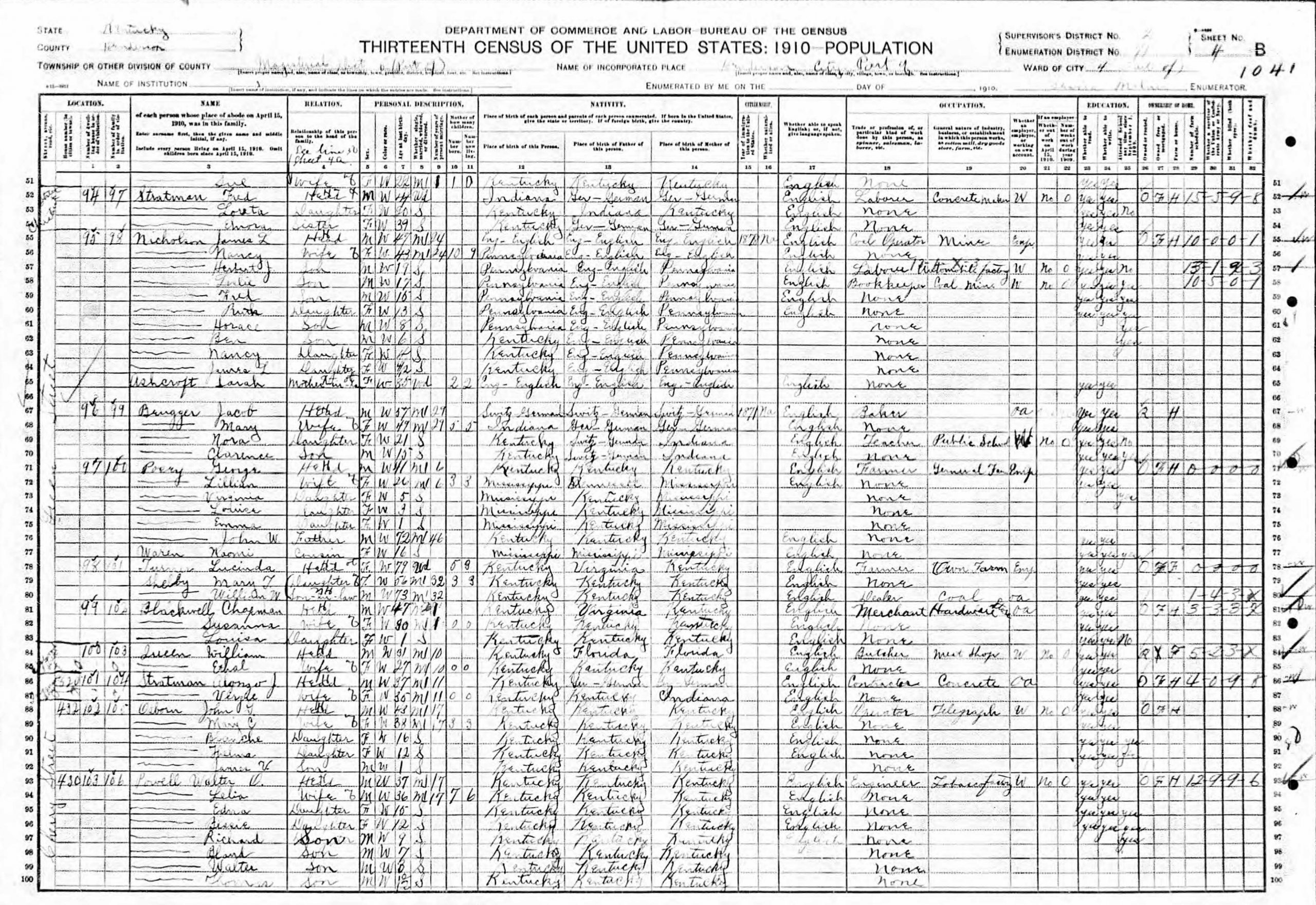
Alonzo J. Stratman was born in Henderson County around 1877, the son of Henry Stratman and Frederica Stratman. Census records place the family in Henderson throughout his youth, where Henry worked as a concrete contractor, suggesting that Alonzo learned the trade from an early age.
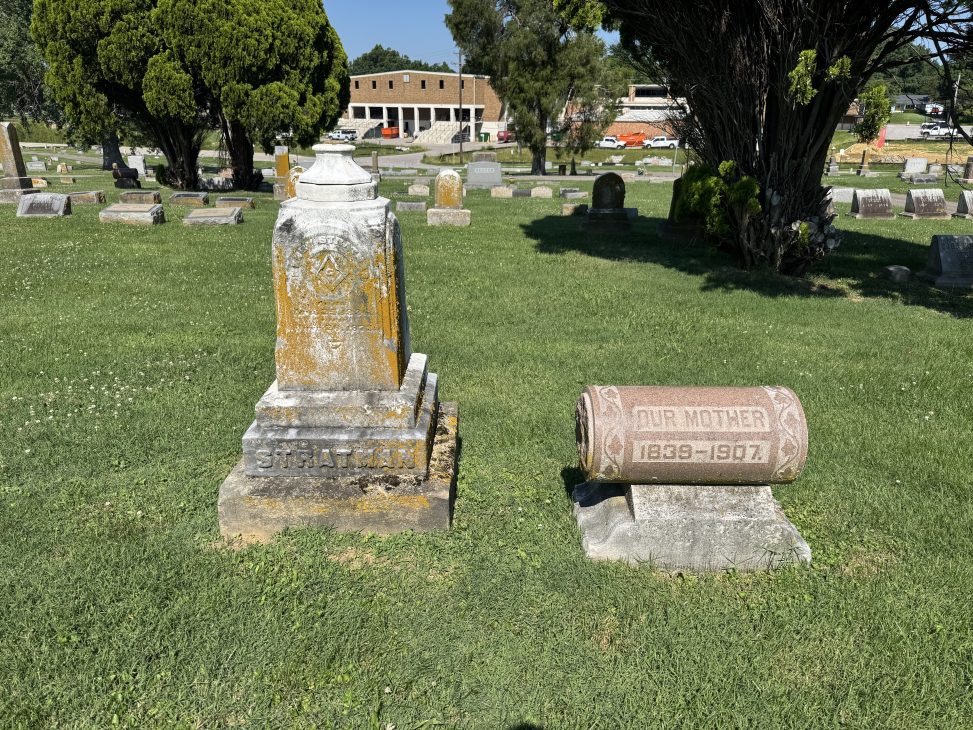
The Stratmans were among Henderson’s German-American families whose hard work and entrepreneurship helped transform the growing river city during the late nineteenth century. Their family plot remains today in Fernwood Cemetery, where several generations of Stratmans are buried.
By 1910, census records listed Alonzo’s occupation simply as “concrete contractor.” At a time when concrete was still a relatively new building material, Stratman recognized its enormous potential.
Building One of Kentucky’s Largest Concrete Companies
Around 1903, Alonzo partnered with Thomas Baskett to establish what became the Stratman Concrete Company. From modest beginnings, the business rapidly expanded into one of the largest concrete manufacturing and construction firms in western Kentucky.
The company specialized in nearly every form of concrete construction imaginable:
- Reinforced concrete buildings
- Sidewalks and curbing
- Sewer and drain tile
- Bridge construction
- Heavy foundations
- Building blocks
- Portland cement products
- Crushed stone and gravel
- Burial vaults
- Concrete monuments
As Henderson modernized during the early twentieth century, Stratman’s company supplied much of the material that made that growth possible.
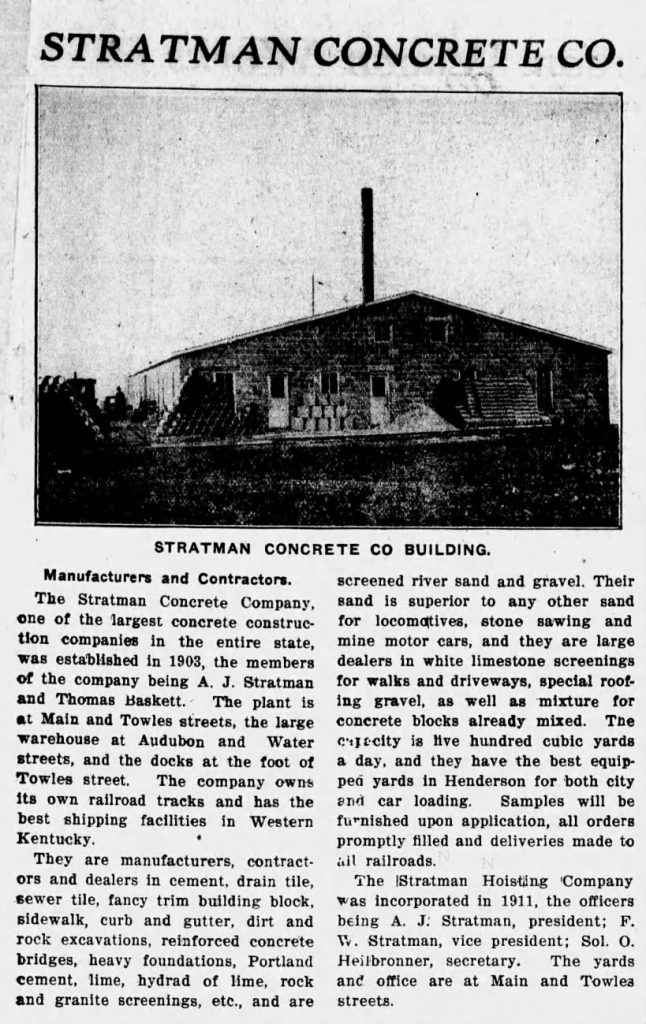
A promotional publication from the era proudly described the Stratman Concrete Company as one of the largest concrete construction companies in the entire state of Kentucky.
A Modern Industrial Complex
The company’s headquarters stood just south of downtown Henderson near Main and Towles Streets, adjacent to the railroad and only a short distance from the Ohio River.
The 1913 Sanborn Fire Insurance Map shows an impressive industrial complex labeled Stratman Concrete Company, complete with manufacturing buildings, storage yards, railroad sidings, and direct access for shipping materials by rail.
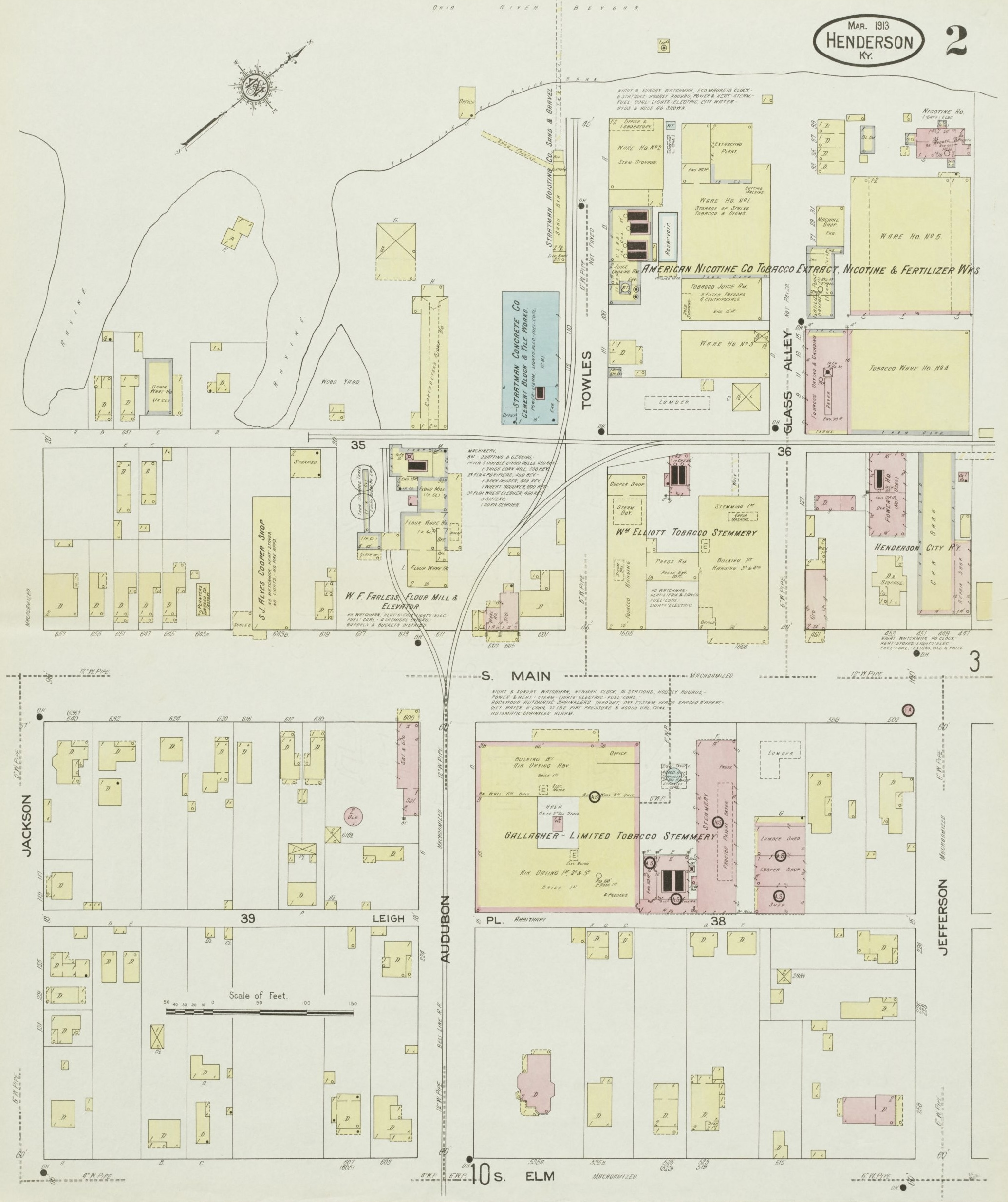
The location was ideal. Raw materials such as sand and gravel could be unloaded by rail or brought from nearby river docks, processed at the plant, and shipped throughout western Kentucky.
Company advertisements promoted Stratman’s ability to manufacture nearly every type of concrete product while filling orders promptly across the region.
New Corporations and Expansion
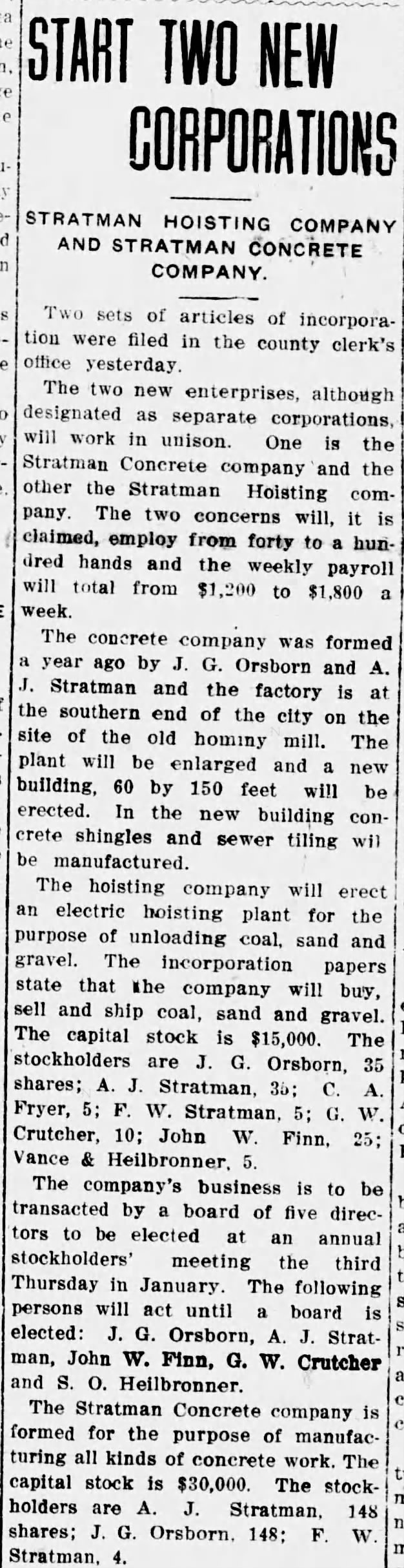
In April 1911, Henderson newspapers announced the incorporation of two ambitious new companies:
- Stratman Concrete Company
- Stratman Hoisting Company
Although organized as separate corporations, they operated together.
The newspaper reported that the businesses expected to employ between forty and one hundred workers, with a weekly payroll of $1,200 to $1,800, a substantial contribution to Henderson’s economy at the time.
The new concrete plant expanded onto the site of the old Hominy Mill near the southern edge of town. A large new manufacturing building measuring 60 by 150 feet was constructed to produce concrete shingles, sewer tile, and additional building products.
The companion Hoisting Company installed an electric unloading facility for coal, sand, and gravel, further strengthening Henderson’s growing industrial base.
For a city of Henderson’s size in 1911, Stratman’s enterprises represented one of its largest privately owned manufacturing operations.
More Than a Contractor
Unlike many contractors of his era, Stratman controlled nearly every step of construction.
His businesses manufactured concrete products, supplied raw materials, designed structures, built them, and even marketed burial vaults and monuments through the associated Stratman Burial Vault Company.
The company handled projects ranging from residential sidewalks to railroad bridges, earning a reputation for quality work throughout western Kentucky and neighboring states.
Advertisements emphasized modern equipment, skilled craftsmen, and guarantees on completed work.
Family Life
Stratman’s success soon extended beyond his business.
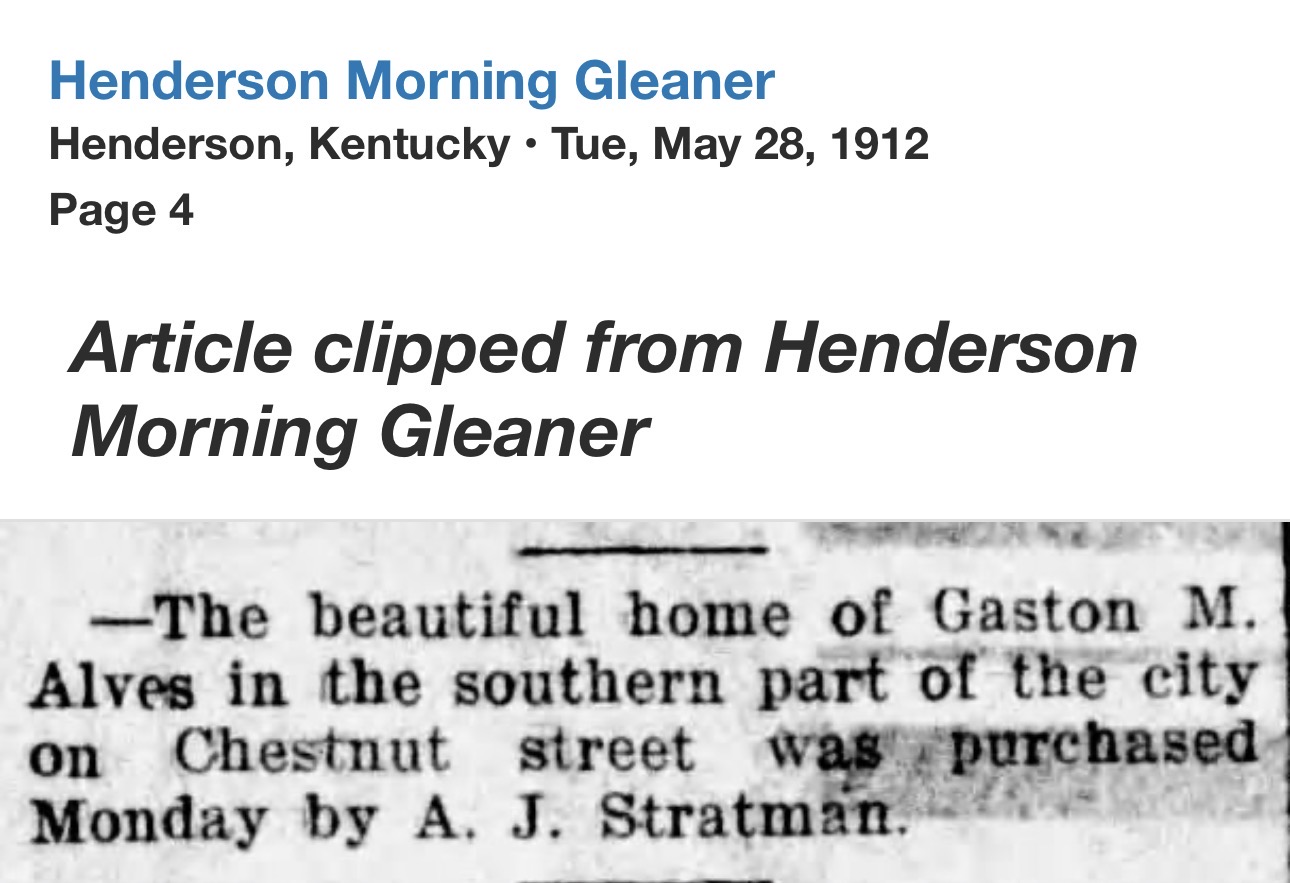
In May 1912, Henderson newspapers reported that he had purchased the handsome home of Gaston M. Alves on Chestnut Street. Two months later, real estate transfers confirmed the sale of the 235-by-580-foot property for $4,000 and other considerations, a considerable investment at the time.
Today, the residence is recognized as the Delano-Alves House, one of Henderson’s finest surviving antebellum homes and now listed on the National Register of Historic Places. Built about 1853 for druggist Ira Delano before passing to the prominent Alves family, the stately Greek Revival home became the Stratman residence during the height of Alonzo’s career. More than a century later, it remains one of Henderson’s architectural treasures.
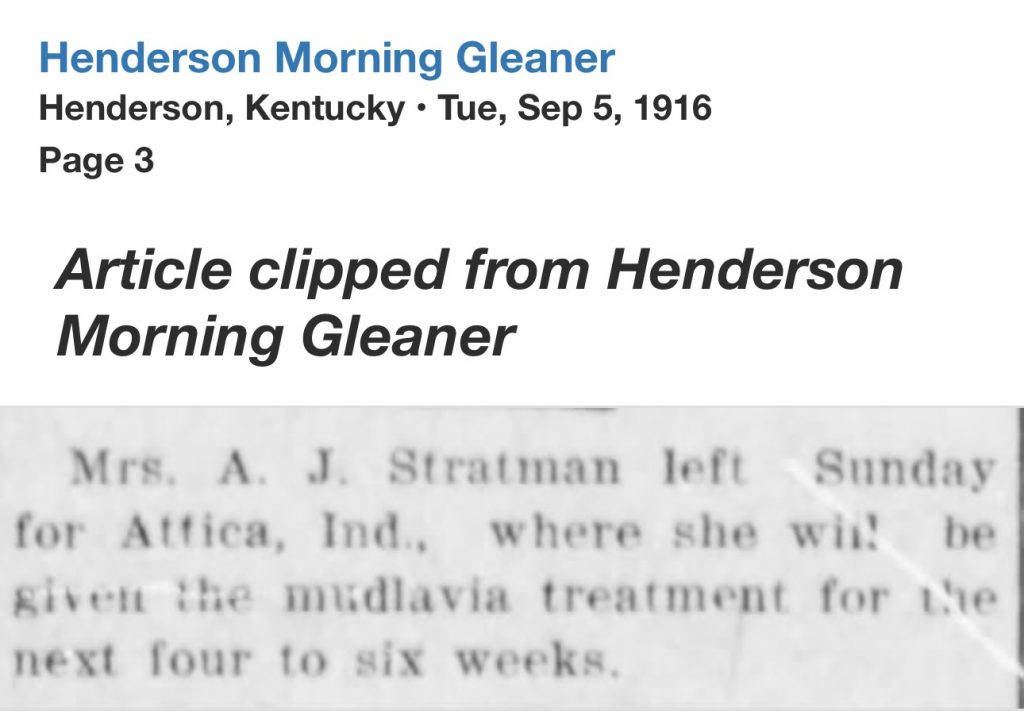
Behind the success, however, the Stratmans were facing growing personal hardship. Alonzo’s wife, Elenora Culver Stratman, suffered from declining health for several years. In September 1916, Henderson newspapers reported that she had traveled to Mudlavia Springs in Attica, Indiana, a nationally known mineral spa where patients sought relief through mud baths and mineral-water treatments. Physicians hoped that four to six weeks of treatment might improve her condition.
Despite those efforts, her health continued to deteriorate.
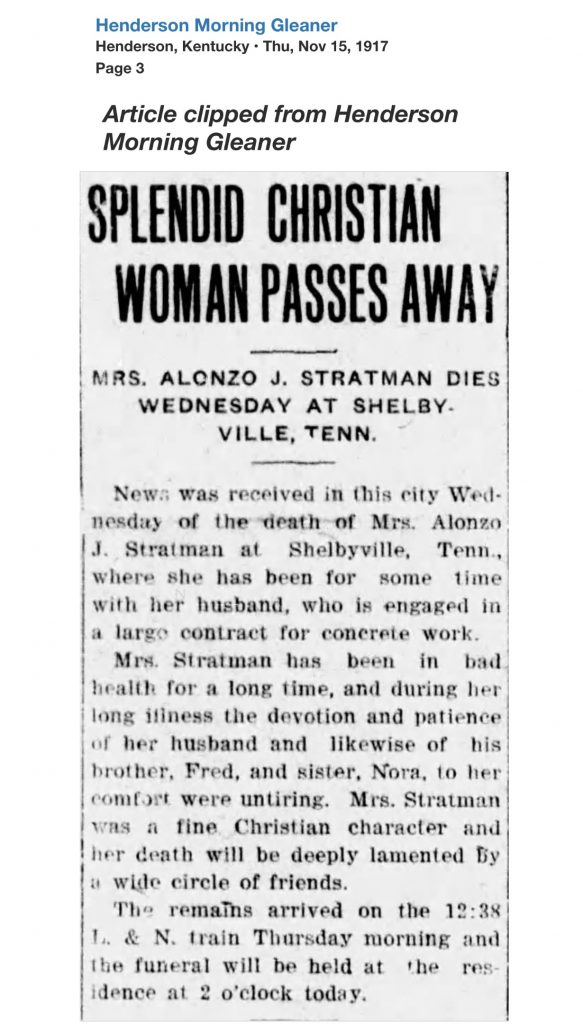
By 1917, Alonzo was supervising a major concrete contract in Shelbyville, Tennessee, and Elenora accompanied him there. Newspapers noted that throughout her lengthy illness, Alonzo devoted himself tirelessly to her care, assisted by his brother Fred and sister Nora.
Friends described her as a woman of deep Christian faith and exceptional character.
In November 1917, after what was reported as a prolonged illness, Elenora died in Shelbyville. Her body was returned to Henderson aboard the Louisville & Nashville Railroad, and funeral services were held not in a church, but in the Stratmans’ own Chestnut Street home before burial in Fernwood Cemetery. Newspapers remarked upon the large number of floral tributes and the many friends who gathered to pay their respects.
Only weeks later, another newspaper notice announced that the Stratman Concrete Company would dissolve its corporate existence.
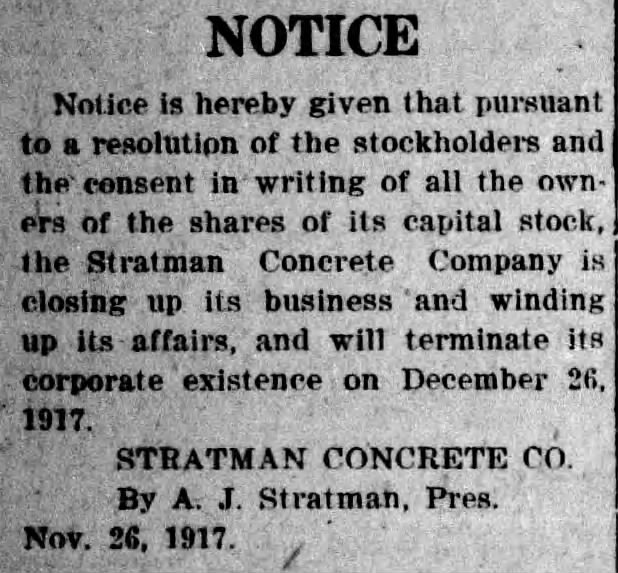
Whether these events were directly connected is unknown, but together they marked the end of one of Henderson’s most significant early industries.
Leaving Henderson
Within a few years, Alonzo permanently relocated to Tennessee. Although he no longer lived in Henderson, the city continued to remember both the man and the buildings he had constructed.
In 1925, newspaper coverage of the death of his brother Fred Stratman noted that Alonzo, then living in Shelbyville, returned to Henderson for the funeral.
Even after decades away, he remained recognized as one of Henderson’s former business leaders.
His Buildings Lived On
One remarkable newspaper article from 1945 demonstrates how lasting Stratman’s influence had become.
When local leaders announced plans for the new Henderson Cabinet Company, the newspaper explained that the factory would occupy “the concrete building built by Alonzo Stratman many years ago.”
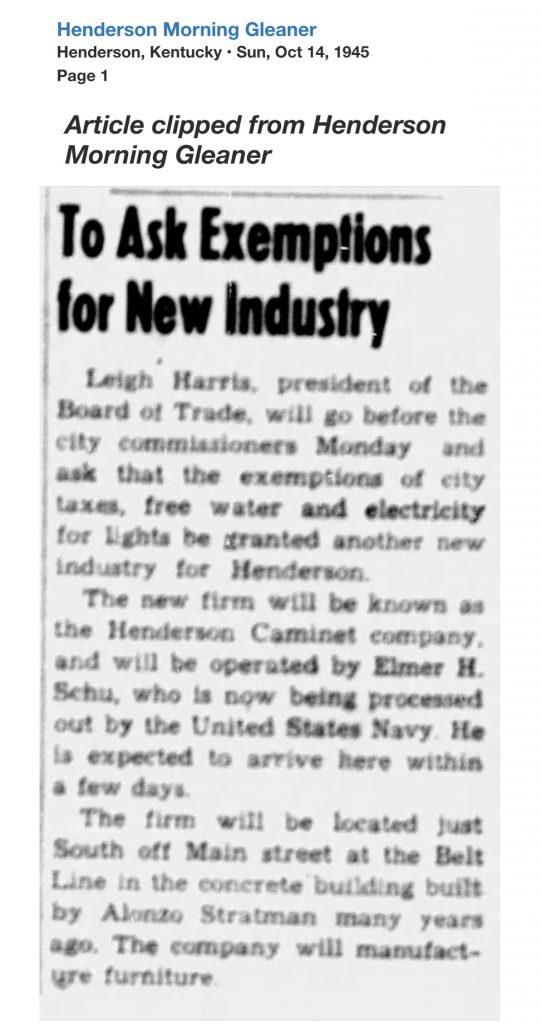
Nearly thirty years after Stratman had left Henderson, and ten years after his death, his industrial buildings were still well enough known that no further explanation was needed. His name had become synonymous with quality construction.
The Road That Bears His Name
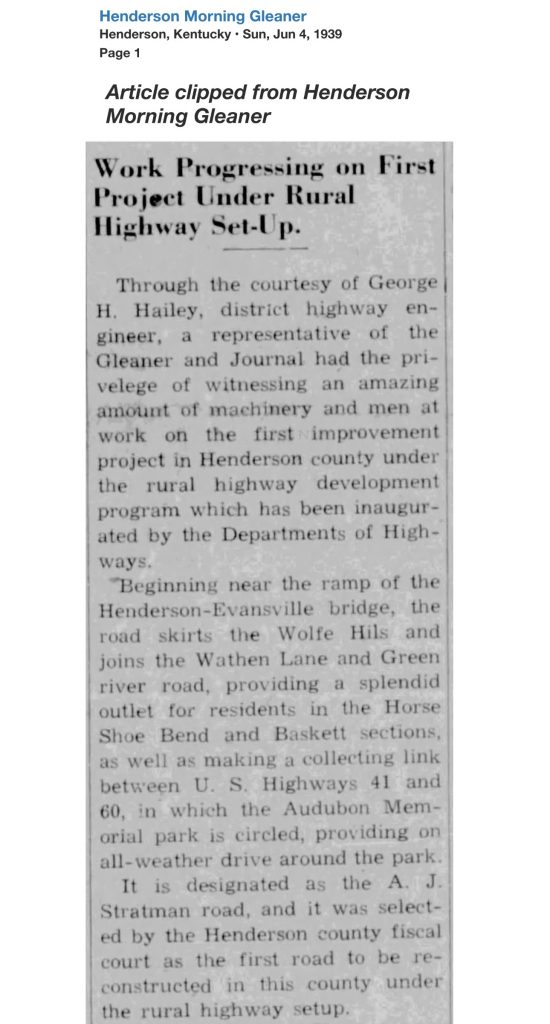
Perhaps Stratman’s greatest public recognition came after his death. On June 4, 1939, the Henderson Morning Gleaner reported on Henderson County’s first rural highway development project.
Beginning near the approach to the Henderson-Evansville Bridge, the roadway followed the Wolfe Hills before connecting with Wathen Lane and Green River Road. It improved access to Horse Shoe Bend and Baskett while creating an all-weather scenic drive around Audubon Memorial Park.
The newspaper noted that the route had officially been designated A. J. Stratman Road, honoring the Henderson contractor whose work had contributed so much to the county’s development.
Today’s Stratman Road represents only part of that original route. East of U.S. Highway 41, the roadway is now known primarily as Wolf Hills Road (Kentucky Highway 414). Although the name changed over time, the original 1939 project encompassed the entire roadway.
Few motorists realize they are traveling along a highway named for one of Henderson’s earliest industrial entrepreneurs.
Final Years
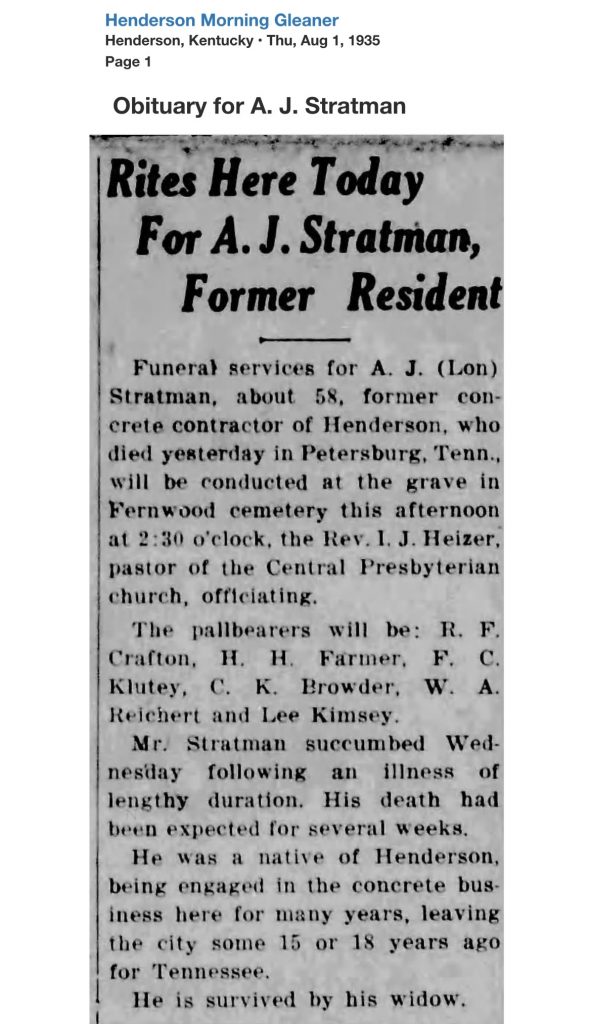
Alonzo J. “Lon” Stratman died in Petersburg, Tennessee, on July 31, 1935, at approximately fifty-eight years of age following a lengthy illness.
Although he had lived in Tennessee for nearly two decades, Henderson remained home. His funeral returned to Fernwood Cemetery, where he was laid to rest beside members of his family.
A Quiet Legacy
Today, visitors to Fernwood Cemetery can still find the Stratman family plot in Section 9.
A handsome family monument bearing the Stratman name remains. Several sides of the monument commemorate relatives, and the front prominently displays the Masonic square-and-compasses emblem.
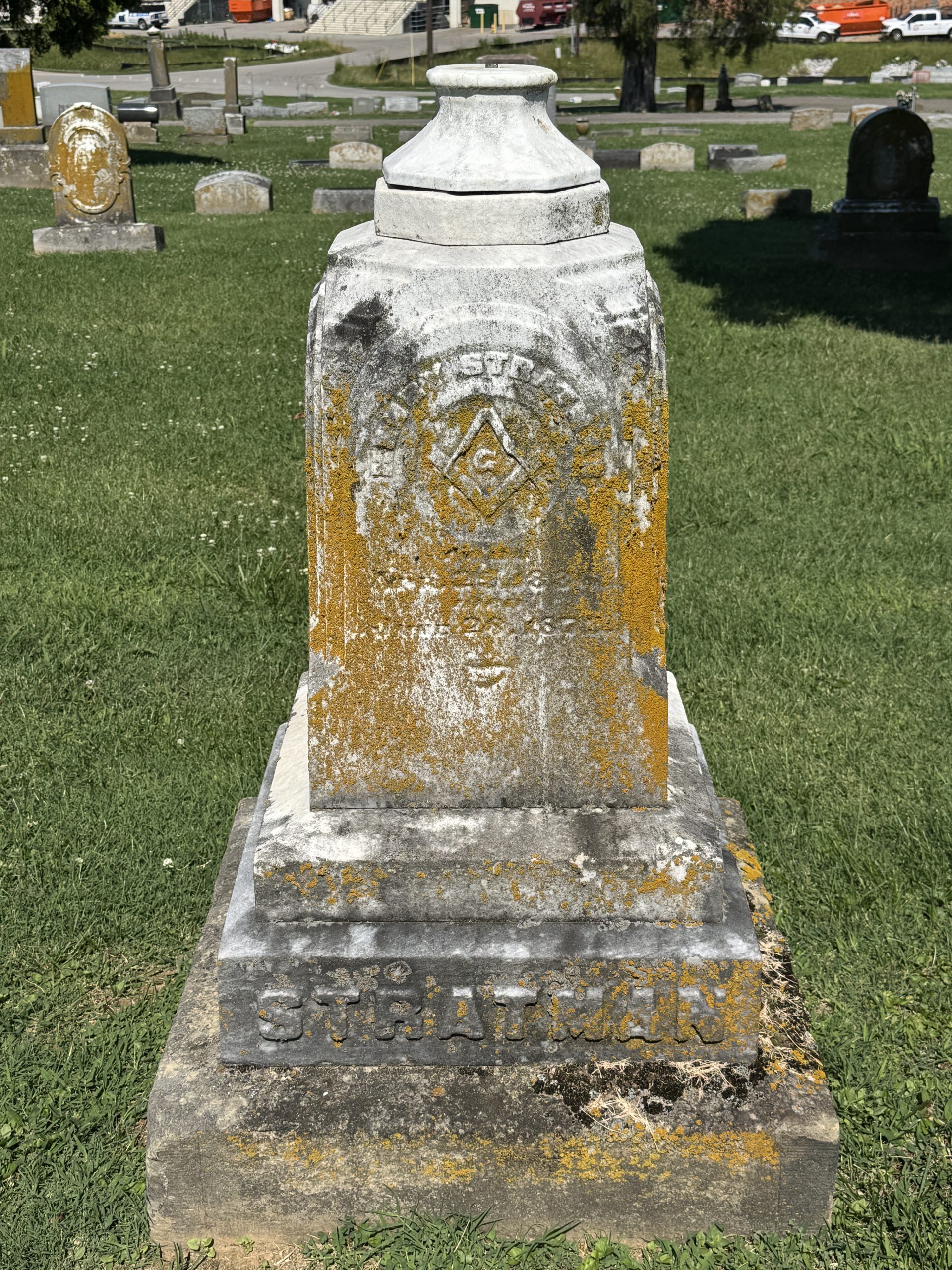
Yet one thing is noticeably absent.
Although cemetery records identify Section 9, Lot 665, Grave 4 as the burial place of Alonzo J. Stratman, no surviving monument or individual headstone bears his name. Whether such a marker was never erected or was lost over time remains unknown.
It is an unexpected irony. A man who spent his life constructing buildings, bridges, sidewalks, foundations, and even cemetery monuments rests today beneath an unmarked grave.
His greatest memorial is not found in Fernwood Cemetery. Instead, it stretches across northern Henderson County in the roadway that still bears his name, a lasting tribute to one of the builders who helped lay the literal and figurative foundations of modern Henderson.
Sources:
This article was compiled from Henderson Morning Gleaner and Gleaner newspaper articles (1909–1945), 1880 and 1910 United States Census records, the 1913 Sanborn Fire Insurance Map of Henderson, Kentucky, Fernwood Cemetery records, and on-site cemetery documentation.
Leave a Reply