EARLY DAYS IN HENDERSON
RECALLED BY JUDGE YEAMAN
Began Law Practice in 1863
Henderson Morning Gleaner – January 9, 1927
This is the first of a series of interviews with Henderson men who have been engaged in their respective occupations for the longest period of time. This week, Judge Malcolm Yeaman, dean of the Henderson bar, recounts many interesting experiences and recalls conditions existing when he came to Henderson in 1863. -Editor’s Note.
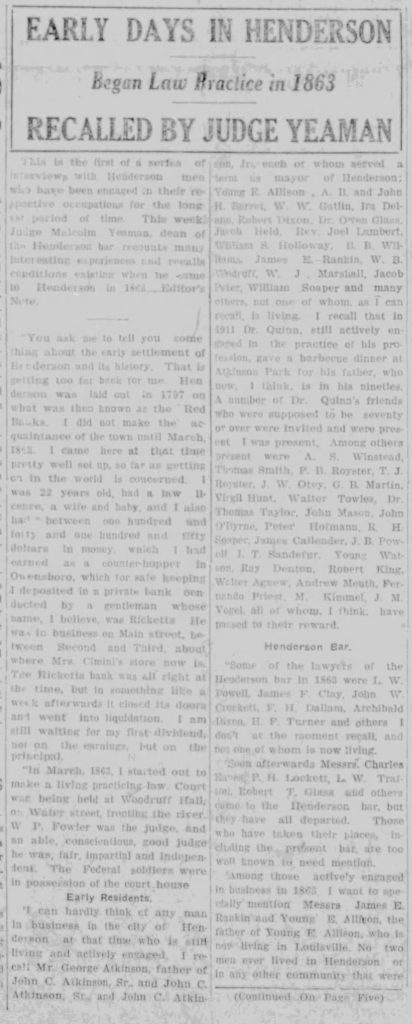
“You ask me to tell you something about the early settlement of Henderson and its history. That is getting too far back for me. Henderson was laid out in 1797 on what was then known as the Red Banks. I did not make the acquaintance of the town until March, 1863. I came here at that time pretty well set up, so far as getting on in the world is concerned. I was 22 years old, had a law license, a wife and baby, and I also had between one hundred and forty and one hundred and fifty dollars in money, which I had earned as a counter-hopper in Owensboro, which for safe keeping I deposited in a private bank conducted by a gentleman whose name, I believe, was Ricketts. He was in business on Main street, between Second and Third, about where Mrs. Cimini’s store now is. The Ricketts bank was all right at the time, but in something like a week afterwards it closed its doors and went into liquidation. I am still waiting for my first dividend, not on the earnings, but on the principal.
“In March, 1863, I started out to make a living practicing law. Court was being held at Woodruff Hall, on Water street, fronting the river. W. P. Fowler was the judge, and an able, conscientious, good judge he was, fair, impartial and independent. The Federal soldiers were in possession of the court house.
Early Residents.
“I can hardly think of any man in business in the city of Henderson at that time who is still living and actively engaged. I recall Mr. George Atkinson, father of John C. Atkinson, Sr., and John C. Atkinson, Sr., and John C. Atkinson, Jr., each of whom served a term as mayor of Henderson; Young E. Allison, A. B. and John H. Barret, W. W. Gatlin, Ira Delano, Robert Dixon, Dr. Owen Glass, Jacob Held, Rev. Joel Lambert, William S. Holloway, B. B. Williams, James E. Rankin, W. B. Woodruff, W. J. Marshall, Jacob Peter, William Soaper and many others, not one of whom, as I can recall, is living. I recall that in 1911 Dr. Quinn, still actively engaged in the practice of his profession, gave a barbecue dinner at Atkinson Park for his father, who now, I think, is in his nineties. A number of Dr. Quinn’s friends who were supposed to be seventy or over were invited and were present. I was present. Among others present were A. S. Winstead, Thomas Smith, P. B. Royster, T. J. Royster, J. W. Otey, G. B. Martin, Virgil Hunt, Walter Towles, Dr. Thomas Taylor, John Mason, John O’Byrne, Peter Hofmann, R. H. Soaper, James Callender, J. B. Powell, J. T. Sandefur, Young Watson, Ray Denton, Robert King, Welter Agnew, Andrew Meuth, Fernando Priest, M. Kimmel, J. M. Vogel, all of whom, I think, have passed to their reward.
Henderson Bar.
“Some of the lawyers of the Henderson bar in 1863 were L. W. Powell, James F. Clay, John W. Crockett, F. H. Dallam, Archibald Dixon, H. F. Turner and others I don’t at the moment recall, and not one of whom is now living.
“Soon afterwards Messrs. Charles Eaves, P. H. Lockett, L. W. Trafton, Robert T. Glass and others came to the Henderson bar, but they have all departed. Those who have taken their places, including the present bar, are too well known to need mention.
“Among those actively engaged in business in 1863, I want to specially mention Messrs. James E. Rankin and Young E. Allison, the father of Young E. Allison, who is now living in Louisville. No two men ever lived in Henderson or in any other community that were more highly respected than they were for sterling integrity, enterprise and intelligence. One of the saddest events that ever occurred in Henderson was the tragic death of Mr. Rankin, which occurred in the summer of 1864.
Tragic Death of James Rankin.
“There came into the city a company of armed men. They claimed to be soldiers, but they were neither Federal or Confederates, but simply murderers and robbers. They went into the store of Mr. Rankin, which stood on the corner of Main and Second streets, where the the Soaper Hotel now is. Demanding the keys to his safe, he hesitated for some reason and was shot to death. The town was paralyzed with gloom, not only on account of the tragedy, but the startling death of one who was so highly esteemed.
“I will relate a little incident which illustrates the habit of Mr. Rankin and more particularly the fact that little and insignificant things sometimes impress themselves upon and remain in our memory. I was directed to purchase a pair of ladies’ gloves of a certain sort. I bought them at Mr. Rankin’s store, paid for them and took them home. Two or three days afterwards I was stopped in front of his store and asked if I hadn’t bought the gloves there. I replied that I had. He said, ‘Well, I made a mistake. I charged you 25 cents too much for them; you must let me refund it.’ That sounds insignificant, but I have never forgotten it.
“And while I am at it I will relate a little incident that occurred between me and Mr. Young E. Allison. He was at the time a magistrate, having his office at the court house. Mr. William S. Elam had, or thought he had, a claim against the Government for horses, provender or something else the soldiers had taken. He wished to make out a claim for payment. To do it, he must establish his loyalty. He came to me to prepare the papers. I knew that Mr. Elam, perhaps, sympathized with the South, but I had a crude idea that a citizen was loyal for all legal purposes unless he had been guilty of some overt act of treason, so I prepared the paper and went with him to Mr. Allison’s office and asked to have the oath administered. He looked at me sternly and said, ‘Do you want to swear to the loyalty of Mr. Elam?’ ‘Yes, sir; that’s what I’m here for.’ ‘Well, you can’t take that oath before me; you will have to go somewhere else.’
“Mr. Allison loved his town, its people, the State and our country, and its institutions, but he was not in sympathy with the rebellion. I want to repeat that I have never known any man who was more highly respected than Mr. Allison, and if he did refuse to administer the oath to me he was always my friend.
George Atkinson.
“I have mentioned Mr. George Atkinson, the father of Mr. John C. Atkinson, Sr., and John C. Atkinson, Jr., both of whom have served as mayor of the city of Henderson. I remember Mr. Atkinson relating what impressed me at the time as an interesting incident. As a young man he was employed in a grain purchasing house in Richmond, Va. He had heard that the Chief Justice of the Supreme Court of the United States was in Richmond, and was looking out for him, expecting to see him drive by in a coach-and-four, with a liveried outrider, and other official paraphernalia.
“One day there walked into the office where Atkinson was employed a plain-looking gentleman, dressed something like a well-to-do farmer, and inquired if he could dispose of a crop of wheat. He was told that the house was engaged in that business. The gentleman said, ‘I have a sample of wheat with me that I would like to show you.’ The sample was examined, the price agreed upon, and the gentleman started out. He was told to wait, ‘We are in the habit of taking written contracts.’ A blank form was filled out and the gentleman shown where to sign his name. He took the pen and wrote in a big, bold hand ‘John Marshall.’ Mr. Atkinson said he was stunned, but jumped off his stool, accompanied the gentleman to the front door and made his profound bow to the Chief Justice.
“It was in the 1860’s, I think, that Webster county was formed, taking a part off of Henderson and other counties.
Court in Early Days.
“A little, one-room frame court house was built, supported by pillars underneath. I was there at one of the early terms being held at night. The weather was extremely cold. The hogs in the neighborhood had taken refuge under the court house and they were fussing and quarreling, and bumping up against the floor. Presently there walked into the court room, and up in front of the judge’s stand, a good citizen of Webster county, I shall not call his name, who had evidently been stimulating. He stopped, looked around, took off his hat and waved it in the air, and called out, ‘Hello, Jedge, I’m a hoss.’ Judge Fowler looked up, of course surprised, and said, ‘Mr. Sheriff, take that horse and lock him up in the county stable.’ And thereupon the business of the court was resumed.
“At this time the hotel accommodations in Webster were quite primitive. At night you had to either sit in your room, which was not very comfortable, or in the general reception room, which was the office and the barroom, all in one. Sitting by a good wood fire, listening to the neighborhood talk, there presently walked into the room two old persons, both evidently very chilled, for the thermometer stood in the neighborhood of zero. Some one said to the younger one, whom I shall call Uncle Eb, ‘What is your age, Uncle Eb,’ ‘I am 67 years old, and I never took a drink of liquor or a chew of tobacco in all my life.’ And turning, he asked the other, ‘How old are you, Uncle Ben?’ ‘I am 79 years old and I’ve been chewin’ tobacker and drinkin’ whisky ever since I was 14 years old.’
“That is not important, but it was amusing at the time.
“Well, I have talked a good deal and haven’t said anything. One word more and I will get you to excuse me.
Interesting Reminiscences.
“The most interesting reminiscences of early American life, especially of Kentucky and much about Henderson, is to be found in ‘Delineation of American Scenery and Character,’ by our early and very distinguished citizen, John James Audubon, a book that was never printed until last year. One little extract which I have just read (the book is before me; I am reading it) will illustrate the conditions and customs of our early times. About one hundred years ago Audubon and his wife went to Philadelphia. He says, ‘My wife rode a horse from Henderson to Philadelphia. About twelve days were considered necessary for performing a journey from Louisville to Philadelphia.’ (Page 290). What would one of our Henderson ladies think today of starting to Philadelphia a-horseback? Audubon’s ‘Delineations’ is a book which every lover of Henderson and the early times in Kentucky should read.
“Can there be any danger that we of today will forget the sturdy, vigorous habits of our forbears and become too soft and luxurious?”
Source: Henderson Morning Gleaner, 09 Jan 1927
Leave a Reply