W. R. Conover: The Florist Behind Henderson’s Water Street Greenhouses
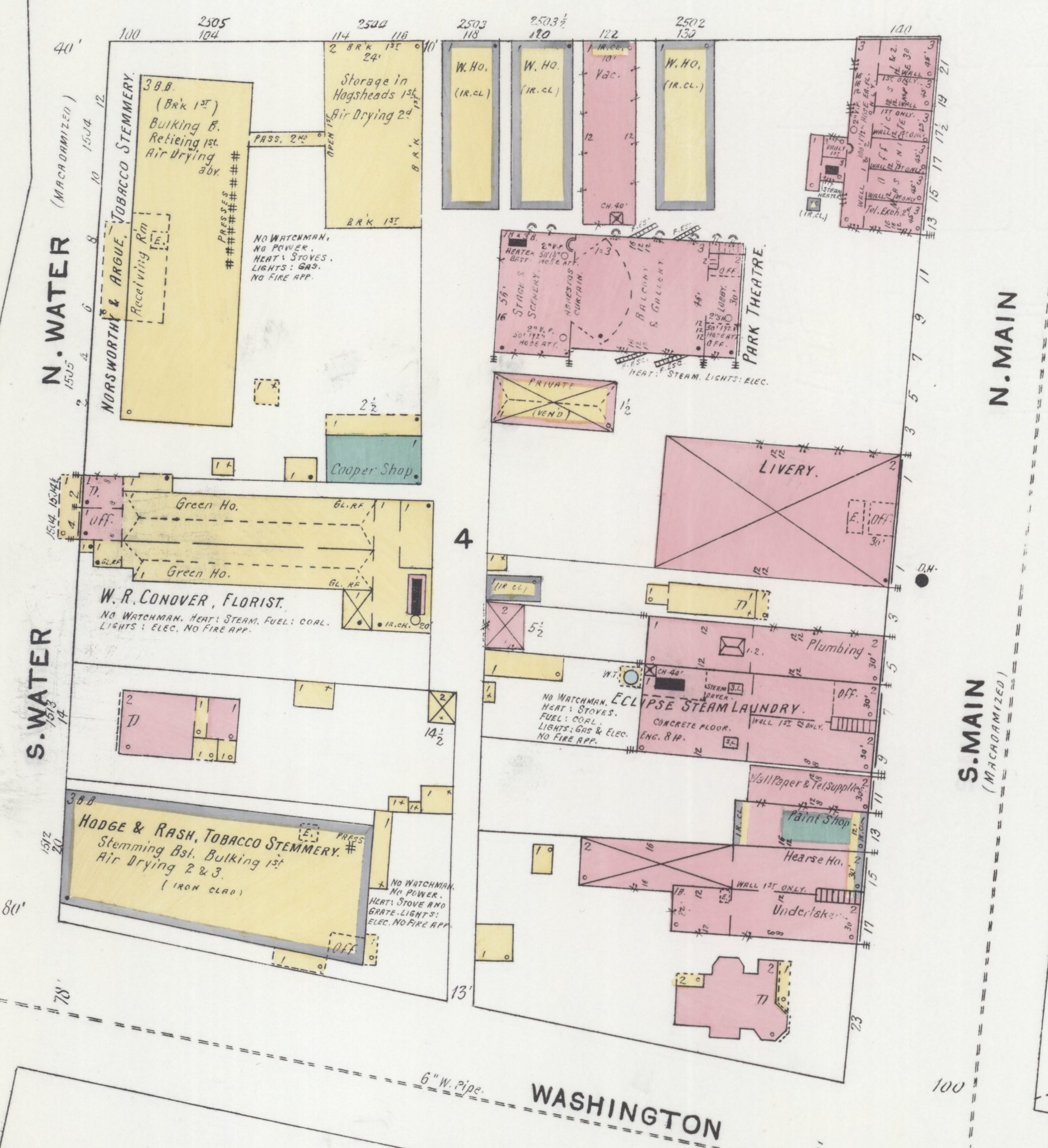
At first glance, Henderson’s 1906 Sanborn fire insurance map appears to be a maze of buildings, measurements and handwritten notes. A closer look at the block bounded by South Water, South Main, First and Washington streets reveals something unexpected: two long, glass-roofed buildings identified simply as “W. R. Conover, Florist.”
The map preserves the remains of a nearly forgotten Henderson business and the story of William R. Conover, a man who spent part of his career growing flowers in the heart of the city.
The Ohio Valley Greenhouses
By the beginning of 1898, Conover was a partner with Le Roy Posey in a business known as the Ohio Valley Greenhouses. On March 8, 1898, the nationally distributed Weekly Florists’ Review reported that Posey had sold his interest to Conover, who would continue operating the business.
The brief notice placed Henderson’s greenhouse within the larger American floral trade:
“Le Roy Posey has sold his interest in the Ohio Valley Greenhouses to his partner, W. R. Conover, who will continue the business.”
The appearance of the transaction in a Chicago-based trade publication suggests that the Henderson operation was known beyond the immediate community.
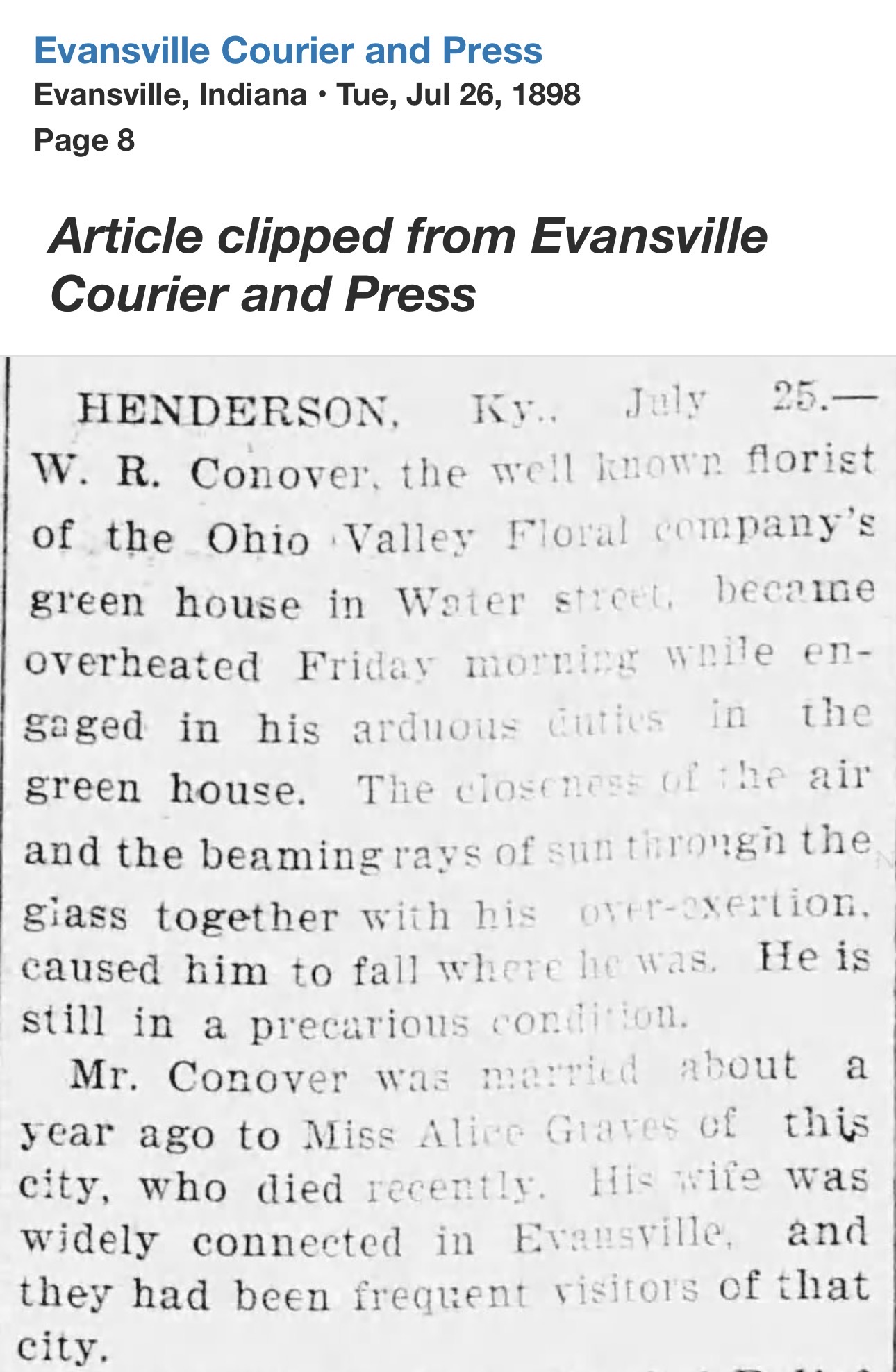
Local newspapers referred to the business by a similar name, the Ohio Valley Floral Company, and described Conover as its “well known florist.”
Dangerous Work Under Glass
Commercial greenhouse work required careful control of heat, sunlight and ventilation. In the summer, the same glass that protected plants during colder months could create dangerously high temperatures.
Conover experienced that danger firsthand on Friday, July 22, 1898.
The Evansville Courier and Press reported that he became overheated while performing his duties inside the Water Street greenhouse. The newspaper explained that the closeness of the air, the sunlight passing through the glass and Conover’s physical exertion caused him to collapse.
Three days later, he was reportedly still in a precarious condition.
The incident offers a rare glimpse into the physical demands of operating a commercial greenhouse before modern ventilation and climate-control systems. Conover apparently recovered, and the business continued.
The same newspaper report also revealed a personal tragedy. Conover had married Alice Graves of Henderson about a year earlier, but she had recently died. The paper noted that Alice was widely connected in Evansville and that the couple had frequently visited that city.
Marriage to Anna Elvira Webb
On September 27, 1899, The Gleaner announced that Conover would marry Mrs. Anna E. Webb that evening at Henderson’s First Presbyterian Church. The ceremony was scheduled for 8:30 p.m. and was to be performed by the Rev. Thomas Cummins in the presence of numerous relatives and friends.
Anna was Anna Elvira Hutchens, the widow of Henderson house painter George S. Webb. She and Webb had married in 1864 and had three children: Elizabeth, Charles and Georgie. Webb died in 1896. HistoricHenderson previously documented the Webb family and Anna’s later marriage to Conover.
Anna would remain Conover’s wife for nearly 35 years.
The Greenhouses on South Water Street
The best surviving picture of Conover’s business is not a photograph. It is the 1906 Sanborn fire insurance map of Henderson.
Conover’s property occupied part of the east side of South Water Street in the block immediately west of the courthouse and Central Park. The greenhouse complex stood among some of Henderson’s most active commercial operations, including tobacco stemmeries, a livery stable, the Park Theatre and the Eclipse Steam Laundry.
The map identifies two long greenhouse ranges with glass roofs. A small office faced South Water Street, while service areas and a heating plant stood near the eastern end of the complex.
Sanborn’s surveyors recorded several important details:
- The greenhouses were heated by steam.
- The property had electric lighting.
- The floors were concrete.
- No watchman was employed.
- No dedicated fire appliances were available.
These details show that Conover’s establishment was more than a backyard flower garden. It was a specialized commercial operation that required heating equipment, electricity, work areas and considerable space under glass.
Steam heat allowed Conover to maintain plants during Henderson’s cold winters and produce flowers outside their natural growing seasons. The glass roofs admitted the sunlight needed for plant growth, although the 1898 accident demonstrated how quickly conditions inside could become dangerous during hot weather.
From Flowers to Real Estate
The exact date when Conover left the floral business has not yet been established. By the end of his life, however, he was identified as a retired real estate dealer.
The change may appear dramatic, but both occupations were closely connected with Henderson’s growth. As a florist, Conover managed a substantial piece of commercial property near downtown. As a real estate dealer, he continued working with land and property in a developing city.
Anna Conover died in Henderson on August 1, 1934. She was buried the following day in Fernwood Cemetery.
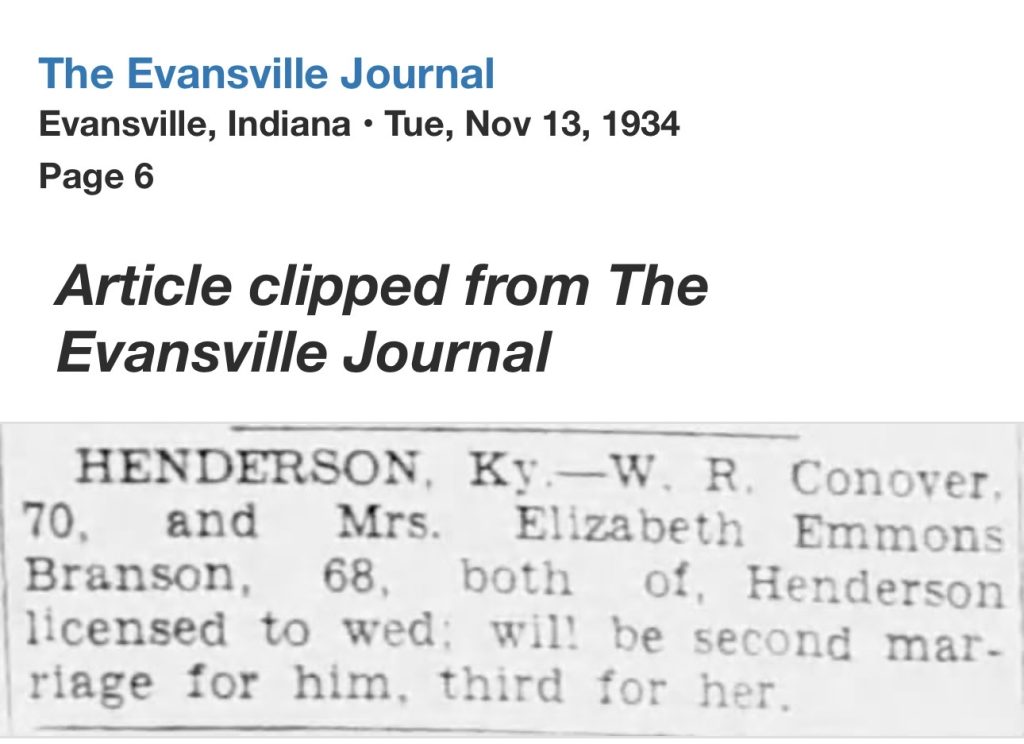
Only a few months later, on November 13, 1934, the Evansville Journal reported that Conover, then listed as 70 years old, and 68-year-old Elizabeth Emmons Branson had obtained a marriage license. Elizabeth was his wife at the time of his death.
His Final Years
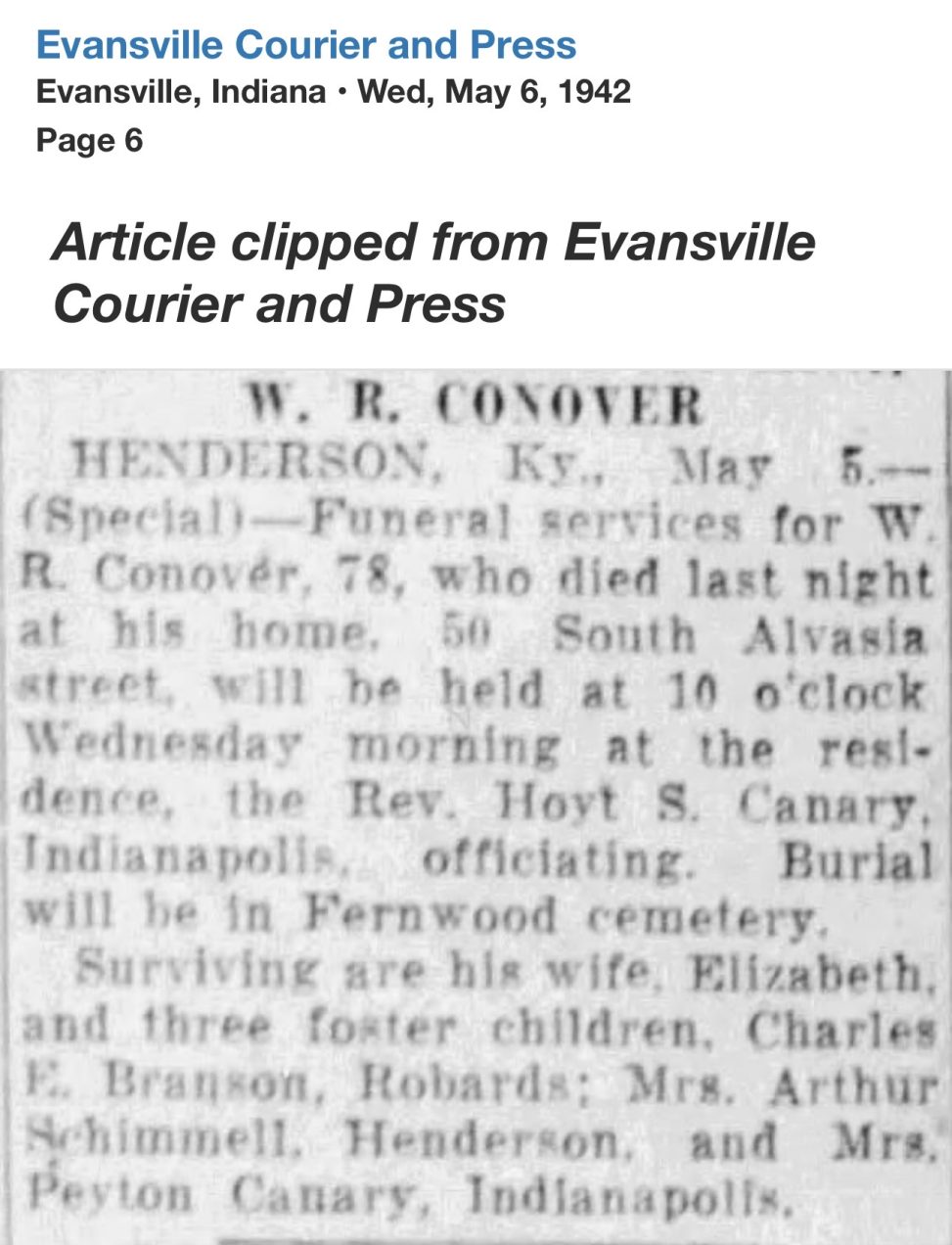
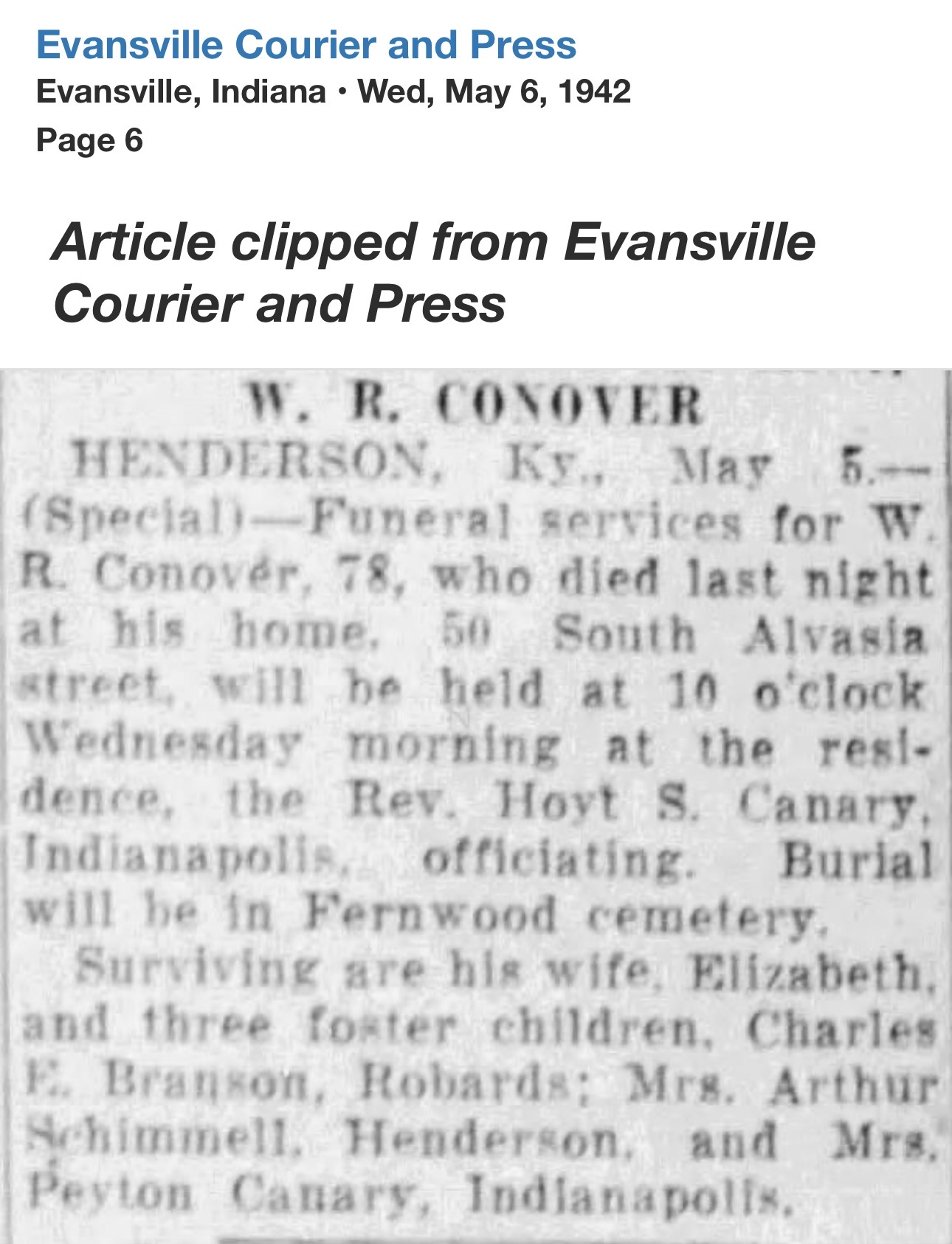
William R. Conover died at approximately 9 p.m. on Monday, May 4, 1942, at his home at 50 South Alvasia Street. Evansville newspapers reported his age as 78, placing his birth around 1864.
His obituary listed his wife, Elizabeth, and three foster children:
- Charles E. Branson of Robards
- Mrs. Arthur Schimmell of Henderson
- Mrs. Peyton Canary of Indianapolis
Funeral services were conducted at the Alvasia Street residence at 10 a.m. on Wednesday, May 6. The Rev. Hoyt S. Canary of Indianapolis officiated.
Conover was buried in Fernwood Cemetery in Section 15, Lot 705, Grave 9. Anna rests beside him in Grave 8. Elizabeth, who was buried in 1950, occupies Grave 7. Burial information can be checked through the city’s official Fernwood Cemetery search.
A Forgotten Part of Henderson’s Business History
W. R. Conover never became one of Henderson’s most famous businessmen. His name does not appear on a surviving landmark or public building. Yet the Sanborn map shows that his greenhouses once occupied a noticeable place in the downtown landscape.
His story also illustrates the importance of combining maps, newspapers, cemetery records and trade publications. A name written inside two yellow shapes on an old insurance map becomes the story of a working florist, a dangerous collapse beneath the greenhouse glass, a downtown commercial operation and a later career in real estate.
More than a century later, the flowers are gone and the greenhouses have disappeared. The 1906 map still preserves their outlines, reminding us that Henderson’s downtown once included not only stores, theaters, laundries and tobacco businesses, but also rows of flowers growing under glass along South Water Street.
Sources
- The Weekly Florists’ Review, March 8, 1898, page 592.
- Evansville Courier and Press, July 26, 1898, page 8.
- The Gleaner, September 27, 1899, page 1.
- Sanborn Fire Insurance Map of Henderson, Kentucky, March 1906, Plate 5.
- The Evansville Journal, November 13, 1934, page 6.
- Evansville Press, May 5, 1942, page 15.
- Evansville Courier and Press, May 6, 1942, page 6.
- Fernwood Cemetery burial records, City of Henderson.
Leave a Reply